Three positions updated in the portfolio this week: a re-entry in Fuchs SE, a special-situation bet on PayPal, and a full exit from EVS SA.
Fuchs SE: Pre-Buying and a Supply Chain Shift
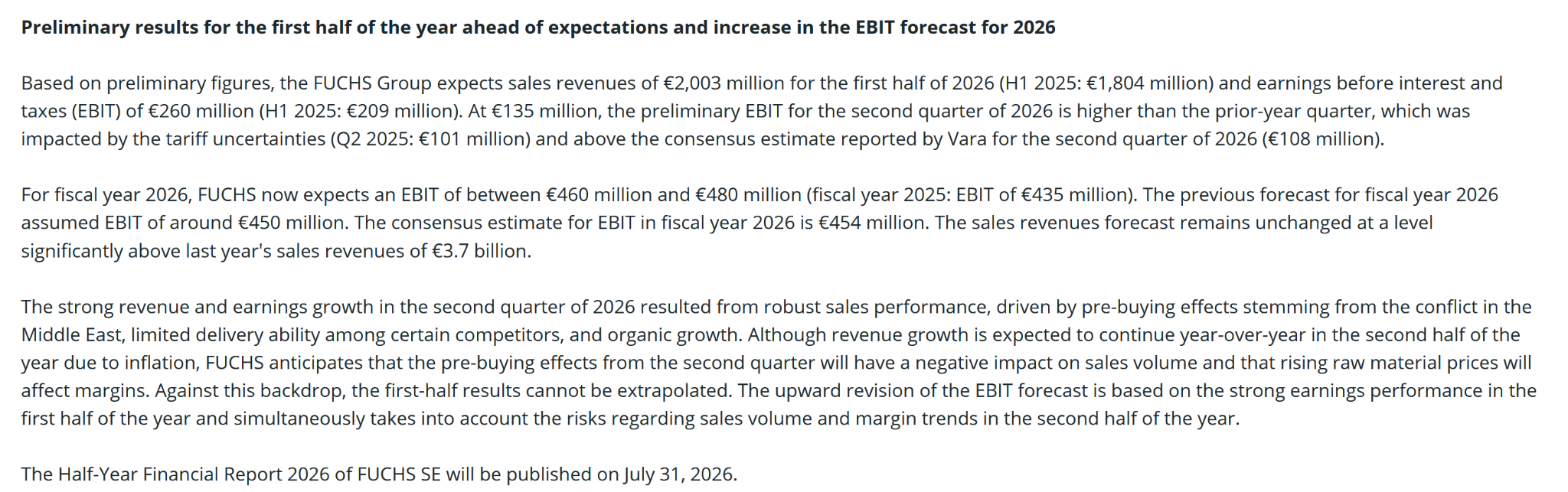
Fuchs common shares are back in the portfolio at 2% after I sold them almost a year ago following a disappointment. The trigger for the re-entry was a Q2 release that the company itself described as a blowout: EBIT up 35%, full-year guidance raised, with management calling the new range conservative.
The market reaction was muted. Other investors I spoke with said the quarter looked like another one-time effect, similar to the spike after the Ukraine invasion that later reversed. I bought back at €33.50, slightly above the €31.50 where I sold.
What changed my mind was a single line in the earnings statement. Fuchs attributed the strong quarter to "pre-buying effects stemming from the conflict in the Middle East, limited delivery ability among certain competitors, and organic growth."
The Gulf region is a major exporter of lubricants and the base oils used in high-performance products. One large base oil refinery in Qatar, Shell's Pearl GTL facility, was hit by Iranian rocket strikes. Production of roughly 30,000 barrels per day is offline, with repairs expected to take at least a year. Force majeure declarations in Bahrain and the UAE, plus the continued closure of the Strait of Hormuz, have stranded product in the region.
About 44% of U.S. Group III demand is typically supplied from the Persian Gulf. That supply is now largely offline.
Fuchs appears to be one of the companies that can still deliver while competitors cannot. I do not know exactly how Fuchs sources its base oils, but the structural opportunity is real. Supply chain managers who depended on Gulf-sourced lubricants may be rethinking that reliance. An independent player like Fuchs could benefit for longer than the current quarter.
Of course, the situation with Iran can change on a single Tweet. But the setup is more interesting now than it was a year ago.
PayPal: A 9% Merger Arb Discount
I wrote about PayPal in March and put it in the "too hard" pile despite the low valuation. The approach from Stripe and Advent changed the calculus.
Last Friday, PayPal traded at $55.50, a 9% discount to the $60.50 offer price. That gap looked too wide for a deal that has a reasonable chance of closing or attracting a higher bid. I bought a 1.5% position.
The undisturbed price is around $47, so the downside is limited. A competing bid from another buyer is possible. The new CEO's bonus is tied to a stock price well above $60.50, giving him an incentive to push for a higher clearing price or negotiate a golden parachute.
This is a special-situation position. If Stripe and Advent withdraw the bid, I sell immediately. PayPal is still too hard for a value investment at this stage.
Since the initial purchase, the stock has climbed to $58.40. I would not add at that level. The main catalyst for the recent move appears to be Q2 numbers that beat expectations.
EVS SA: Exiting After a Broken Growth Story
I wrote up EVS SA, formerly EVS Broadcast SA, about two years ago. The thesis was straightforward: ambitious growth targets, a cheap valuation, and a rock-solid balance sheet. The stock initially performed well, with 2024 turning into a strong year.
Then the cracks appeared. Q1 2025 was a slight disappointment. The stock jumped on a World Cup contract win in Q2, but that was followed by weak first-half numbers. The preliminary 2025 results were not great, though the 2026 outlook remained positive in March.
In May, the Q1 trading update guided to the low end of the range. The CFO left without a direct replacement.
An EBIT at the low end of the 40-50 million euro range would mean operating profit similar to 2023, a year without the Winter Olympics or the Football World Cup. The company is now far from the 10% annual growth path I had underwritten.
I do not fully understand why the business is so weak. What made the decision easier was a comparison with Canadian-listed competitor Evertz Technologies. Evertz shares have performed well over the past 12 months. In its latest report, Evertz mentioned "revived growth" in the Middle East. EVS blames the Gulf war for weak results. Those two statements are hard to reconcile.
I sold the entire position. Better opportunities exist elsewhere.