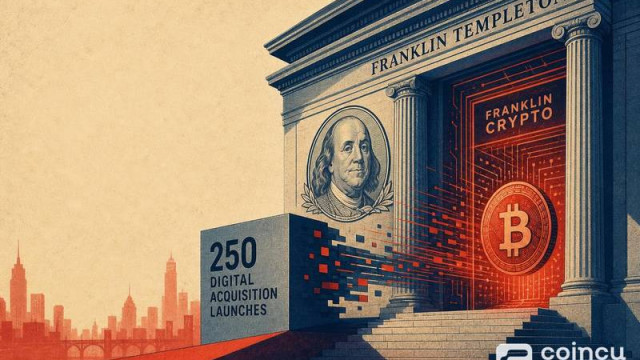
Franklin Templeton closed its 250 Digital acquisition and launched Franklin Crypto as an active digital asset management unit targeting pension funds and sovereign wealth funds. The deal transfers the 250 Digital investment team and CoinFund liquid strategies into the $1.78 trillion manager.
Franklin Templeton closed its acquisition of 250 Digital on June 22, 2026, and formally launched Franklin Crypto as the firm's dedicated active digital asset management division. The unit targets pension funds, sovereign wealth funds, and other large institutional allocators, the firm said.
The transaction transferred the 250 Digital investment team and all liquid cryptocurrency strategies previously managed under CoinFund into Franklin Templeton. The firm reported $1.78 trillion in assets under management as of May 31, 2026.
Franklin Crypto will offer actively managed cryptocurrency strategies rather than passive index or custody-only products. The division is designed for institutional clients who want exposure to liquid crypto markets through a regulated, traditional-finance wrapper.
Christopher Perkins, Seth Ginns, and Tony Pecore lead Franklin Crypto under Sandy Kaul. Perkins, who described the institutional moment for crypto as having "arrived," brings the CoinFund-era investment approach to the new division.
"Crypto's institutional moment has arrived," Perkins said in the announcement.
The liquid strategies acquired were originally built and managed by CoinFund before being spun out into 250 Digital. These are actively managed positions in liquid crypto tokens, distinct from venture-style locked-up investments in early-stage protocols.
Franklin Templeton CEO Jenny Johnson called the deal "an exciting addition" for the firm, signaling the acquisition fits a broader strategic build-out rather than an opportunistic one-off.
Franklin Crypto is not a retail product. Banking Dive reported the division is specifically aimed at pension funds, sovereign wealth funds, and other large institutional allocators – a client segment that has historically lacked access to actively managed crypto strategies from brand-name asset managers.
Pension and sovereign funds typically require regulated counterparties, institutional custody solutions, and compliance frameworks that most crypto-native firms cannot provide. Franklin Templeton's scale and regulatory infrastructure give Franklin Crypto a distribution advantage that pure-play crypto funds lack.
Franklin Templeton's digital-assets business managed roughly $1.8 billion in global assets as of December 31, 2025, providing a pre-existing base for the new division. The firm's digital-assets team has been active since 2018 and now spans more than 50 people. The 250 Digital acquisition adds portfolio management capacity to an infrastructure that already included tokenization work and on-chain settlement tools.
The April 1 pre-close announcement noted that part of the transaction consideration would use BENJI tokens tied to Franklin Templeton's Franklin OnChain U.S. Government Money Fund, highlighting the firm's commitment to using its own tokenized infrastructure in deal execution.
Franklin Templeton closed the deal and launched Franklin Crypto while Bitcoin traded near $64,589 and the Crypto Fear & Greed Index sat at 20, a reading classified as "Extreme Fear." The timing suggests the firm is building for long-term institutional demand rather than reacting to market cycles.
The deal value remains undisclosed in all sourced material. Neither the June 22 completion release nor the April 1 announcement specified the total transaction price.
The June 22 completion announcement confirmed the deal closed and Franklin Crypto was formally established. It did not detail specific pension or sovereign fund mandates, product launch timelines, or initial client commitments. The pension and sovereign fund targeting is more explicitly described in third-party coverage than in Franklin Templeton's own releases.
Product rollout details, mandate sizing, fee structures, and client uptake remain the next data points.
Prepared with AlphaScala research tooling and grounded in primary market data: live prices, fundamentals, SEC filings, hedge-fund holdings, and insider activity. Each story is checked against AlphaScala publishing rules before release. Educational coverage, not personalized advice.