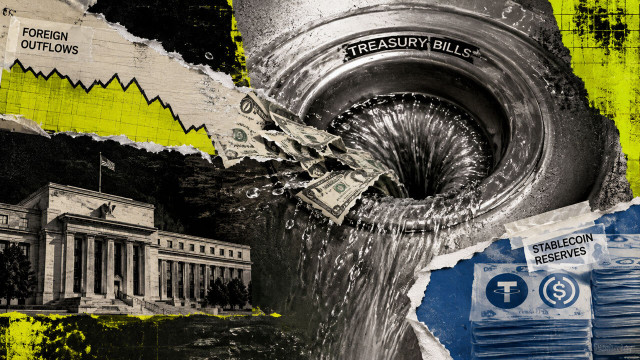
Foreign investors pulled $29 billion from Treasury bills in June, the same month they bought $181.4 billion of US equities.
The Treasury International Capital report, or TIC, tracks cross-border securities flows. June's headline net inflow of $133.5 billion into US markets masks a sharp split. Most of the money went to stocks, while demand at the short end of the government debt market softened.
Foreign holdings of short-term Treasuries fell to $1.400 trillion in June from $1.430 trillion in May. That marks two consecutive monthly declines, with $43.5 billion sold in May and $29 billion in June. Central banks and money-market funds have long treated bills as cash equivalents. Stablecoin issuers now hold a similar role.
The TIC data does not explain why those investors sold. Routine cash management, a preference for equities, or a shift in reserve allocation by a sovereign fund could each drive the figure. The country-level table in the report should also be read with caution, because custodians often record securities in ways that obscure the owner's true location.
Tether's second-quarter attestation listed $114.96 billion in direct Treasury bills and another $25.62 billion in repo positions. June's entire foreign bill sale equaled roughly one-quarter of that portfolio. Circle's USDC reserves sit in the Circle Reserve Fund, a government money-market fund managed by BlackRock that buys short-dated Treasuries and overnight repo. Both structures turn demand for digital dollars into demand for cash-like US assets.
The mechanism only creates fresh Treasury demand when stablecoin circulation expands or an issuer moves reserves out of another asset. Tether reported $184.6 billion of USDT in circulation at the end of the second quarter, up only about $446 million from the first quarter. DefiLlama put the entire stablecoin market near $302.1 billion on Aug. 21, down 0.14% over 30 days. Those figures rule out the idea that new token creation directly absorbed the $29 billion sale.
The same mechanism runs in reverse. When users redeem stablecoins, issuers need cash and may sell bills or let them mature. Stablecoins can become a major buyer of government debt while still producing their own periods of buying and selling.
Washington is building rules for this buyer class. The GENIUS Act requires regulated payment stablecoins to hold liquid reserves. Treasury's proposed rule, released Aug. 17, advances a federal framework that gives cash and short Treasury obligations favored treatment. The regulatory interest reflects the growing overlap between digital dollars and government debt markets.
The next TIC release, covering July, is due Sept. 16. The two numbers to watch are foreign bill holdings and total stablecoin circulation. A third month of foreign sales with flat token supply would leave the demand gap open. Higher stablecoin circulation and larger bill positions in issuer disclosures would show the new buyer becoming more active.