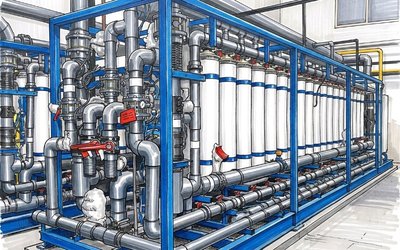
Fluence Corporation secured a US$3.7 million contract to design and build an ultrafiltration and reverse osmosis water treatment plant in Texas. The plant will treat up to 1.5 million gallons per day of groundwater for a major US manufacturer, with commissioning expected by the end of 2026. The win is the latest step in Fluence’s strategy to target water-scarce industrial markets, where clients are seeking to reduce dependence on municipal supplies.
Inside the Texas UF/RO Plant
The contract covers a system that combines ultrafiltration and reverse osmosis to treat groundwater from an on-site well. The treated water will serve as cooling tower makeup, directly displacing the manufacturer’s municipal water draw. Fluence states the plant will achieve greater than 90% water recovery, a metric that matters for both operating cost and sustainability credentials. The end-2026 commissioning timeline gives Fluence a multi-quarter engineering and procurement cycle. Revenue recognition is likely weighted toward the second half of FY2026 and into FY2027, meaning the contract adds to backlog now but will convert to revenue gradually.
Industrial Water Scarcity and the SPS Play
Texas industrial users face chronic water stress. Drought conditions and population growth have pushed municipal water costs higher and made supply reliability a boardroom issue for manufacturers. Fluence’s pitch is straightforward: on-site treatment and reuse cuts the water bill and insulates operations from municipal restrictions. The Texas contract fits the company’s Smart Product Solutions and Recurring Revenue framework, where the hardware sale can lead to service, consumables, and eventual replacement cycles. Management has pointed to water-scarce US industrial markets as a priority. This contract provides a reference plant in a state where industrial water demand is rising, and it strengthens the case for similar deals with other manufacturers facing the same cost and reliability pressures.
FY2025 Financial Reset
Fluence’s financial position improved markedly from the prior year. The company reported full-year FY2025 revenue of $78.4 million, a 52.3% increase from FY2024. The swing in profitability was even sharper: EBITDA of $4.0 million compared with a negative $4.0 million in FY2024, and operating cash flow reached $10.9 million. The year-end backlog stood at $74.8 million.
| Metric | FY2024 | FY2025 |
|---|
| Revenue | $51.5M (est.) | $78.4M |
| EBITDA | -$4.0M | $4.0M |
| Operating Cash Flow | Not disclosed | $10.9M |
| Backlog (year-end) | Not disclosed | $74.8M |
Revenue estimate for FY2024 derived from reported 52.3% growth.
The cash flow generation is a critical detail. It means Fluence funded its operations and growth without leaning on the revolving credit facility, a point that matters as the company negotiates an extension of that facility.
Q1 2026: Margin Gains, Order Timing Gap
The first quarter of FY2026 showed continued margin progress. Revenue of $17.2 million was up 3.6% from Q1 2025. Gross margin expanded to 29.2%, a 3.0 percentage point improvement, which management attributed to better project execution. New orders, however, fell 38% year-on-year to $7.5 million. Fluence characterized the decline as a timing issue, with several projects delayed rather than lost, and guided for a rebound in Q2 2026. The backlog at 31 March 2026 was $64.4 million.
Management expects double-digit revenue growth for the full FY2026, even after factoring in a planned reduction in Ivory Coast Addendum revenue. That guidance implies a significant step-up in order intake and project conversion over the remaining three quarters. The Texas contract, while modest in size, adds to the order book and aligns with the higher-margin SPS and recurring revenue segments the company is prioritizing.
Credit Facility and Working Capital
Fluence is negotiating an extension of its $20 million revolving credit facility. The facility was originally set to mature on 30 April 2026. The company has pushed the maturity to July 2026 and expects to finalize the extension well before that date. The negotiation is not a sign of distress–Fluence generated $10.9 million in operating cash flow in FY2025–but it does introduce a near-term funding watch item. A successful extension on reasonable terms would remove a distraction. Any delay or less favorable terms would shift the risk calculus, particularly given the working capital needs of a growing project backlog.
Path to Double-Digit FY2026 Growth
The $3.7 million contract is not large enough to single-handedly move the revenue needle for a company that did $78.4 million in FY2025. Its value lies in the strategic signal. It places a reference plant with a major US manufacturer in a water-stressed state, directly supporting the SPS and recurring revenue narrative. The plant’s high recovery rate and industrial application make it a template for similar deals.
The next concrete test is whether Fluence can convert the delayed Q1 orders into signed contracts in Q2. The company needs a visible rebound in order intake to sustain the backlog and meet the double-digit growth target. Execution risk also sits in the project pipeline: the Texas plant must be delivered on time and on budget, and the broader backlog must convert to revenue without margin erosion. The credit facility extension is the other near-term catalyst. A clean resolution keeps the focus on operations; a messy one would refocus attention on the balance sheet.
For broader context on how industrial water plays are being valued, see our stock market analysis.