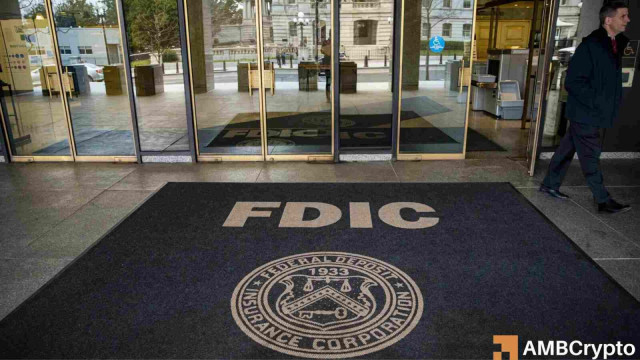
The FDIC proposed a rule on Friday that would require stablecoin issuers to implement anti-money laundering and countering the financing of terrorism (AML/CFT) programs and enforce U.S. economic sanctions. The proposal, issued under the GENIUS Act passed last year, formalizes the use of backdoor freezing features already embedded in USDT and USDC as a sanctions enforcement tool. For traders, the question is not whether the rule passes but whether the July 18th deadline holds.
FDIC's Sanctions Framework for Stablecoin Issuers
The proposed rule covers Bank Secrecy Act compliance, sanctions screening, and standard reporting requirements. It also incorporates provisions from FinCEN and OFAC, including sender and receiver identification for stablecoin transfers. The FDIC cited Tether's recent assistance in freezing $344 million of crypto funds allegedly linked to Iran's government as a precedent for formalizing such mechanisms.
What the Rule Changes
Currently, stablecoin issuers like Tether and Circle voluntarily cooperate with sanctions enforcement. The FDIC's proposal makes AML/CFT programs mandatory for U.S.-based issuers and extends oversight to any issuer seeking access to the U.S. banking system. The rule applies to both fiat-backed and algorithmic stablecoins, though the latter remain rare in regulated markets.
The Backdoor Freezing Mechanism
Both USDT and USDC already allow issuers to freeze addresses at the request of law enforcement. The FDIC's proposal codifies this capability as a regulatory requirement, meaning any issuer operating in the U.S. must maintain the technical ability to freeze and reverse transactions. This removes the voluntary element and creates a compliance baseline.
The GENIUS Act Clock: 55 Days and Counting
The GENIUS Act instructed financial agencies to implement stablecoin regulations by July 18th. So far, only seven proposed rules have been issued across agencies including the FDIC, OFAC, OCC, NCUA, and FinCEN. Of those, only three have closed their public comment windows. None have been finalized into formal guidelines.
The Banking Lobby Pushback
Banking groups have called for delays, raising concerns over the OCC granting crypto firms national trust charter licenses and access to Federal Reserve payment systems. The lobby argues that the rulemaking process is too compressed and that the July 18th deadline is unrealistic. The FDIC's proposal opens a 60-day comment window, which would extend past the deadline if the agency waits for the full period before issuing a final rule.
What Would Confirm the Timeline
- The FDIC closes comments within 30 days and issues an interim final rule before July 18th.
- Other agencies (OCC, NCUA) follow with final rules on the same schedule.
- The Treasury signals that the July 18th deadline is firm.
What Would Weaken the Setup
- The FDIC extends the comment period beyond 60 days.
- Congress introduces legislation to delay the GENIUS Act implementation.
- Banking lobby lawsuits or formal objections slow the process.
Who Is Exposed: From Tether to U.S. Bancorp
The rule directly affects stablecoin issuers with U.S. exposure, including Tether, Circle, and any issuer seeking to operate within the U.S. banking system. It also affects banks and asset managers that are building tokenized money funds targeting stablecoin reserves.
Tokenized Money Funds as Stablecoin Reserves
Fidelity, JPMorgan, and U.S. Bancorp are rolling out tokenized money funds specifically designed to hold stablecoin reserves. These funds aim to provide instant liquidity while earning yield on the balance. The FDIC's rule adds a compliance layer: any stablecoin issuer using these funds must ensure the fund's operations comply with AML/CFT and sanctions requirements.
U.S. Bancorp (Alpha Score 74/100, label Moderate, sector Financials) is one of the banks positioning for the regulated stablecoin market. Its tokenized fund strategy depends on clear rules. A delay or weakening of the GENIUS Act implementation would slow adoption. Conversely, a finalized rule by July 18th would give U.S. Bancorp and its peers a regulatory green light.
Second-Order Effects on Crypto Markets
- USDT and USDC trading volumes could shift if issuers face compliance costs or operational restrictions.
- Decentralized stablecoins (e.g., DAI) may see increased demand if centralized issuers face regulatory friction.
- Crypto exchanges that rely on stablecoin liquidity could face settlement delays if issuers tighten compliance.
What Would Confirm or Weaken the Thesis
The core thesis is that the FDIC's proposal will be finalized by July 18th, creating a clear compliance framework for stablecoin issuers. That framework would reduce regulatory uncertainty for banks and asset managers entering the space.
Confirmation Signals
- The FDIC closes comments within 30 days and issues a final rule before July 18th.
- Other agencies (OCC, NCUA) follow with final rules on the same schedule.
- The Treasury signals that the July 18th deadline is firm.
Weakening Signals
- The FDIC extends the comment period beyond 60 days.
- Congress introduces legislation to delay the GENIUS Act implementation.
- Banking lobby lawsuits or formal objections slow the process.
For traders, the next concrete marker is the 60-day comment window closing date. If the FDIC moves to finalize before July 18th, expect tokenized fund announcements from Fidelity, JPMorgan, and U.S. Bancorp to accelerate. If the deadline slips, stablecoin issuers face continued regulatory ambiguity, and the banking lobby's push for delay gains credibility.
The GENIUS Act implementation is a binary event for the regulated stablecoin market. The FDIC's proposal is the third of seven required rules, and the clock is running.