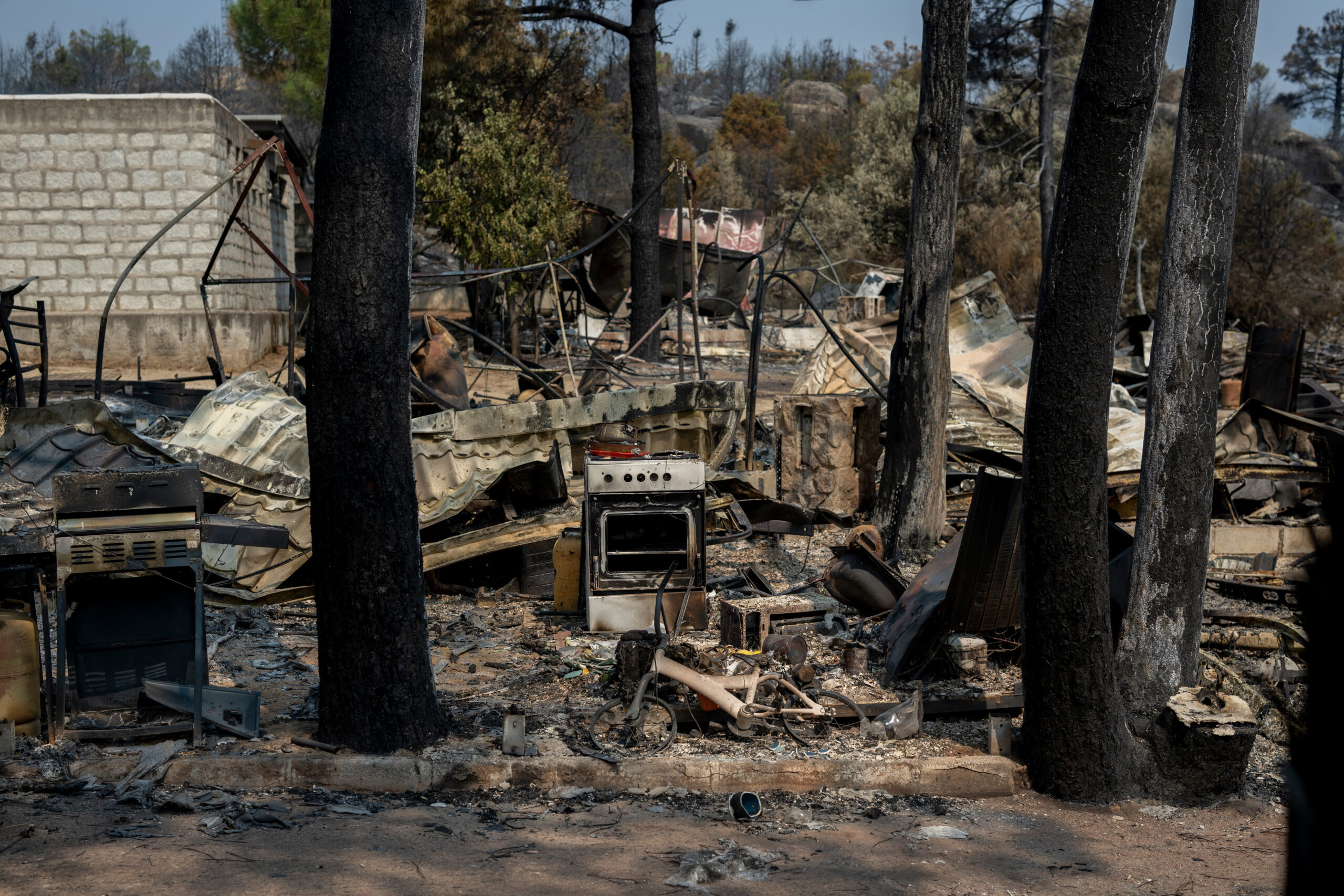
Wildfire losses in Europe's fastest-warming continent are driving insurers to reassess risk. Spain's 2025 season cost €5 billion, only €1 billion insured.
Europe’s insurers are bracing for a new catastrophe cycle driven by rising temperatures on the world’s fastest-warming continent.
Insurers, reinsurers and brokers contacted by Bloomberg predict higher premiums and bigger natural-catastrophe losses. They see the latest extreme heat as a long-term trend, not a temporary shock.
The industry is “actively evaluating” the extent to which rising temperatures “represents a fundamental shift in Europe’s catastrophe risk landscape,” said Will Bruce, global head of climate risk consulting for Aon Plc, the second-largest insurance broker.
Efforts are underway to expand the “range of capital available to support resilience and recovery,” Bruce said. That may mean transferring more risk to capital markets via catastrophe bonds and other insurance-linked securities.
Munich Re says the combined forces of El Niño and global warming have produced a “dangerous mix” that will drive up losses in the second half of this year.
Wildfires have already ravaged Spain, France and Greece. European forecasts show “very high” fire danger through early August reaching as far north as Scandinavia. In the UK, a large wildfire broke out near a nuclear power station.
“What is already clear is that wildfire losses extend well beyond damage to property,” said Tyson Vickery, managing director and global placement leader for Europe at Marsh, the world’s largest insurance broker. “Business interruption caused by evacuation orders, smoke or restricted access can create significant losses even where there is limited or no physical damage.”
Spain’s 2025 wildfire season resulted in close to €5 billion in economic losses. Only €1 billion was insured, Vickery said.
Allianz SE, Europe’s largest primary insurer, says heat is altering risk patterns as regional temperatures rise twice as fast as the global average. There are now “more pronounced wildfire and drought risks driven by extreme weather and record temperatures,” said Matthias Trüstedt, global head of property & casualty at Allianz.
In Spain, Allianz has implemented an AI-powered satellite-based wildfire detection and alert service. As of July 20, the system had generated 417 wildfire alerts, triggered 73 response activations and enabled notifications to thousands of customers, Trüstedt said.
“We are now all exposed to all kinds of weather-related hazards,” said Stephanie Duraffourd, a spokesperson for Assurland, one of France’s largest online insurance comparison websites. “No region is spared.”
Risk levels will be reassessed, Duraffourd said. There will be “more significant premium increases locally, this also applies to the entire country.”
Roland Lescure, the French finance minister, has said insurers will cover the cost of temporary housing for thousands evacuated due to wildfires. The decision, negotiated with France Assureurs, applies whether homes were damaged or not.
Historical data no longer provide an adequate foundation for loss probabilities. The industry now relies “heavily” on forward-looking scenario analysis, Aon’s Bruce said. Europe’s ability to generate reliable catastrophe risk models will play a key part in attracting investors to products such as cat bonds, he added.
Catastrophe bonds help insurers offload unmanageable risks to capital markets. Investors are on the hook if a predefined catastrophe hits. They profit if it does not. They only invest with reliable data to base their bets.
Last year, the California FAIR Plan – the state’s insurer of last resort – entered the cat bond market with a wildfire bond after the January 2025 fires that devastated the Los Angeles area. The FAIR Plan faced an estimated $4 billion in losses.
Globally, more than $5 billion of cat bonds with some exposure to wildfire risk were issued by insurers and sold to investors last year. That is more than double the 2024 level.
Swiss Re Institute notes wildfire is now the fastest-growing weather peril globally. “Additional risk-transfer capacity cannot replace measures that reduce the underlying risk to keep insurance affordable,” said Balz Grollimund, Swiss Re’s head of catastrophe perils.
Wildfire risk is not currently covered under state-backed public-private natural disaster compensation frameworks in Spain or France. That carries implications for how easily insurers can transfer risk, said Manuel Arrive, a credit analyst at Fitch Ratings.
“The question that arises is whether the state-backed natural catastrophe scheme should be extended to cover wildfires or other perils related to climate change,” Arrive said. “In any case, there is a willingness on the part of European insurers to do so.”
With climate-related losses expected to double every eight to nine years, Allianz’s Trüstedt says Europe now “urgently” needs to focus on protecting against losses in the first place, “rather than simply redistributing losses after they occur.”
Drafted by a large language model from the source reporting linked above, then screened by automated publishing checks. It is not read by a journalist before publication. Some articles cite our Alpha Score. Verify prices and figures against the original source. Educational coverage, not personalized advice.