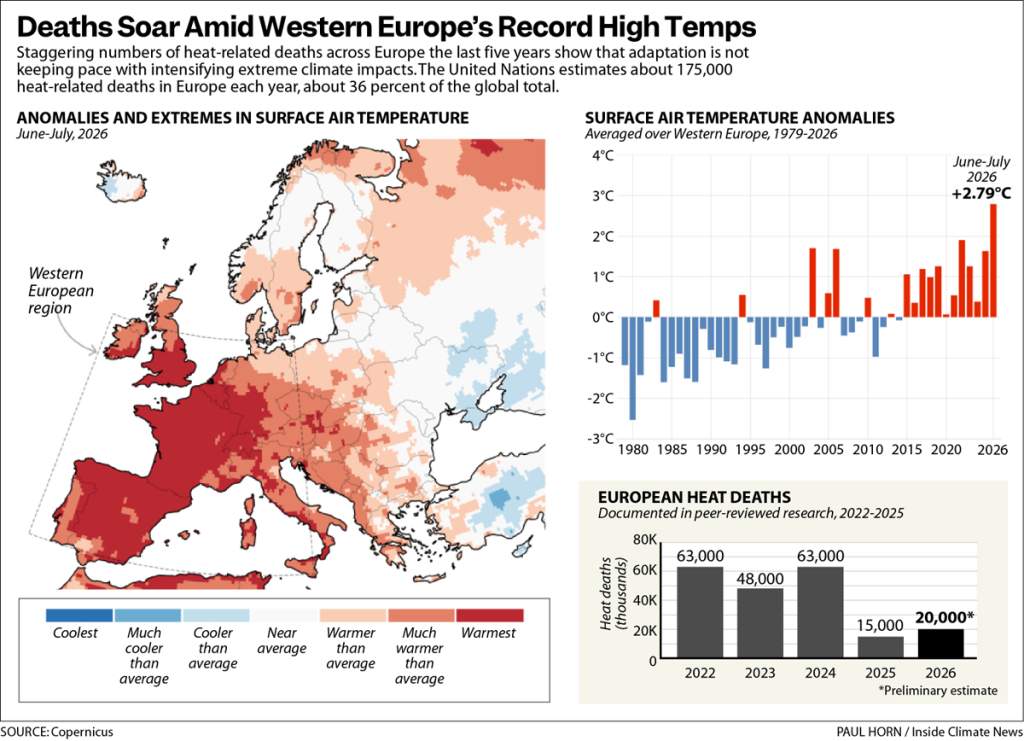
At least 33,000 people have died in Europe's summer heatwaves so far, with far-right parties using the crisis to attack governments while Green parties demand action.
A summer of extreme heat across Europe has killed at least 33,000 people in eight countries alone, according to an AFP tally published Saturday. The count covers excess deaths and fatalities directly linked to high temperatures, and summer is not over. Europe recorded 63,000 heat-related deaths in 2022 and another 63,000 in 2024, a 2025 study in the journal Nature Medicine found. This year’s toll is expected to surpass both.
The casualties have sparked a political fight. European Green party leaders in July called the summer a “dark summer” and blamed political inaction. Vula Tsetsi, co-chair of the European Green Party, said in a July 18 statement that “there is a widening gap between the scale of Europe’s heatwaves, literally hitting every EU country, and the absence of decisive European action.” She urged the European Council to convene a heat summit. Tsetsi said the EU Commission had planned to release a heat and cooling plan in April but has not delivered it due to political gridlock.
The first heat surge in June caused about 10,000 deaths across the continent. In Austria, where an estimated 395 people died, the Green Party called on the national government to hold a heat summit. In Linz, Austria’s third-largest city, Green Party City Councilwoman Eva Schobesberger formally requested a special session of the city legislature to consider immediate protections for vulnerable residents.
“We know what we need to do,” Schobesberger said. Europe can forecast extreme heat increasingly well, and public-health experts know what measures can reduce deaths, she explained. Yet the death tolls keep climbing. The 2025 Nature Medicine study found that heat mortality remains high, with tens of thousands dying each year. Political leaders say they have learned from the 2003 heatwave, which killed an estimated 70,000 people, Schobesberger said, “but the results aren’t there.”
Linz has taken some steps. The city appointed an urban climatologist in 2020, built a detailed urban heat map that shows where cooling infrastructure is missing, and is expanding district cooling for hospitals. Schobesberger said the biggest obstacle to further progress is political, not technical. Much of the city’s climate work happened after 2021, when the Green Party won about 16 percent of the municipal vote. The Fridays for Future demonstrations in 2019, sparked by Greta Thunberg, showed politicians that climate action had public support, she said. “Politicians across parties wanted to demonstrate that they wanted to do something on climate.” The Green Party used that window to launch projects that would be hard to reverse.
Since then, political attention has shifted to wars, inflation and other concerns. In Linz, the mayor’s office downgraded a prominent climate coordination position and removed the word “climate” from the department responsible for resilience. Conservative and far-right populist politicians have complained that newly greened areas took away road and parking spaces, hinting they could tear them out, Schobesberger said. The city approved a highway corridor that will raise temperatures, over Green Party objections. Hundreds of trees have been cut down for asphalt and cars.
On the national level, the far-right Austrian Freedom Party (FPÖ) runs an ongoing campaign to confuse the public about the causes of the climate crisis and to block the shift to renewable energy, especially wind power, she said.
Reinhard Steurer, a professor of climate politics at Vienna’s BOKU University, said he saw the far-right weaponize the heat firsthand. During the June heat surge, producers with ServusTV, an Austrian media company aligned with right-wing populist parties, asked him via email to appear on a news program and criticize the government for failing to adapt. Steurer said his first reaction was disbelief, because for years ServusTV denied human-caused global warming and downplayed its impacts, similar to Fox News in the United States. He described it as a broader political strategy: acknowledge the suffering caused by extreme heat while shifting responsibility to the current government to gain political advantage. Instead of acknowledging that human-caused warming worsens wildfire conditions, the disinformation narrative shifts blame to migrant campfires, he added. ServusTV did not immediately respond to questions from Inside Climate News.
The politics of climate extremes do not have to follow that path, said Aaron Thierry, a researcher at Cardiff University in Wales. He pointed to Spain’s Prime Minister Pedro Sánchez, who is using the worsening disasters to argue for action. Sánchez has spoken bluntly about the connection between extreme weather and global warming. As wildfires swept across Spain this summer, he called the climate emergency a threat to lives and ecosystems and said governments need to address both causes and consequences.
It is too early to measure the effect of this summer’s extremes, Thierry said. Overall public and media climate discourse is still way off target, he added, citing several recent studies showing a sharp decline in climate coverage in recent years. That decline takes pressure off governments to act.
“It feels like the climate issue is actually getting less attention and I find that deeply concerning,” Thierry said. Recent reports from the Intergovernmental Panel on Climate Change show that addressing the root causes is the only way to prevent mass casualties during even hotter summers projected for the decades ahead. The rising heat-related death tolls across Europe show that even wealthy, developed countries are reaching the limits of adaptation. “We can’t lose sight of the fact that we have to phase out fossil fuels because that’s ultimately what’s driving extreme heat,” he said. “The science is trying to tell us this is super-urgent. It’s transformational change that is needed, and our politics are not at that place yet.”
Prepared with AlphaScala editorial tooling from the source reporting linked above. Indexable analysis may include a cited Alpha Score value. Publishing checks screen each story before release. Educational coverage, not personalized advice.