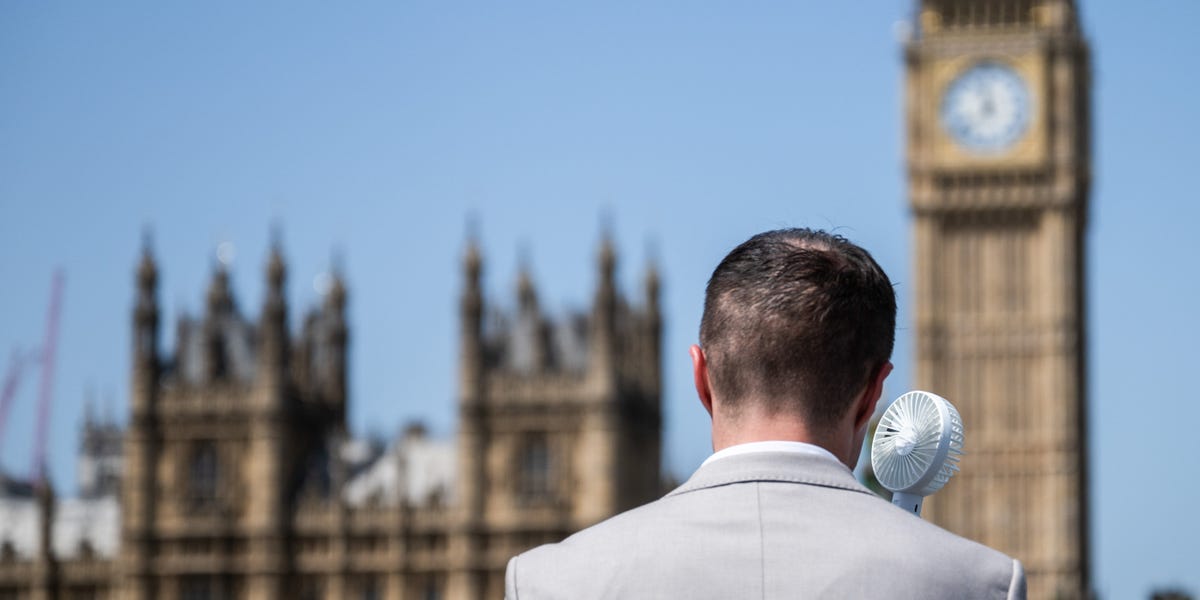
For decades, Europeans treated air conditioning as a luxury for hotels and American excess. This summer, that calculus is breaking down.
After Western Europe recorded its hottest June on record, manufacturers say Europeans are buying air conditioners in droves as another relentless heat wave pushes temperatures above 100 degrees Fahrenheit across parts of the continent.
"Air conditioning is clearly moving beyond a niche category in several European countries," Alexandre Loeur, senior research manager at market intelligence company Euromonitor International, told Business Insider. "The underlying trend appears structural rather than temporary."
Kieron Heath, a 39-year-old fantasy author in Essex, England, spent about £585 on a Meaco portable air conditioner last April. He said Britain's heat waves have become longer, hotter, and harder to escape, leaving him "fed up with those kind of two weeks of being too hot, not sleeping, feeling unwell, feeling drowsy."
"When we get these heat waves, all of our existing cooling solutions – which is basically as many fans as you can buy – stop working," he said. "You're just pushing hot air around."
A Samsung spokesperson told Business Insider its air-conditioner sales in Europe recorded double-digit year-on-year growth in the first half of 2026, with key markets including Italy, Spain, and France also posting double-digit gains.
Chinese appliance giant Midea said shipments to Spain and France jumped 108% compared with last year, while German e-commerce sales climbed 37%. One of its most popular portable units sold out in some sales channels after an early heat wave sent shoppers scrambling for relief.
Mitsubishi Electric said demand had been particularly strong in France, Spain, Britain and Germany. LG Electronics said one of its South Korean factories has been running at full capacity since April to keep up with global demand.
The industry's trade association, Eurovent, expects the momentum to continue. Deputy Secretary General Stijn Renneboog told Business Insider the growth in Europe's air conditioning market is "not a one-off, but a long-term trend."
He pointed to European Commission modeling showing the number of room air conditioners in the EU grew from fewer than 7 million units in 1990 to around 57 million in 2020, and could exceed 100 million by 2030.
"Rising temperatures and more frequent extreme heat events are becoming impossible to ignore," he added. "Heat is a serious public health risk."
EuroMOMO, the European mortality monitoring network, estimated excess deaths across Europe climbed from about 33,000 in mid-June to more than 45,000 by the end of June and early July. In England and Wales alone, researchers led by Imperial College London estimated the late June heat wave caused 2,183 heat-related deaths.
Europe has reasons to resist air conditioning: homes are older, electricity is more expensive, and installing AC often requires landlord approval or costly renovations. According to the International Energy Agency, only around one in five European households has air conditioning, compared with roughly nine in ten in the United States.
"I think it's almost cultural," Heath said. "In the UK, it's been seen as not worth investing in because we don't need it for very long."
A recent trip to visit his girlfriend in Arkansas this spring helped him understand why Americans see things differently. "In the US, unless you work outside, you're barely in the heat," he said. "You go from your front door to your car, you've got AC. You get to work or the mall, you've got AC."
Even after the record June heat, Euromonitor's Loeur said he doesn't expect Europe to develop the same relationship with air conditioning as the US anytime soon. "Europe is unlikely to resemble markets such as North America in the near future," he said, though he added they believe "many markets are approaching a tipping point."
For Heath, Americans' bewilderment now makes perfect sense. "The American mindset is, 'I'm hot, so why would I stay hot? I can just turn the AC on.' Ours has almost been, 'Well, there is no other choice but to be too hot.'"
He said that mindset is beginning to change. "It's gone from being a luxury to a necessity," he said. "Do I want to try and sleep in a house that's about 36 degrees?"