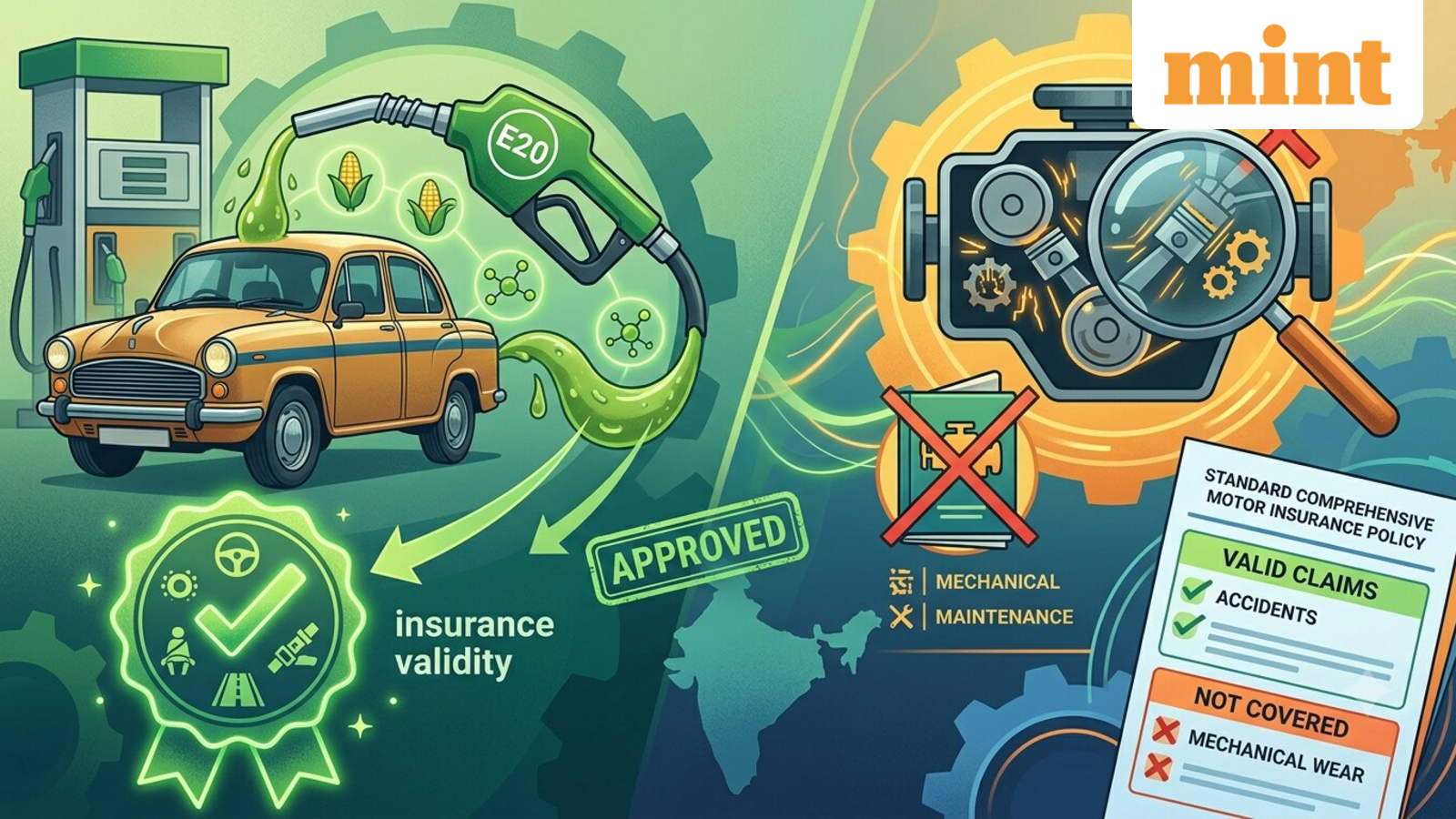
India's push to expand ethanol-blended petrol has vehicle owners asking whether E20 could void their insurance or lead to claim rejections. The answer, according to insurance experts, is no.
Using government-approved ethanol-blended fuel does not invalidate a comprehensive motor insurance policy, said Hari Radhakrishnan, Expert at the Insurance Brokers Association of India (IBAI). Insurers have clarified that E20 does not amount to unlawful or unsafe vehicle use. A claim cannot be rejected solely because the vehicle was running on ethanol-blended petrol.
The question arises as India accelerates its E20 rollout under a strategy to cut crude oil imports and lower emissions. Automakers have advised owners of older vehicles to check compatibility before regular use. That is a mechanical issue, not an insurance one.
Many motorists assume that if ethanol-blended fuel causes engine damage, repair costs would be covered. Radhakrishnan said that is a misconception. Comprehensive motor insurance covers accidental external damage. It does not cover gradual wear and tear or mechanical deterioration that develops over time.
Even if prolonged use of incompatible fuel contributes to engine problems, the damage would occur gradually. Incremental mechanical defects fall outside the scope of standard motor insurance.
An engine protection add-on also does not help in such situations. These covers are designed for accidental engine damage – water ingress during floods, loss of lubrication after an accident, or damage from an external impact. They are not intended for mechanical issues arising from long-term use of ethanol-blended fuel.
Radhakrishnan said the biggest misconception is that E20 and insurance are linked. They are separate issues. Since the government promotes ethanol blending as public policy, insurers have no reason to deny coverage simply because a policyholder uses approved E20 petrol.
For consumers, the message is straightforward. If the vehicle manufacturer recommends or permits E20, using it will not affect insurance cover. Owners should still follow the manufacturer's fuel compatibility guidelines. Long-term mechanical issues remain a maintenance matter, not an insurance claim.
The sector readthrough is modest. For non-life insurers, the government's clarification removes a potential source of disputes. Insurers face fewer claims battles over ethanol-related engine problems. For the auto service sector, older vehicles that need fuel system upgrades create a small but steady demand for parts and labor. The overall impact on auto sales is negligible.
The ethanol blending policy is part of a broader shift in commodities analysis, reducing India's reliance on imported crude oil. The government's target of 20% ethanol blending by 2025 remains on track, with the next phase expanding E20 availability to more cities nationwide.