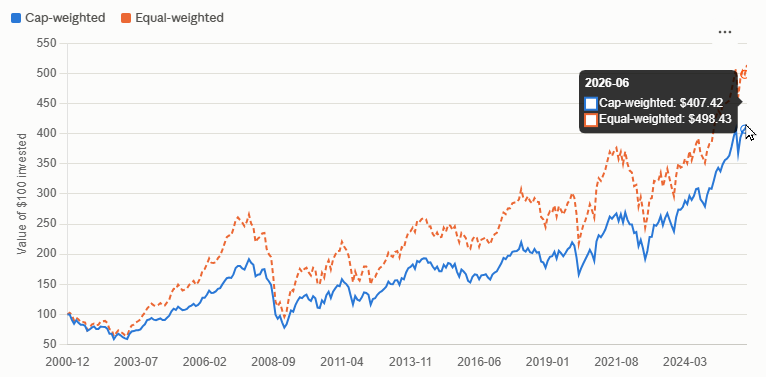
A recent comparison of market-cap weighted and equal-weighted indexes across three global regions shows the equal-weight approach has delivered higher long-term returns in every case, with the margin widest in Asia.
From December 2000 through July 2026, the MSCI World Equal Weighted Net Total Return Index beat its cap-weighted counterpart. The same held for the MSCI Europe Equal Weighted Index and the MSCI AC Asia Ex Japan Equal Weighted Index over the same period.
Each equal-weight portfolio holds positions of roughly equal size. In the MSCI World version, each stock accounts for about 0.10% of the portfolio. In Europe, the figure is about 0.30%. In Asia ex Japan, 0.16%.
The outperformance reflects a structural feature of equal-weight indexes: they avoid over-concentration in the largest stocks, which cap-weighted indexes must hold in proportion to their market value. When mega-cap stocks lag, the equal-weight version benefits. When they lead, it trails. Over 25 years, the net has favored equal weight.
The comparison uses net total return indexes, which include dividends after withholding taxes and assume reinvestment. The data covers the period from December 2000 to July 2026, roughly 26 years.
Interactive Brokers (IBKR), which scores an Alpha Score of 72/100 on AlphaScala's proprietary model, has been a beneficiary of the trend toward global, low-cost investing. The broker's platform gives individual investors the tools to replicate equal-weight strategies across markets without paying the fees that come with institutional index funds. The stock issued as a bonus to new clients under IBKR's current promotion – USD 1 in shares for every USD 100 deposited, up to USD 1,000 – is, over the long run, more than a token. The company's share price has risen steadily as it captured market share from traditional brokers.
MSCI Inc., by contrast, carries an Alpha Score of 46/100, reflecting a more mixed outlook. The index provider benefits when more investors chase its benchmarks, but the shift toward equal-weight and factor-based strategies could pressure its market-cap-weighted product lineup over time.
For investors, the data points to a simple conclusion that has held for a quarter-century: equal-weight indexing works, and it works in any developed or Asian market where the cap-weighted benchmark is top-heavy. The edge is not always visible in a single year, but over two decades it compounds into real outperformance.
Kyith is the Owner and Sole Writer behind Investment Moats. He worked as an IT operations engineer from 2004 to 2019 and now works as a Senior Solutions Specialist at fee-only wealth advisory firm Providend. All opinions are his own and do not represent the views of Providend.