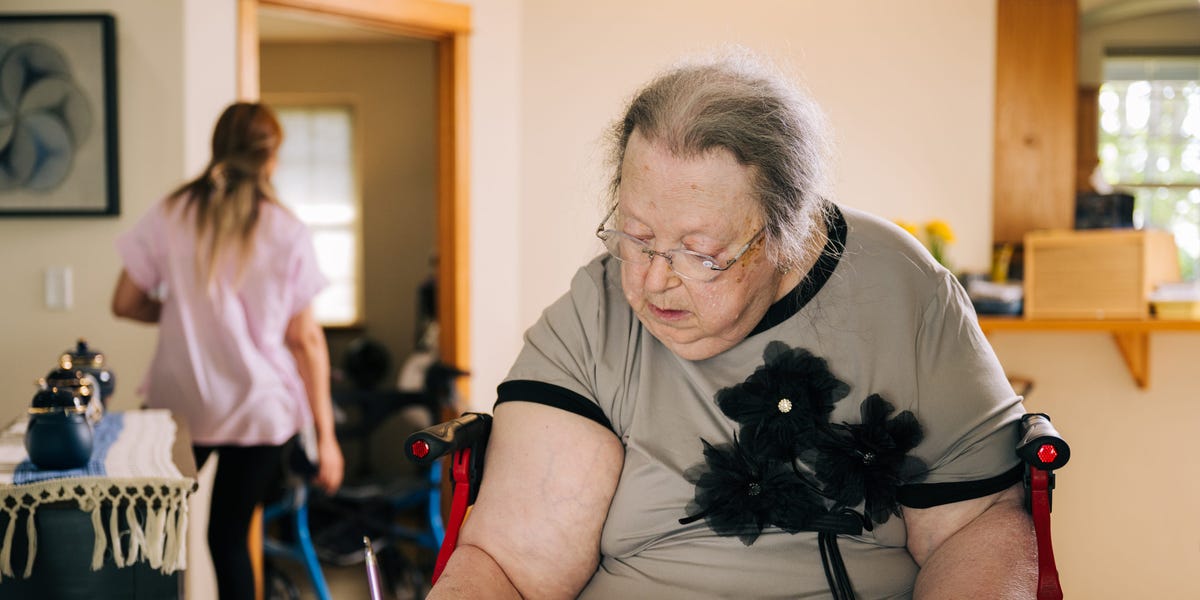
Nursing home costs have risen 212% since 1997, more than double the overall inflation rate over the same period. Adult day services climbed 109%. Families are bearing the weight.
Tamara Johnson, 58, made six figures in an executive role before her mother's Parkinson's diagnosis in 2017. She moved from New Orleans to Virginia to care for her. After her mother died in 2020, her husband suffered a series of catastrophic medical events. Johnson quit her job this year to care for him full-time. Between her mother and husband, the family spent over $700,000 on care, she estimated.
"I was one of those people who was taught that you don't quit, you suck it up, and you keep going," Johnson said. "I felt like I didn't have the luxury of falling apart, because if I fell apart, then who would pick up the slack?"
Overall inflation has been tapering since 2023, with prices rising about 11% in that period. Care services rose about 17%. The gap is widening.
Wages for nursing and residential care workers rose from $17 an hour to nearly $27 over the last decade, a 57% increase from 2016 to 2026. That outpaced the 47% growth across all private wages. Those higher labor costs pass directly to families paying out of pocket.
Home care now costs a median of about $34 an hour, according to senior care company A Place for Mom. Private-pay costs for home health aides rose 48% between 2019 and 2024. Homemaker services rose 47% in the same period, roughly double the increase from 2010 to 2019, an AARP report showed.
Lana Mountford, 75, moved into an assisted living facility in 2021 for $4,300 a month. After a surgery she moved to a two-bedroom unit for $5,500, which rose to nearly $7,000 over two years. She moved into a 55-plus development, buying a home in cash for $580,000. A caregiver now comes six hours a week for $200.
"I knew my savings would be drained if I had to keep paying that much, when I could live in my own place with a full kitchen," Mountford said.
Some 59 million Americans care for loved ones, 48 million of them unpaid, according to an AARP and National Alliance for Caregiving report. Alan Weil, senior vice president of public policy at AARP, said caregivers put about $7,000 of their own money into caregiving resources annually.
John Nuar, 35, built a home for his father with dementia. After his father moved into a memory care facility, Nuar and his wife paid about $120,000 out of pocket over three years, covering what his father's retirement income could not. The cost rose from $4,200 to $6,600 monthly.
"The month-over-month stress of the cost and not knowing how long it would last still affects me two years after his passing," Nuar said. "Having to look at dollars and then make a care decision was and is still very hard."
Medicaid pays for many kinds of long-term care, including residential nursing and in-home support. Spending on Long-Term Services and Supports has grown, improving access in some states. Gaps remain. Nuar said his father would have qualified for Medicaid drug coverage in Virginia, not in Michigan.
Marc Cohen, co-director of the LeadingAge LTSS Center at UMass Boston, said the government should create a Social Security-style program for long-term care, with workers paying in throughout their careers. He said more politicians should fight Medicaid cuts that have reduced support for older Americans.
"There has not been the political courage to just talk to the American public and say, to solve this problem, this is what we need to do," Cohen said. "We need to prefund benefits so that if and when you have a long-term care need, you have some protection."
Federal proposals include the Caring for Seniors Act, introduced in the House last year, which would expand affordable assisted living access and fund workforce training. The bipartisan WISH Act would create a national long-term care insurance trust fund and give some Social Security beneficiaries home care benefits.
Washington State launched the WA Cares Fund, funded by a 0.58% payroll tax, with a lifetime inflation-adjusted cap of $36,500 in benefits. California, Minnesota, New York, and Pennsylvania have introduced similar legislative proposals.
Some companies, including Microsoft, offer eldercare resources such as legal services and backup care. Meta, Google, and Cisco have partnered with the care navigation platform Wellthy. The MSFT stock page shows the stock at $495.40, down 0.30% today, with an Alpha Score of 71.
Kevin Prindiville, executive director of Justice in Aging, said state and local governments should invest in alternative housing for older residents, including accessory dwelling units, co-housing, and home modification grants. Housing costs have risen faster than older adults' incomes.
"There's an old narrative of the older person having bought their house forever ago and having paid it off and now living easy – that's gone," Prindiville said. "The housing cost burden is actually highest in families that include people 65 and older."
Margaret Burke, 62, who lives in Taiwan, bought a condo for her 91-year-old mother in Myrtle Beach, South Carolina, for $62,000 six years ago. Monthly fees of $1,000 to $2,500 cover meals, utilities, a pool, and group activities.
"She's always on the go, often shopping, going for walks, or taking day trips to museums," Burke said. "There is this 'third path' between independent living and assisted living that is affordable for most middle-income seniors."