ECB's Lagarde Rejects Euro Stablecoins, Backs Digital Euro
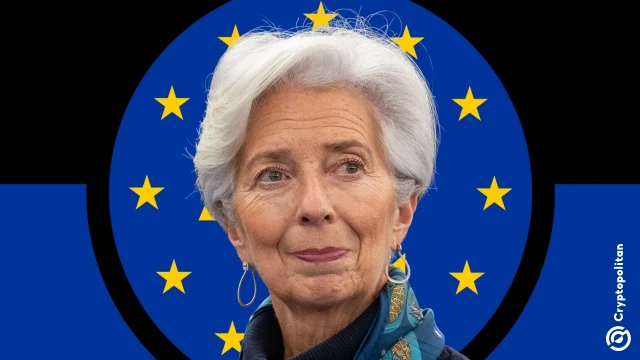
ECB President Lagarde says euro stablecoins are structurally fragile and pushes digital euro as the only credible path, with pilot not expected until 2027.
European Central Bank President Christine Lagarde is making the case against euro-denominated stablecoins. Speaking at the Banco de España LatAm Economic Forum in May, she called the argument for them "far weaker than it appears." Dollar stablecoins command a market cap of roughly $317 billion, per CoinMarketCap. Euro stablecoins sit below $1 billion.
Lagarde pointed to the USDC depegging during the Silicon Valley Bank collapse in 2023 as evidence of structural fragility baked into stablecoin design. She said ECB research shows that if stablecoins replaced bank deposits at scale, lending to firms would weaken and the central bank's ability to transmit interest-rate policy would diminish. Her preferred alternative is the digital euro, a central bank digital currency that would run on European infrastructure and reduce reliance on foreign payment providers like Visa and Mastercard.
ECB Executive Board member Isabel Schnabel reinforced that position on June 1 at a Bank of Korea conference in Seoul. She drew a parallel between modern stablecoins and the money market funds that pulled deposits out of banks in the 1970s. Both promise stability while creating fragility underneath, she warned. Because nearly all stablecoins in circulation are pegged to the dollar, Schnabel argued their spread would entrench American monetary influence through network effects and first-mover advantages, not necessarily stronger economic fundamentals.
The digital euro is not close to launch. A pilot program is expected to begin in the second half of 2027, running 12 months with a limited number of banks and merchants. Even under the most optimistic timeline, the ECB does not expect to issue a digital euro before 2029. The European Parliament voted in February to endorse the framework, with 420 lawmakers backing online and offline functionality.
That timeline leaves a gap that private-sector players are racing to fill. Ten major European banks, including BNP Paribas, ING, and UniCredit, formed a consortium called Qivalis to launch a euro-backed stablecoin. The consortium applied for an electronic money institution license with the Dutch Central Bank. ING, with an Alpha Score of 75 and a Strong label, is one of the more established players in this push. Euro stablecoin transaction volume grew from $69 million in January 2025 to $777 million by March 2026, according to TRM Labs. Circle's EURC holds over 50% of the euro stablecoin market after securing an early French electronic money institution license under MiCA.
Lagarde's stance puts her at odds with the European Commission and several member-state governments. France sees euro stablecoins as a tool for boosting the currency's international standing, according to Reuters. A report from Blockchain for Europe released in April and co-authored by former ECB Director General Ulrich Bindseil stated that MiCA's restrictions are too harsh and risk pushing stablecoin businesses out of Europe entirely. Bundesbank board member Michael Theurer told reporters that both tokenized deposits and stablecoins are "crucial," even as he acknowledged the risks tied to the latter.
The ECB's broader position on tokenized markets is clear: settlement should happen in central bank money. Lagarde endorsed tokenized commercial bank deposits as a safer blockchain-compatible option, arguing they avoid the run risk that plagues stablecoins while still enabling on-chain circulation. That view aligns with the ECB's earlier statements on the topic.
For traders watching the stablecoin space, the key tension is between regulatory intent and market momentum. Dollar stablecoins dominate, euro stablecoins are growing fast from a tiny base, and the digital euro is years away. The Qivalis consortium and Circle's EURC are the main vehicles for euro-denominated on-chain activity in the interim. Any regulatory shift under MiCA or a faster digital euro timeline would reshape the competitive dynamics. The next concrete marker is the Qivalis license decision from the Dutch Central Bank.
Drafted by a large language model from the source reporting linked above, then screened by automated publishing checks. It is not read by a journalist before publication. Some articles cite our Alpha Score. Verify prices and figures against the original source. Educational coverage, not personalized advice.