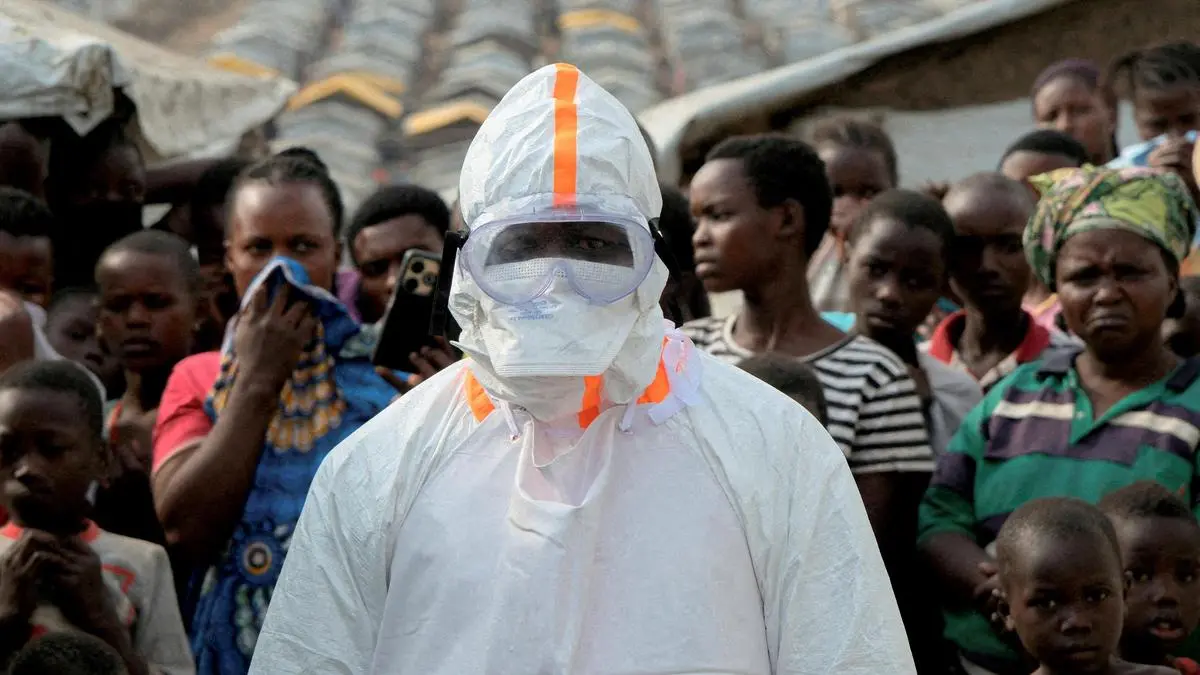
Health workers in eastern Democratic Republic of Congo may get an experimental Ebola vaccine strategy within weeks. Africa CDC plans to seek clearance Tuesday for a small study that would test whether a prime-boost regimen can protect against the Bundibugyo strain.
At least 121 health workers and other frontline responders have been infected during the outbreak. 18 are hospitalized. 36 have died.
The trial could begin within two weeks if it receives regulatory and ethical approval, Africa CDC said in an email Sunday.
The regimen would use Merck & Co.'s licensed Ebola vaccine, Ervebo, which targets the more common Zaire strain, followed by an experimental vaccine being developed against Sudan Ebola by the International AIDS Vaccine Initiative. The idea is that the combination might generate an immune response broad enough to provide at least some protection against Bundibugyo.
Arthur Caplan, founding head of the division of medical ethics at NYU Grossman School of Medicine, said the trial should go ahead. He called it ethical to offer a regimen that may provide only partial protection, given the risks frontline workers already face and the limited number of volunteers.
Existing Ebola vaccines generate immune responses that recognize Bundibugyo. It's unknown whether those responses are strong enough to protect people from disease.
“We don’t know whether that level of antibodies would be beneficial or meaningless,” Mark Feinberg, chief executive officer of IAVI, said in an interview. “We just don’t know.”
Research on macaques at the University of Texas Medical Branch in Galveston found that monkeys given sequential vaccines against the Sudan and Zaire Ebola viruses several weeks apart survived after being deliberately exposed to the Bundibugyo virus. Most animals receiving the two vaccines simultaneously did not. The findings suggested a so-called prime-boost strategy might broaden protection, though not necessarily prevent illness altogether.
Vasee Moorthy, who leads WHO’s research and development work on emerging epidemic threats, said a scientifically robust and ethically conducted study of Ervebo, with or without a Sudan Ebola vaccine, would be consistent with WHO recommendations. He cautioned against broader use outside controlled research settings.
Broader deployment may fail to confer protection and “could generate a false sense of security among affected communities and responders, potentially undermining trust and adherence to proven public health measures and damaging confidence in Ebola vaccination if breakthrough infections occur,” Moorthy said in an email.
Armand Sprecher, an emergency physician and epidemiologist with Médecins Sans Frontières, said from the Congolese city of Bunia that the possibility breakthrough infections could undermine confidence is “not unimportant.” He said the decision to receive a vaccination regimen thought to provide only partial protection should rest with healthcare workers after informed consent.
“Something is better than nothing and we know that it’s safe. It is your choice,” Sprecher said, adding that healthcare workers are capable of understanding that trade-off after informed consent.
Africa CDC plans to seek rapid ethical approval because Ervebo is already licensed and IAVI’s experimental Sudan Ebola vaccine was used during Uganda’s 2025 Sudan Ebola outbreak. The agency is also discussing contributing an initial $500,000 to launch the study while seeking additional funding from partners.
An initial study could provide safety and immune-response data, Africa CDC said. Further studies would be required to establish whether the approach prevents infection, severe disease, or death.