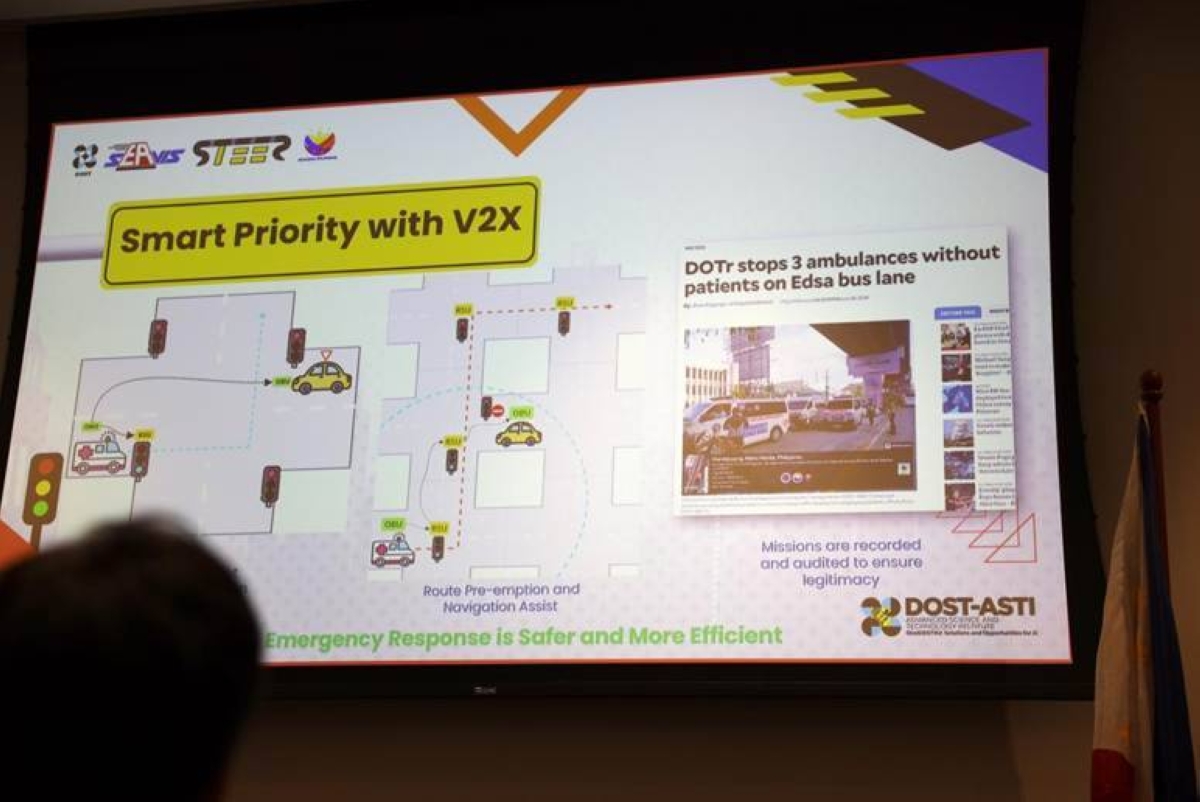
The Philippines tests V2X traffic preemption for emergency vehicles. The system logs every priority request to prevent abuse. No pilot city announced yet.
The Philippine Department of Science and Technology is testing a system that lets ambulances and fire trucks talk directly to traffic lights. The goal is to cut response times in a country where gridlock can delay emergency vehicles by 20 minutes or more.
The project, called sERVis-Steer, uses Vehicle-to-Everything wireless technology. An onboard unit in the emergency vehicle communicates with roadside infrastructure. When an ambulance approaches an intersection, the system can preempt the signal cycle, turning the light green and holding it until the vehicle passes. A centralized platform, the Emergency Response Information Exchange Server, connects hospitals, dispatch centers, and traffic agencies. It logs every preemption request and verifies that only authorized vehicles get priority.
DOST-ASTI’s Miguel Asido presented the system at an ITS Stakeholders’ Summit on June 4, 2026. The event brought together local government units, the Department of Transportation, and partner institutions for demonstrations and planning. DOST Secretary Renato Solidum Jr. said in a video message that cooperation from LGUs and the public is critical for the pilot. He called the project a step toward broader Intelligent Transportation Systems adoption in the Philippines.
The technology itself is not new. Cities in Japan, Singapore, and parts of Europe have used similar V2X preemption for years. What makes sERVis-Steer notable is the integration layer: the audit platform that prevents abuse. Without it, any vehicle with a transmitter could claim priority. The server-side validation is the difference between a functioning system and a traffic nightmare.
Pilot deployment is the next hurdle. DOST has not announced a specific city or timeline. The summit was a coordination exercise, not a launch. For traders watching infrastructure plays in Southeast Asia, the project is worth tracking as a signal of government willingness to fund smart-city technology. The real test will come when an ambulance actually hits a Manila intersection with the system live.
Prepared with AlphaScala research tooling and grounded in primary market data: live prices, fundamentals, SEC filings, hedge-fund holdings, and insider activity. Each story is checked against AlphaScala publishing rules before release. Educational coverage, not personalized advice.