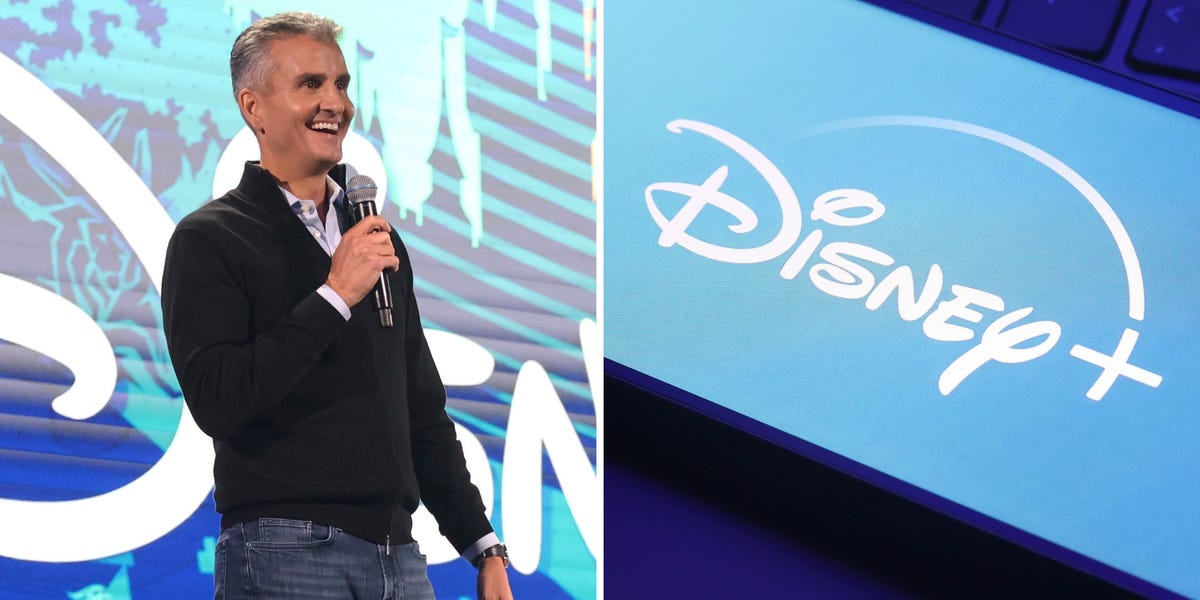
Disney CEO Josh D'Amaro's plan to turn Disney+ into a "super app" is taking shape, pairing streaming with games, merchandise, and theme-park bookings. The question is whether customers want all of it in one place.
"Disney+ will continue to evolve, bringing together games, merchandise, and other experiences, while offering increased personalization, exclusivity, and benefits for subscribers," D'Amaro told employees in a post-earnings memo last week. He said the upgraded app could arrive next spring.
D'Amaro's memo framed the changes as a way to "deepen engagement, improve the value proposition, lower churn, and increase lifetime fan value." That language tracks an obvious problem for Disney: the stock has been flat for a decade. Disney shares are down 8% over the past 12 months and up about 10% over 10 years. The S&P 500 more than tripled in the same stretch.
The streaming unit needs to be the growth engine the stock has lacked. Disney+ is absorbing Hulu's content library and earlier this year added a short-form video feed. Soon it will get a curated feed of Disney-themed TikTok clips. The company is also exploring a free, ad-supported tier, D'Amaro said last week.
Not every analyst is sold on the super-app idea.
"When you have a 'super app,' you wind up with a whole lot of mediocrity," said Alan Wolk, a media industry analyst at TVREV. Folding games and shopping into Disney+ could make the experience messy, he said.
Mike Proulx, a Forrester analyst, warned Disney against turning its flagship streamer into "a digital shopping mall." He said the company is "chasing engagement, frequency, and ad inventory, but there's a risk to its customer experience if Disney+ becomes too cluttered."
Other analysts see upside if the execution is tight.
Hernan Lopez, founder of media consulting firm Owl & Co., said the key is monetizing high-value fans. A single day at a Disney theme park can generate more revenue than a year of Disney+ subscriptions, he noted. That makes selling park tickets through the app an attractive lever.
Yet John Conca, a media analyst at Third Bridge, called any "meaningful uptick" in park-ticket or merchandise sales through the app "aspirational." He added that "any benefits from having a 'super app' are incremental rather than transformational."
The same logic applies to games. Netflix has invested heavily in its gaming push for years, but Conca said "Netflix is proof that it will take significant time before that becomes any sort of engagement driver."
Disney+ accounted for 4.9% of U.S. TV viewership in May, up slightly from 4.7% at the end of 2025, according to Nielsen. YouTube grew from 12.7% to 13.8% over the same span, as viewers gravitate toward free, ad-supported services. Disney's ad-tier subscriber base will be the metric to watch when it reports next quarter.
Paolo Pescatore, a media analyst at PP Foresight, argued that Disney+'s ambitions need to be broader. "Disney+ should be the masterpiece and showcase for the entire Disney universe," he said, adding that games, creator content, and commerce slots belong on the platform alongside movies and sports.
Pescatore pointed out that adding e-commerce features gives Disney a direct line to user behavior – what fans click on and buy – which is data it currently gets from third-party retailers.
Disney's Experiences business still drives the bulk of corporate profits. The super-app bet is an attempt to pull more of those sales inside Disney's own distribution funnel. Whether customers want to buy a cruise between episodes of "The Bear" is the open question.
D'Amaro's memo did not set a firm release date beyond "spring 2026."