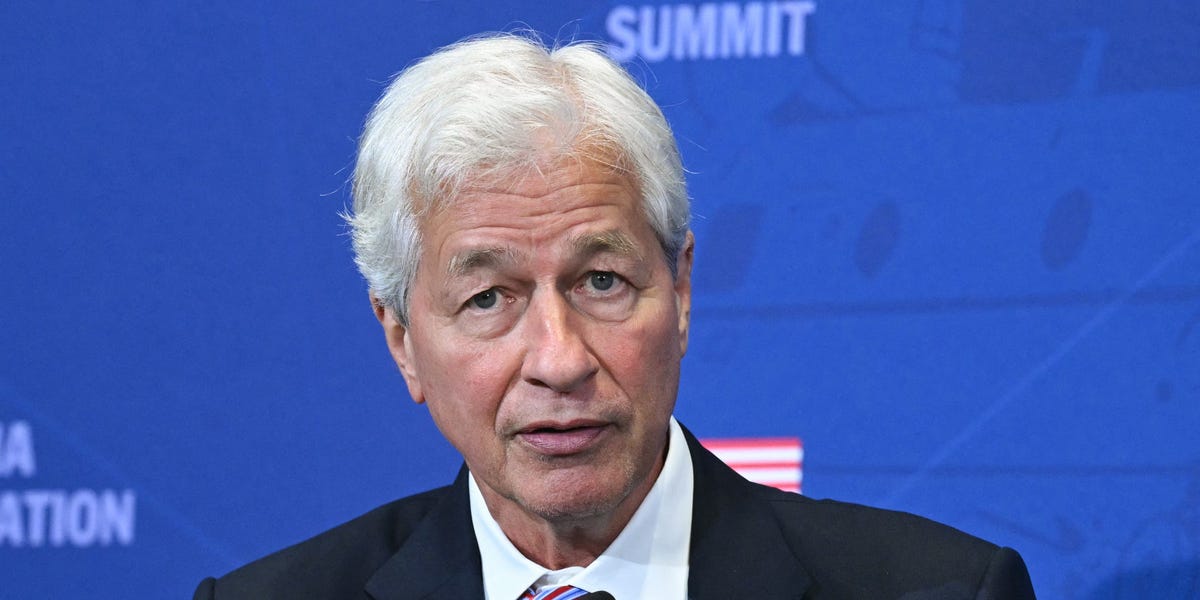
Jamie Dimon says companies are already getting smarter about how they spend on artificial intelligence. The JPMorgan Chase CEO told CNBC on Wednesday that businesses need to be mindful of token costs and their return on investment.
"They all see the costs going up rapidly," Dimon said. "So, of course, we're all going to be rational about it like any other resource we use."
Dimon, who has led the bank since 2006, said JPMorgan considers the value AI adds and negotiates with vendors "all the time." He added that companies are already being smart about spending across the AI supply chain. "I've already seen tons of systems. People are going to send queries to the cheapest token, the cheapest thing," he said. "That's already happening, and that's going to happen with power. It's going to happen with data centers."
The bank is not giving up its data either, Dimon said, addressing a concern executives are increasingly raising. "We are very protective of our data and our IP," he said. "You should assume that JPMorgan will do everything they can to protect its own data, its own IP, to protect our customers."
Dimon is the latest business leader calling for more conservative AI spending. Business Insider's Aditi Bharade and Henry Chandonnet reported on the phenomenon of "modelmaxxing," where firms avoid defaulting to the most expensive, powerful frontier model for every task. As AI expenses soar, businesses are turning away from "tokenmaxxing" – using tools like Claude, Codex, and Cursor in a wasteful way.
Palantir CEO Alex Karp is among the strongest critics of tokenmaxxing. In a CNBC interview earlier this month, Karp said AI models have been "oversold" and that many U.S. businesses are silently admitting they pay for tokens that add no value. "Something has gone completely wrong," Karp said. "The basic view among enterprises in this country is 'I'm going to chillax and waste my time with tokens, I'm going to get no value, and they're going to get my IP.'"
In an interview last month, Karp compared the urge to use so much AI to watching pornography. "Really, we call it the demastibatory, like get off masturbation thing internally," Karp said. "It's like people are just sitting there all day, kind of like a porn addiction."
Cerebras Systems CEO Andrew Feldman has also criticized unnecessary token spend. At a Bloomberg event last month, he called the idea of giving employees unlimited tokens "boneheaded from the get-go." "You don't need a Ferrari to go to the grocery store, right? Use a lower-cost open source model," he said. "What we're learning is how to shop at Costco."
The push toward cheaper tokens has direct implications for the AI supply chain. If enterprises route queries to the lowest-cost model, providers like OpenAI and Anthropic face pressure to cut prices or offer tiered services. Data center operators could see slower demand growth if companies optimize power usage. Software vendors that embed AI – such as ServiceNow and Salesforce – may need to adjust pricing models as customers scrutinize per-token costs.
JPMorgan shares rose 1.17% on Wednesday, trading at $346.91. The stock carries an Alpha Score of 63 out of 100, a Moderate rating. The broader market reaction suggests investors see Dimon's comments as a signal that AI spending discipline is spreading beyond tech companies into traditional finance.
For a deeper look at how AI costs affect software margins, see OpenAI's ChatGPT Work Pressures Software Margins.