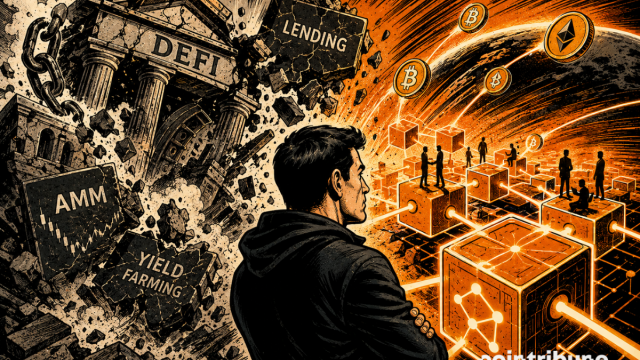
Cronje says most DeFi fails his three-part test. He proposes "on-chain finance" as a label for protocols where teams keep control. Only small niches qualify as truly decentralized.
Andre Cronje has a message for the industry. Most of what people call DeFi no longer qualifies. The founder of Flying Tulip prefers the term "on-chain finance" for protocols where companies, committees or teams retain the power to intervene. His point goes to the heart of a question that has lingered for years: how much decentralization is real, and how much is just a label.
During a discussion on X, Cronje laid out three criteria. A protocol must be decentralized, immutable, and function without an intermediary. Immutability means the rules cannot be changed after launch. By that standard, he said, only a few small niches still qualify.
"I do not think DeFi still exists outside of a few very small niches," he said.
Cronje's proposed alternative captures a different reality. Transactions are recorded on a blockchain and publicly visible, but the entire organization does not have to be decentralized. A protocol can execute on-chain operations while depending on a human group for critical parameters like asset selection, risk limits, or pause triggers.
The partial centralization does not always come from a desire to take power from users. It also responds to a concrete problem. Protocols manage billions of dollars and can face a bug, a price manipulation, or unexpected market behavior. Waiting for a lengthy governance vote while a flaw threatens to drain the protocol in minutes can be catastrophic.
Teams have added safeguards. Emergency pause, deposit caps, limits on certain assets, the ability to modify risk parameters. These tools can prevent an incident from escalating. The question they raise is who holds the controls. If a handful of people can suspend withdrawals, change a parameter, or decide which assets are accepted, the claim of no intermediary becomes harder to defend. The contested vote at Aave has already shown that the boundary between community, founders, and operational teams remains hard to draw.
A working paper published by the European Central Bank in March gives a measurable dimension to the problem. On Aave, MakerDAO, Ampleforth, and Uniswap, the top 100 addresses held more than 80% of the observed governance tokens. The data came from November 2022 and May 2023, so it mainly measures governance concentration, not the technical decentralization of each protocol. Still, the numbers show a pattern that aligns with Cronje's critique.
The discussion takes place against a backdrop of shrinking total value locked across DeFi. According to DefiLlama, TVL dropped from $165.71 billion on October 5, 2025 to $74.96 billion on August 13, 2026. That drop of about 54.8% in a little over ten months amounts to nearly $90.75 billion leaving the sector.
The decline itself cannot be blamed on centralization. A period of financial pressure makes the trade-off Cronje highlighted more visible. When markets turn or a protocol is threatened, teams often favor speed. A committee that can modify a parameter in minutes becomes more efficient than a decentralized vote that takes days.
Cronje's statement is a demanding definition, not proof that all innovation has vanished. He himself acknowledges small pockets of "real DeFi" still exist. For the user, the right reflex now is to look past the label. Who can modify the code? Who can suspend withdrawals? Who can change parameters? Projects that claim to operate without intermediaries will have to show that promise holds during a crisis.
The broader crypto market analysis reflects a shift in sentiment as TVL contracts and governance questions persist. The gap between the label and the reality is a risk that users should not ignore.
Drafted by a large language model from the source reporting linked above, then screened by automated publishing checks. It is not read by a journalist before publication. Some articles cite our Alpha Score. Verify prices and figures against the original source. Educational coverage, not personalized advice.