DeepSeek, the Chinese AI lab behind some of the cheapest large language models on the market, just closed the largest private AI financing in the country's history. The $7.4 billion round, led by existing backers and new institutional investors, values the three-year-old startup at more than $50 billion. Founder Liang Wenfeng told potential investors on a video call earlier this year that his team is "a group of very ordinary people." The money says otherwise.
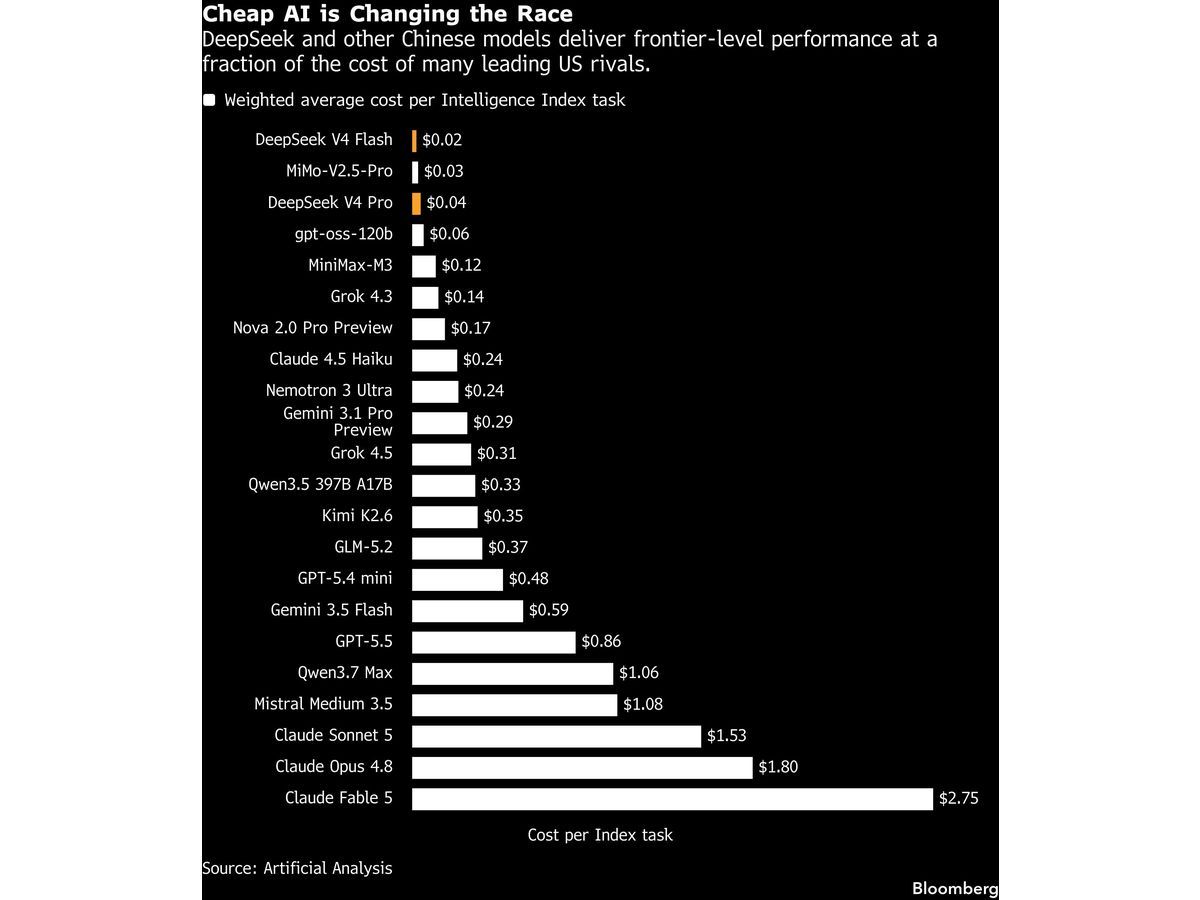
The fundraising gives DeepSeek the firepower to expand its global push. Its models already undercut US rivals by a wide margin. The weighted average cost of running a standardized intelligence task on DeepSeek's V4 Flash model is 2 cents, according to benchmarking site Artificial Analysis. The same task on Anthropic's Claude Fable 5 costs $2.75. That is a 99% discount.
Corporate customers are noticing. San Francisco-based Lindy AI switched from Anthropic's Claude Sonnet to DeepSeek after six weeks of testing. CEO Flo Crivello said the startup now pays about 10% of its previous AI bill, saving millions of dollars annually – more than the cost of its entire 27-person workforce.
"DeepSeek isn't just a technical breakthrough, it's an economic one," said Robert Wu, CEO of Chinese analytics firm BigOne Lab.
The pricing pressure is spreading across the sector. Big companies that jumped into AI in recent years are growing cost-conscious. Tesla and Meta Platforms have set up internal leaderboards to reward employees for "tokenmaxxing" – using as many AI tokens as possible – but are discovering that unbridled spending does not pay off. Meta, which runs its own open-source Llama models, now faces a competitor that offers comparable performance at a fraction of the cost.
DeepSeek is also planning an initial public offering in 2027 that could bring in billions more. That timeline gives it years to build market share before public investors get a chance to buy in.
The read-through for the AI sector is straightforward. Companies that rely on proprietary high-cost models – OpenAI, Anthropic, and their enterprise resellers – face a structural pricing headwind. Customers with flexible workloads can switch to cheaper open-source alternatives with minimal friction. The winners in this environment are the infrastructure providers that host multiple models and the companies that can absorb margin compression through scale.
Liang's pitch to investors emphasized that DeepSeek is not a one-off. "We're a group of very ordinary people," he said. The market is treating the company as anything but.