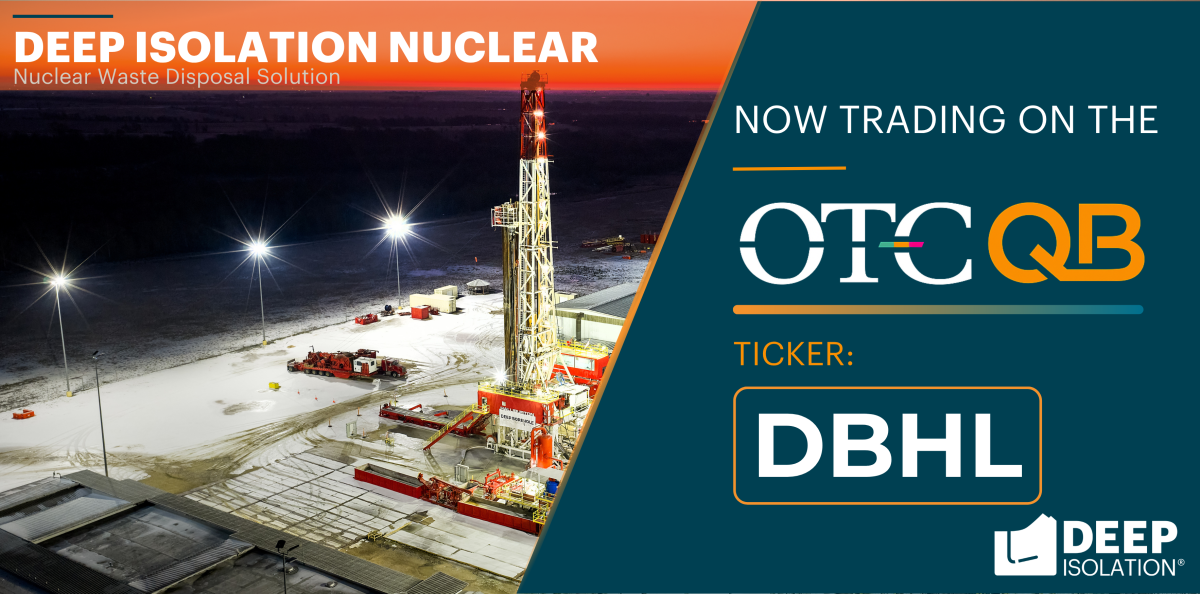
Deep Isolation, a developer of deep borehole nuclear waste disposal technology, began trading on the OTCQB Venture Market on Wednesday under the ticker DBHL. The listing follows an oversubscribed $33 million private offering and an Alternative Public Offering that closed earlier this year.
CEO Rod Baltzer said the OTCQB listing gives public investors a chance to back the company's Universal Canister System, which is designed to store, transport and permanently dispose of spent nuclear fuel in boreholes drilled thousands of feet underground. The company holds more than 100 patents and is the first to pursue commercial deep borehole disposal, a method it says costs less than traditional mined repositories.
Deep Isolation's technology was developed through a three-year project funded by the U.S. Department of Energy's ARPA-E program. In January, the company launched a full-scale Commercialization Pilot at Cameron, Texas, in partnership with Halliburton (HAL), Amentum (AMTM), NAC International and Occlusion Nuclear Solutions. Halliburton's drilling expertise is central to the pilot, which aims to demonstrate that existing oilfield drilling methods can safely isolate waste in horizontal, vertical or slanted boreholes.
The company's OTCQB listing provides access to capital markets as it advances the pilot and works toward commercial contracts. The OTCQB requires companies to meet financial standards, maintain current reporting and undergo annual verification. Deep Isolation's Alpha Score is 49 out of 100, a Mixed rating in the Energy sector.
Nuclear waste disposal has long been a bottleneck for the industry. The U.S. has no permanent repository for high-level waste, and projects like Yucca Mountain remain stalled. Deep Isolation's approach – drilling deep boreholes on existing nuclear sites or remote land – avoids the multibillion-dollar cost and decades-long permitting of a mined repository. The company says its canister system can handle waste from both legacy reactors and next-generation advanced reactors.
Baltzer said the company is focused on completing the Texas pilot and securing its first commercial contracts. The pilot is expected to run through 2026. A successful demonstration would position Deep Isolation to bid on government and utility contracts in the U.S. and abroad, where countries like Canada, Finland and Sweden are also pursuing permanent disposal solutions.
Trading on the OTCQB gives the company a public currency for future fundraising and potential acquisitions. The stock opened at $2.50 on Wednesday.