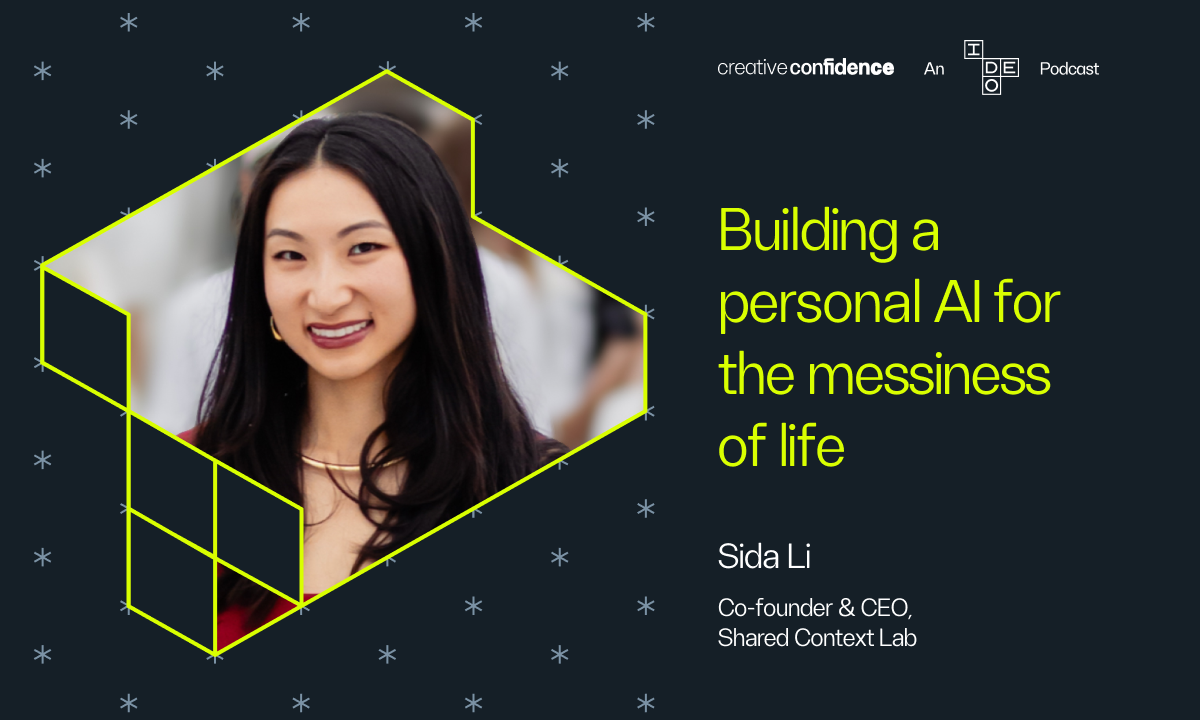
A missed birthday. A kid's schedule that shifted last minute. A group chat that never quite settles on a restaurant. This is the terrain AI mostly hasn't touched. Sida Li decided to build for it.
Li is co-founder and CEO of Shared Context Lab, where she's building Cue, a personal AI that lives inside iMessage and group chats. She noticed plenty of AI apps were being built for managing work. Her bet is that personal life, messier and less systemized, needed a solution too.
"If it's not solving a fundamentally human need, it won't be an enduring product or solution," she says.
Work comes with built-in scaffolding: calendars, project trackers, inboxes. Personal life mostly doesn't. Li's read is that AI has spent years getting good at problems that already have structure, while the long tail of everyday needs is still a struggle.
Several of Cue's most distinctive choices come down to one question: does this feel like something on your side, or something watching you a little too closely?
Li built Cue inside iMessage instead of a new app, since texting already feels personal in a way opening another app doesn't. She made Cue proactive instead of waiting to be asked, on the idea that most people don't know everything a personal AI could do for them. Users can dial down how much Cue initiates if it feels like too much. And she dropped a word most AI companies reach for by default: agent.
"We want to use language that consumers use in their lives," she says. "The jargon in AI today is confusing, and it feels cold." A conversation with IDEO's Tim Brown pushed her toward the word she uses instead: routine. "Agents have their own incentive. They have their own agenda," he told her. Cue, by contrast, is meant to act as an advocate "in your best interest," as Li puts it.
Even the transparency built into Cue's memory, with every input visible, editable, deletable, traces back to the same instinct: earn trust first.
Li didn't know how to code when she started Shared Context Lab, but she ended up building Cue's front end herself. "It's kind of crazy how much has changed in the last six months," she says. The tools have moved fast enough that a founder can explore more ground solo before bringing in the team to build it.
She applies the same instinct to Cue's business model that she'd apply to the product itself: test it, learn from it, be willing to rebuild it. She leans on a framework from IDEO – desirability, viability, feasibility – to pressure-test ideas before committing to them.
Not everything survives that test. Li originally explored a version of the business built around enterprise clients. Everyone she pitched liked the idea. She hit a real problem when she pushed further: there was no budget line inside those organizations for it. "It would be an uphill battle," she says. A consumer product turned out to be the better fit.
Pricing got the same scrutiny. Right now, it's simple by design. Li is already innovating on several fronts at once with her product, a new category of consumer behavior, the interface, and the language she uses to describe all of it. She's keeping pricing simple to leave space to learn how people respond to everything else first.
This is the second in a two-part series profiling founders from IDEO's Startups-in-Residence program. The first conversation is with Johannes Seemann of Sooner. Listen on Apple, Spotify, YouTube, or wherever you get your podcasts.