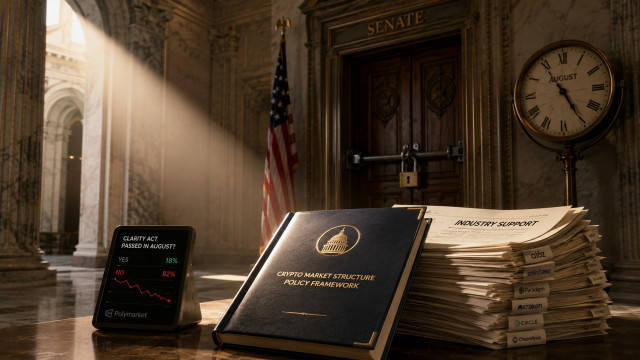
A coalition of more than 200 crypto companies and organizations sent a letter dated June 7 to Senate Majority Leader John Thune and Senate Minority Leader Charles Schumer. The group is urging an immediate floor vote on the CLARITY Act, a bill that would define digital asset classifications and create a developer safe harbor. The letter frames the legislation as essential for US competitiveness in blockchain innovation. Signatories include major exchanges, venture firms, and developer advocacy groups. Their core argument is that regulatory uncertainty is driving talent and capital offshore.
The timing creates a specific catalyst window. The Senate faces a packed calendar of appropriations bills and a potential debt ceiling fight. Floor time is scarce. If the bill does not reach the floor by late July, the August recess effectively kills any chance of movement until September at the earliest. By then, election-year dynamics could shift the calculus entirely.
Prediction Markets Price the Scheduling Bottleneck at 25-30%
Polymarket and other prediction platforms show odds hovering around 25% to 30% for CLARITY Act passage before September. That is not a vote of no confidence in the bill's substance. It is a vote of no confidence in the Senate calendar.
The mechanism is straightforward. Prediction markets price in both the probability of a yes vote on the floor and the probability of the bill actually getting a floor vote. The low odds suggest traders believe the scheduling bottleneck, not the policy opposition, is the binding constraint.
A key insight: if odds climb above 40% in the next two weeks, it would signal that floor time is being formally allocated. A move below 20% would imply the bill is effectively dead for the summer session. Either move would create a tradable event for politically-sensitive crypto names like COIN and MSTR.
The Developer Safe Harbor Is the Real Battle
The CLARITY Act's most consequential provision is the developer safe harbor. It would protect software developers from securities law liability when they create and distribute decentralized protocols, as long as they do not control the network or profit from its secondary trading.
This clause draws the sharpest opposition from the SEC. Chair Gary Gensler has argued that such a safe harbor would create a loophole for projects to raise capital through token sales without registration. Industry advocates counter that without it, US-based developers face legal risk for publishing open-source code.
The practical effect for traders: if the safe harbor survives into the final bill, projects that have been wary of US incorporation may announce relocations or new token launches. That would be a direct catalyst for ETH and Layer-1 tokens with active developer ecosystems.
What This Means for Positioning
The coalition letter creates a defined risk window. If the bill passes with the safe harbor intact, the crypto market analysis suggests a structural bullish signal for tokens focused on decentralized applications. If it stalls in committee, the market absorbs a negative signal about US regulatory intent. That would likely pressure coins with heavy US retail exposure.
Practical rule: do not size a position on Senate floor timing alone. The prediction market spread between a bill that gets a vote and one that passes is wide. The first real tell will be a committee markup date, not a floor vote count.
The current environment favors options strategies over outright longs. A calendar spread on COIN expiring after the August recess would capture the volatility from either outcome without requiring a directional guess.
The Next Decision Point
The June 7 letter puts the ball in Thune's and Schumer's court. Each must decide whether to use procedural tools to force a vote before the July 4 break or to let the bill languish through the summer.
A committee hearing announcement or a public statement from either leader expressing support for a floor vote would be the first concrete sign of momentum. Until then, the 25% prediction market odds are likely the fair price for a bill that faces both substantive opposition and a calendar that is running out.
White House CLARITY Act talks continue behind closed doors. The administration has not issued a formal position. If the White House endorses the bill, the odds would jump. The floor-vote bottleneck would then become the only remaining hurdle.