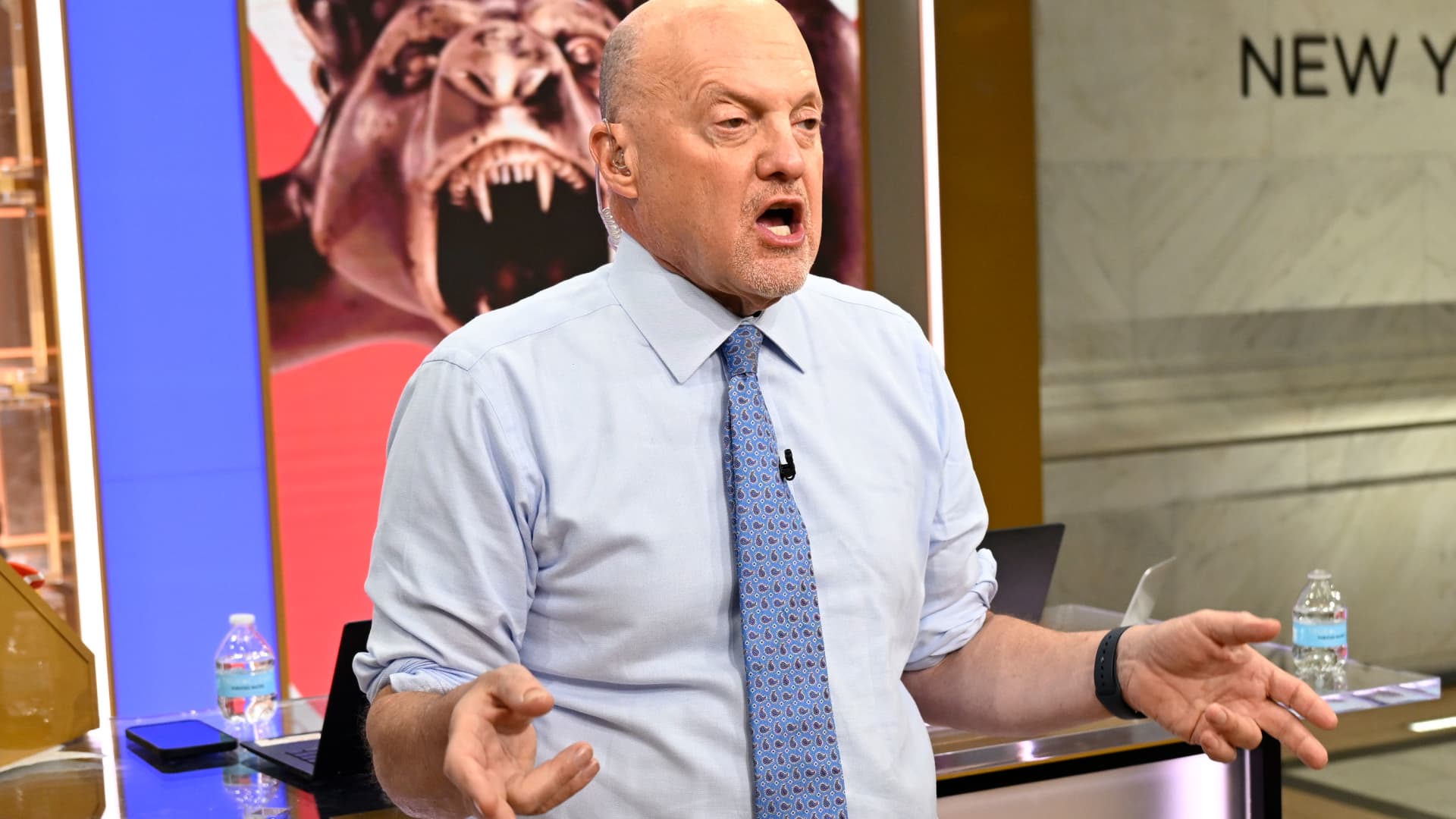
Thursday's session delivered a Dow Jones Industrial Average record, up 874 points ( 1.7% ), while the S&P 500 added 0.4% and the Nasdaq Composite slipped 0.09% . The divergence itself is a clue: the rally was broad, not tech-led. Jim Cramer, host of CNBC's Mad Money, called it a sign of a market with a "huge appetite" – one that shrugged off what he described as "two of the biggest obstacles" that normally would have derailed the session.
For an AlphaScala reader, the question is not whether the rally happened why the market could ignore those obstacles and what that tells you about positioning, risk appetite, and the next decision point. The simple read is that investors are resilient. The better read is that the market is pricing in a specific mechanism: it is differentiating between headline risk and fundamental damage, and it is rotating into sectors that had been left behind.
The Obstacles That Didn't Stop the Rally
Cramer identified two categories of headwinds that, on the surface, should have pressured stocks: earnings disappointments from high-profile names and renewed fears in private credit. Neither triggered a selloff.
Why Earnings Disappointments Weren't Disappointing
Cramer pointed to Broadcom and CrowdStrike as examples where the initial market reaction looked worse than the underlying results. For Broadcom, he noted the company's history of issuing conservative forecasts before delivering stronger results later. The stock had already rallied sharply heading into earnings, meaning the bar was high, the guidance pattern is well-known to institutional investors.
Key insight: When a company with a consistent track record of under-promising and over-delivering prints a "miss," the market often treats it as noise. The mechanism is that the sell-side has already modeled the eventual beat into their estimates. The real catalyst is the next quarter's actuals, not the initial print.
For CrowdStrike, Cramer argued that concerns were overblown – the results and outlook were stronger than the market reaction implied. The stock sold off on a headline risk (a specific incident), the core subscription revenue and retention metrics remained intact. The market's ability to look past that suggests that investors are differentiating between transient operational noise and structural deterioration.
Private Credit: Why the Market Overlooked Blackstone's Redemption News
News that Blackstone limited redemptions in a flagship private credit fund would typically rattle financial stocks, as it raises questions about liquidity and investor confidence in the asset class. Instead, shares of Blackstone, KKR, and Ares all moved higher.
Practical rule: When a known risk (redemption gates) fails to trigger a selloff in the most exposed names, it usually means the risk is already discounted or the market sees it as idiosyncratic to that fund, not systemic. The mechanism is that institutional investors have already stress-tested their private credit exposure and concluded that the liquidity mismatch is manageable at current redemption levels.
For KKR, the stock's resilience is notable given its Alpha Score of 37/100 (Mixed, sector Financials). The score reflects a neutral-to-cautious fundamental view, the price action suggests that the market is looking past near-term headwinds and focusing on the fee income stream from committed capital. A reader tracking KKR should watch for any acceleration in redemption requests across the sector – that would break the thesis.
The Quantinuum IPO: A Liquidity Test That Passed
Quantinuum, the quantum computing company spun out of Honeywell, debuted on Thursday. Demand was strong enough that underwriters increased the size of the offering, the stock finished its first day relatively flat – not the "sloppy deal" Cramer said he had feared.
A successful IPO in a speculative, long-duration sector (quantum computing) signals that risk appetite is not confined to mega-cap tech. The market is willing to underwrite new issuance even as the IPO pipeline grows. That removes a layer of uncertainty for investors who worry that supply will overwhelm demand.
The Rotation That Confirms the Thesis
Cramer noted that leadership broadened beyond AI and data center trades. Financials, healthcare, and transportation stocks all participated in the rally. This is the mechanism that matters most for portfolio construction.
Why Sector Breadth Changes the Risk Profile
A rally led by a handful of AI names is fragile – it depends on a single narrative (capex, GPU demand, energy consumption). A rally that includes financials, healthcare, and transports is more durable because it reflects improving economic expectations, not just a thematic bet.
- Financials benefit from a steepening yield curve and higher net interest margins.
- Healthcare is defensive also has idiosyncratic catalysts (drug approvals, M&A).
- Transportation is a cyclical bellwether – when rails and airlines rally, it signals that investors expect freight demand and travel to hold up.
Checklist for confirmation:
- The S&P 500 equal-weight index outperforms the cap-weighted index over the next week.
- Financial sector ETFs (XLF) hold above their 50-day moving average.
- Transportation stocks (IYT) continue to gain relative to tech.
Checklist for weakening:
- AI names (NVDA, AVGO) resume their dominance and the equal-weight index lags.
- Private credit redemption news spreads to other funds (e.g., Apollo, Blue Owl).
- The IPO pipeline stalls – if the next deal after Quantinuum prices poorly, the appetite signal reverses.
What Confirms or Breaks the 'Huge Appetite' Thesis
Cramer's framework is that the market is resilient because it can absorb bad news. Resilience is not the same as invulnerability. The next catalyst that would confirm the thesis is a successful absorption of a genuinely negative macro print – for example, a hot CPI or a hawkish Fed surprise that the market initially sells off then recovers within the session.
What would break the thesis:
- A single large-cap earnings miss that is not a guidance pattern a demand collapse (e.g., a consumer staple or industrial reporting falling orders).
- A private credit fund that actually suspends redemptions, not just limits them.
- A sharp reversal in the IPO market – if the next high-profile deal prices below range and trades down.
The KKR Read-Through: Alpha Score 37 and the Private Credit Angle
KKR stock rose on Thursday despite the Blackstone redemption news. The Alpha Score of 37/100 (Mixed) suggests that the fundamental setup is not overwhelmingly bullish, the price action indicates that the market is focusing on the fee stream from committed capital rather than the liquidity risk in the fund complex.
For a reader tracking KKR, the practical question is whether the redemption news is a one-off or a leading indicator. If other private credit managers report similar redemption pressure, the sector's valuation multiple will compress. If Blackstone's move is seen as prudent risk management, the sector holds.
The Session in Context: What the Broadening Rally Means for Your Watchlist
Thursday's action is not a reason to chase the Dow's record. It is a reason to re-examine sector allocation. The market is telling you that it is willing to rotate out of the AI trade and into areas that had been left for dead. That rotation is the mechanism that creates alpha for the next quarter.
- Financials: Look at regional banks (KRE) and asset managers (KKR, BX, ARES). The redemption news was a test, they passed.
- Healthcare: Biotech (XBI) and large-cap pharma (PFE, MRK) are showing relative strength.
- Transportation: Rails (UNP, CSX) and airlines (DAL, UAL) are benefiting from the broadening.
The market's ability to ignore two known risks is a bullish signal for the near term, it does not eliminate the macro uncertainty. Use the broadening as a reason to trim overconcentrated AI positions and add exposure to sectors that are just now catching bids. The next confirmation point is the absorption of the next macro data point – if the market can shrug off a negative CPI print the same way it shrugged off earnings and private credit, then the 'huge appetite' thesis is real.
For more on the broader market setup, see our stock market analysis. For KKR-specific data, visit the KKR stock page.