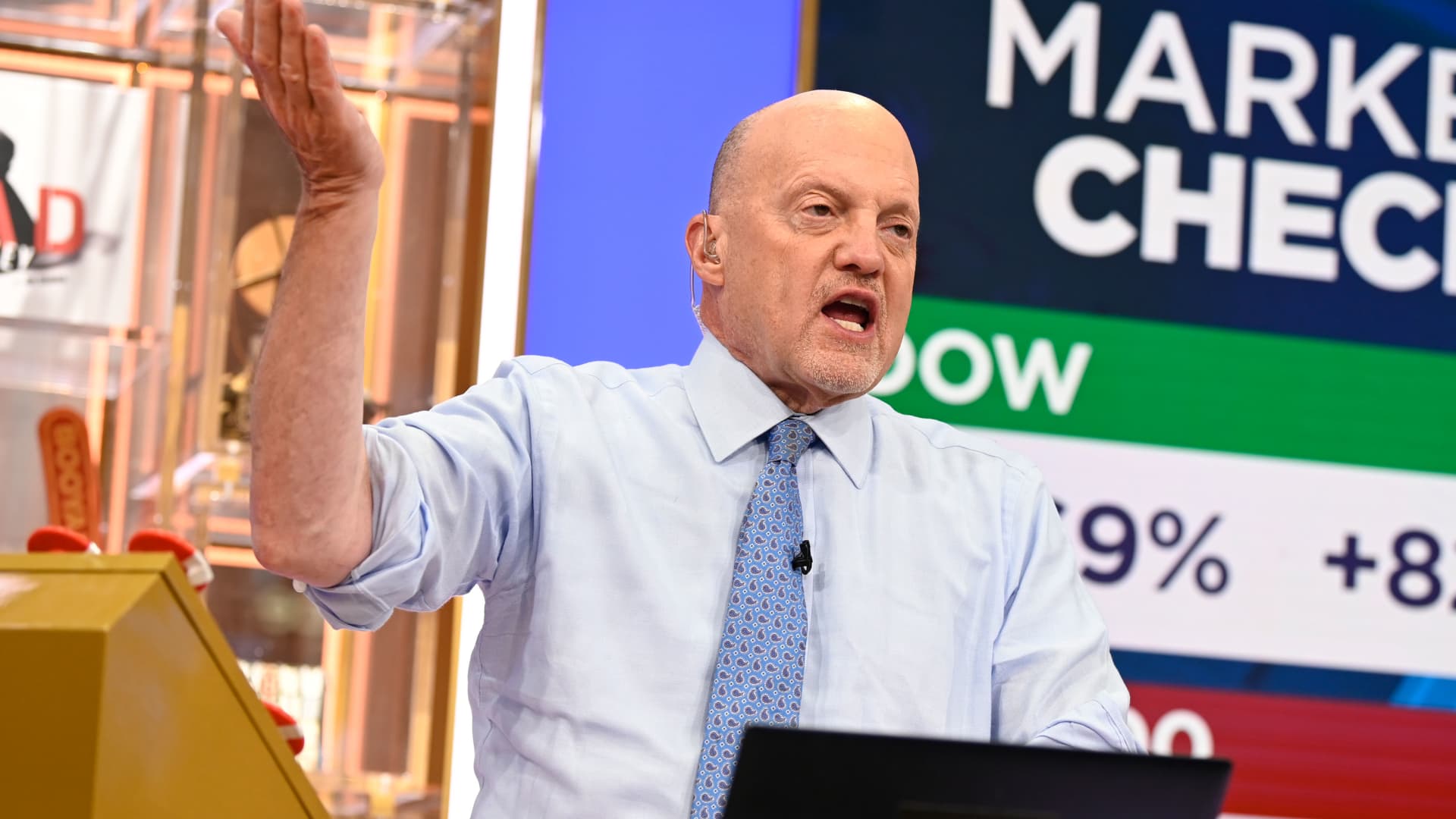
The April consumer price index rose 0.6% month-over-month, pushing the annual inflation rate to 3.8% and sending the 2-year Treasury yield briefly to 4%. Jim Cramer, on CNBC's "Mad Money," said the stock market cannot sustain a rally without lower interest rates, framing the bond market's cooperation as essential oxygen for equities.
The CPI print did not merely delay rate-cut expectations. It challenged the assumption that disinflation was on a steady downward trajectory. The consequence is a market environment where any equity bounce that is not accompanied by falling yields risks being a short-lived trade rather than the start of a new leg higher.
April CPI at 3.8% Resets Rate-Cut Expectations
The 0.6% monthly increase was hotter than consensus forecasts and broad-based. The annual rate of 3.8% marked an acceleration that forced investors to confront the possibility that the final mile of the inflation fight will be the hardest. The immediate reaction in the Treasury market was a sharp sell-off, with the policy-sensitive 2-year yield testing the 4% threshold.
The 2-Year Yield Touching 4% and the Equity Valuation Ceiling
Higher yields raise the discount rate applied to future corporate earnings, compressing equity valuations. They also increase the opportunity cost of holding risk assets relative to risk-free government debt. For rate-sensitive sectors – housing, autos, capital goods – the transmission is even more direct. Mortgage rates, auto loan rates, and corporate borrowing costs all rise in sympathy with the Treasury curve, cooling demand.
Tuesday's session did feature a rotation into previously battered sectors like healthcare, a move that on the surface looked constructive. Cramer acknowledged the rotation. He cautioned, however, that sector shifts without an accompanying decline in yields do not create the conditions for a broad, lasting rally. The money moving into healthcare was not new capital flowing into equities; it was existing capital seeking shelter.
Cramer's 'Oxygen' Thesis: Why Equities Need Lower Rates
Cramer's argument distills to a simple market axiom: equities and bonds are not independent. When the bond market is tightening financial conditions through higher yields, the equity market eventually follows. The relationship is not always immediate, and it can be masked by sector rotation or earnings beats, yet it reasserts itself over time.
"Without the bond market on your side, you might just be up on a trade."
This is the practical risk for traders. A rally that occurs while the 2-year yield is climbing toward 4% is a rally built on borrowed time. The question is not whether the equity market can post a few positive sessions; it is whether those gains can hold when the cost of capital is rising and the Fed is on hold.
What the 2-Year at 4% Signals About Fed Expectations
The 2-year yield is the market's most sensitive gauge of near-term Fed policy expectations. When it touches 4%, it implies that investors see little room for rate cuts in the coming quarters. The Fed's own projections have been at odds with market pricing for months, and the April CPI print narrowed that gap in the hawkish direction. For equities, this means the "Fed put" – the idea that the central bank will ride to the rescue with easier policy – is further out of the money than many had assumed.
Home Depot at November 2023 Lows: A Rate-Sensitivity Case Study
Cramer pointed to Home Depot (HD) as a concrete example of how higher rates are already weighing on stocks that depend on cheaper borrowing costs. The stock traded Tuesday at its lowest levels since November 2023, a decline that reflects the housing market's acute sensitivity to mortgage rates.
The Housing Transmission Channel
Home Depot's business is tied to home improvement spending, which in turn depends on housing turnover and mortgage activity. When mortgage rates rise, existing home sales slow, and homeowners become less willing to finance large renovation projects. The stock's slide to multi-month lows is not a coincidence; it is the equity market pricing in a prolonged period of elevated borrowing costs that will suppress housing-related demand.
Cramer disclosed that he purchased Home Depot for the CNBC Investing Club's Charitable Trust on the belief that eventual rate cuts would support the stock. The April CPI report, by pushing those rate cuts further into the future, directly undermines that thesis. The position now sits in the path of a bond market that is not cooperating.
AlphaScala's proprietary scoring system rates Home Depot a Weak 27 out of 100, reflecting the stock's vulnerability to sustained high rates and housing market softness. The score incorporates technical, fundamental, and sentiment factors that align with the pressure Cramer described.
The Broader Rate-Sensitive Basket
Home Depot is not alone. The entire universe of stocks that rely on low financing costs – homebuilders, real estate investment trusts, auto retailers, and durable goods manufacturers – faces the same headwind. When the 2-year yield is at 4%, the cost of capital for these businesses rises, and their equity valuations compress. The CPI print did not create a single-stock problem; it reinforced a sector-wide risk.
Oil, Iran, and the Broadening Inflation Impulse
Cramer identified a specific mechanism that he believes is amplifying inflation in ways that even tariffs did not: the Iran war and its effect on oil prices. Rising crude, he argued, is pushing up costs across a wide range of categories.
- Shelter: Higher energy costs feed into utilities and building materials.
- Services: Transportation and logistics costs rise with fuel.
- Food: Farm-to-table supply chains are energy-intensive.
- Apparel: Synthetic fibers and shipping both depend on petroleum.
- Gasoline: The most visible price for consumers, directly tied to crude.
This is the second-order risk. The April CPI report was not just a backward-looking data point; it contained forward-looking signals that geopolitical tensions are feeding into core inflation measures. If oil prices remain elevated or rise further, the disinflation that the market had priced in will continue to recede, keeping the bond market in the driver's seat and equities in a reactive posture.
Why This Inflation Is Stickier
Tariffs are a one-time price-level adjustment. A geopolitical supply shock in oil is different. It can persist, escalate, and spread through the economy in ways that are difficult for the Fed to address without crushing demand. Cramer's point is that the current inflation impulse is not a statistical residual; it is being actively fueled by a conflict that shows no sign of resolution. That makes the path back to 2% inflation longer and the bond market's grip on equities tighter.
Conditions That Would Restore the Bond Market's Cooperation
For the stock market to regain durable upward momentum, the bond market must signal that rate cuts are back on the table. That requires a sequence of events that is not yet in place.
- Cooling CPI prints: A reversal in the monthly inflation trend, ideally below 0.2% month-over-month, would be the first signal.
- Stable or falling oil prices: A ceasefire or de-escalation in the Iran conflict that takes crude lower would remove a key cost-push channel.
- Shelter disinflation: The lagged effect of falling market rents needs to show up in the official data.
- Fed rhetoric shift: Any signal from Fed officials that they see progress would allow the 2-year yield to retreat from 4%.
Without these conditions, the equity market's rallies will remain vulnerable to bond market reversals. The "oxygen" Cramer described is not a metaphor; it is the real cost of capital that determines whether stocks can sustain higher multiples.
When the Bond Market Tightens Further: The Downside Scenario
The opposite scenario is equally important for traders to map. If the next CPI report confirms that inflation is stuck above 3.5%, the bond market will price out rate cuts entirely and may begin to price in hikes. That would push the 2-year yield above 4% and potentially toward 4.5%, a level that would inflict serious damage on rate-sensitive equities.
- Services inflation remains the stickiest component. If it does not roll over, the Fed has no cover to ease.
- Escalation in the Middle East that sends oil above $100 a barrel would feed directly into headline CPI and consumer inflation expectations.
- A hawkish Fed pivot – even a subtle one – would accelerate the bond sell-off and remove the last hope of a near-term cut.
Home Depot at November 2023 lows is a warning. If the bond market tightens further, that level may not hold, and the stock could test deeper support. The same logic applies across the housing and consumer discretionary complex.
Key insight: The April CPI report did not just delay the rate-cut timeline; it introduced the risk that the timeline is broken. Until the bond market signals otherwise, equity rallies are on borrowed time.
The next concrete marker is the May CPI report. A cooler print would give the bond market permission to rally and equities room to run. A hot print would confirm that the inflation problem is deepening, and the "oxygen" Cramer described would become even scarcer. For traders positioned in rate-sensitive names like Home Depot, the asymmetry is clear: the upside requires bond market cooperation that is not yet priced in, while the downside is already visible in the stock's slide to multi-month lows.