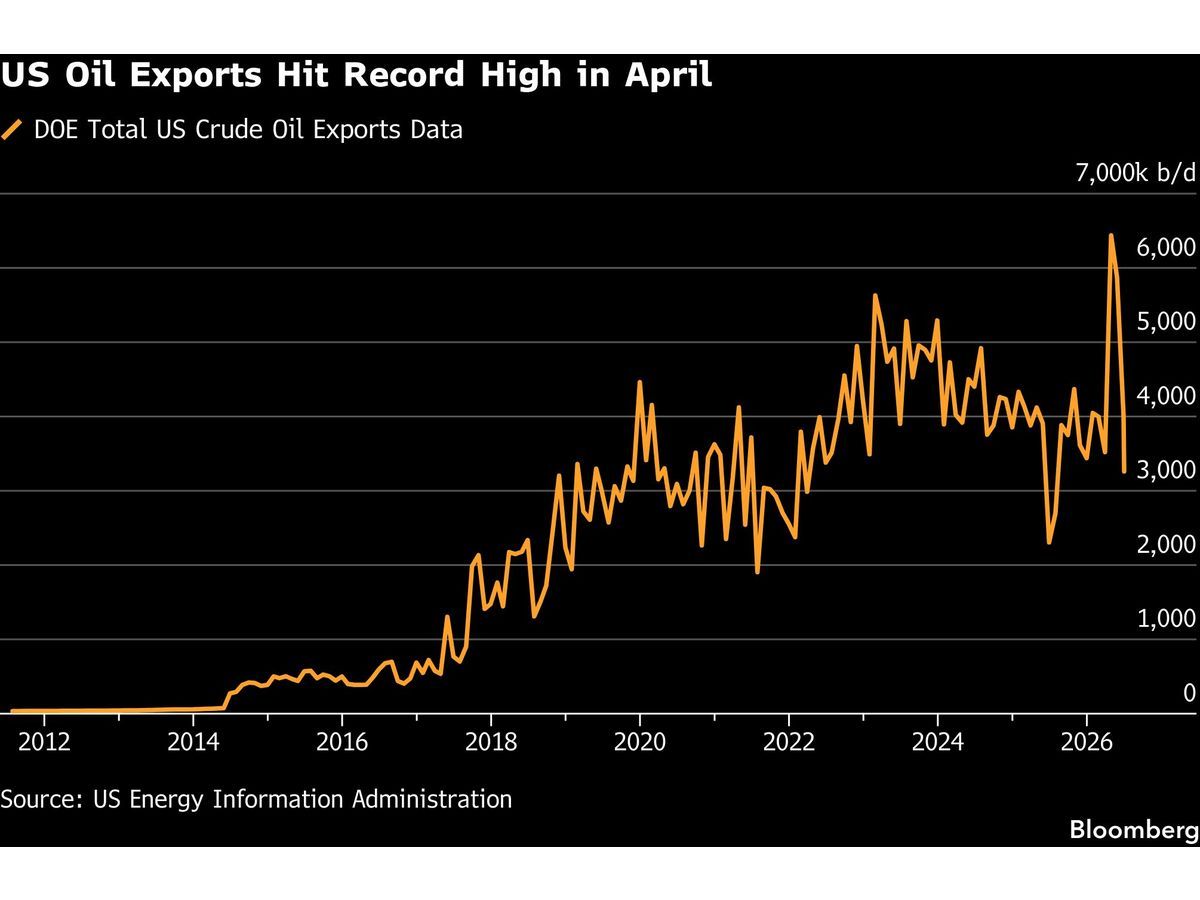
The surge in US crude exports triggered by Iran war disruptions will likely hold above prewar levels, the head of the largest US oil port said. The near-closure of the Strait of Hormuz choked off Mideast crude and sent buyers to American shores. US oil exports hit 6.4 million barrels a day, the highest on record, versus about 4 million a day before the conflict.
“It’s been a nonstop parade of ships past our windows,” Port of Corpus Christi Chief Executive Officer Kent Britton said in an interview with Bloomberg News Tuesday. The port had a record first half of the year for oil and liquefied natural gas cargoes.
The US could export a million barrels a day more than prewar levels, Britton said. Some 400,000 of those daily barrels could leave from Corpus Christi, the remainder from Houston and Louisiana terminals. “There has to be a demand signal. There has to be a supply signal from the big E&Ps who have to say that they’re willing to go fill that need,” he said, referring to oil producers.
“There’s no coincidence to why the president stood in Corpus Christi the day he made a decision to go into Iran,” Port of Corpus Christi Commission Chairman Gabe Guerra said in the interview at Bloomberg News’ Houston bureau.
Conversations about a pipeline connecting Corpus Christi to the oil hub of Cushing, Oklahoma have revived. Cushing is the main conduit for shipping Canadian and Bakken Basin oil to Gulf Coast refineries and export terminals. Britton said the port has been in talks this year about such a pipeline, declining to name the companies involved.
Phillips 66 and Plains All American Pipeline LP previously planned a pipeline on the route. The project was halted after a slow recovery in US oil output following the Covid-19 pandemic. Corpus Christi currently only exports barrels from the Permian and Eagle Ford basins. A Cushing-to-Corpus pipeline would open Permian and Bakken supply to Gulf Coast export terminals, potentially widening the price spread between inland and coastal crude grades.
“If I were building for the future, I would get a pipeline out of Cushing,” Britton said.
The sustained export volumes support the case for midstream infrastructure investment along the Gulf Coast. Phillips 66 and Plains All American Pipeline both have existing exposure to the Corpus Christi corridor, though neither has confirmed new pipeline plans. The two companies previously planned the Cushing connection. A revival would depend on producers committing to higher output levels.
For now, the port is busy. Britton said the pace of shipments shows no sign of slowing. The commodities analysis team tracks these flows as a key indicator of US energy dominance.