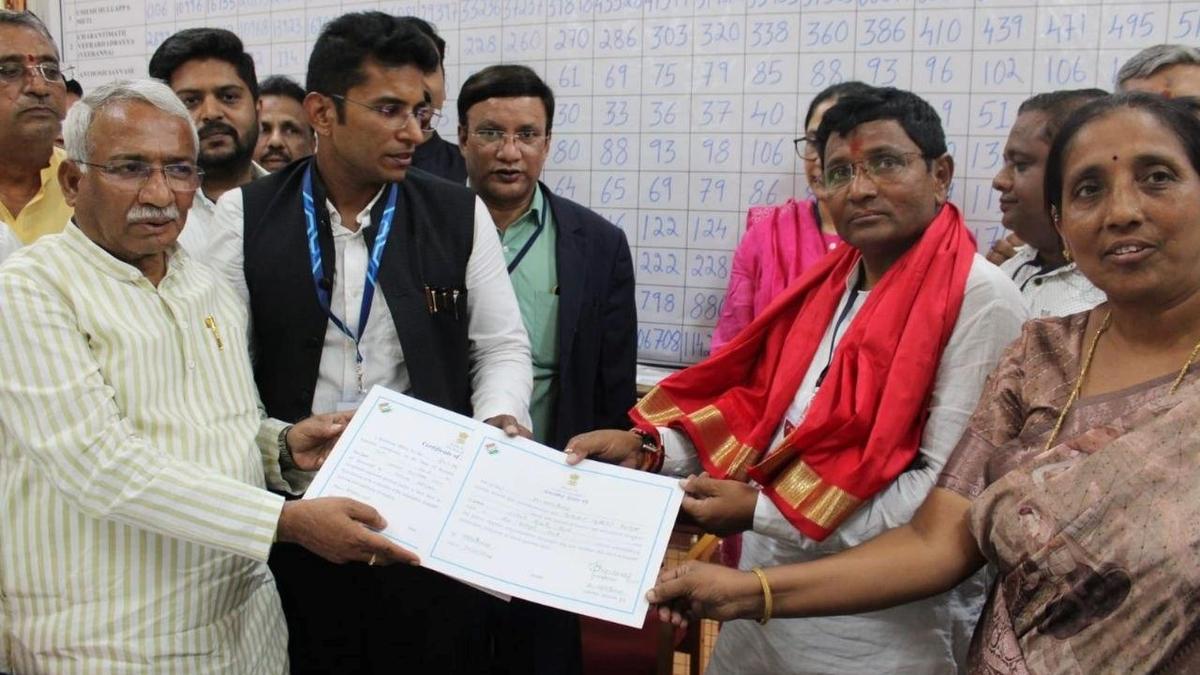
The Indian National Congress has successfully defended its position in Karnataka, securing victories in both the Bagalkot and Davanagere South Assembly constituencies following the April 9 bypolls. These contests, triggered by the passing of senior MLAs H.Y. Meti and Shamanur Shivashankarappa, served as a crucial test for the ruling party’s regional influence and its ability to maintain control over established bastions. While the results provide a morale boost for the party, the underlying data suggests a more complex narrative regarding voter consolidation and the emergence of third-party spoilers.
The Mechanics of the Bagalkot Victory
In Bagalkot, the electoral outcome proved more decisive than in the neighboring constituency. Umesh Meti, the son of the late H.Y. Meti, secured a victory by a margin of 22,332 votes. After 23 rounds of counting, Meti polled 98,919 votes, effectively neutralizing the challenge from the BJP’s Veeranna Charantimath, who finished with 76,587 votes. The voter turnout in this district was recorded at 68.74 percent. This margin indicates a strong retention of the incumbent party’s core support base, likely bolstered by the sympathy factor associated with the late incumbent, a dynamic that often plays a significant role in byelection outcomes where familial succession is involved.
Competitive Pressure in Davanagere South
Conversely, the contest in Davanagere South exposed vulnerabilities within the Congress support structure. Samarth Shamanur Mallikarjun, grandson of the late Shivashankarappa, won by a narrower margin of 5,708 votes. After 24 rounds of counting, Mallikarjun secured 69,578 votes against the BJP’s Srinivasa Dasakariyappa, who garnered 63,870 votes. The presence of the Social Democratic Party of India (SDPI) candidate, Afsar Kodlipete, who secured 18,975 votes, significantly complicated the math. The SDPI’s performance suggests a fragmentation of the traditional support base that the Congress has historically relied upon in this region. With a voter turnout of 68.55 percent, the narrow victory underscores that the party’s hold on this bastion is not as ironclad as historical trends might suggest.
Strategic Implications for Regional Governance
Political analysts have framed these outcomes as a necessary "face-saver" for the Congress. Sandeep Shastri, Vice-President at Nitte University, noted that while the sympathy factor worked in the party’s favor, the narrow margin in Davanagere South indicates that the party made a difficult task out of what should have been a more comfortable win. The split in the support base, evidenced by the SDPI’s vote share, worked to the BJP’s advantage, forcing the Congress to expend significant political capital to retain a seat it already held.
For those tracking stock market analysis and regional political stability, the results highlight a recurring theme in Indian state politics: the reliance on legacy candidates to maintain control in the face of shifting voter loyalties. While the Congress has successfully managed internal contradictions for now, the results serve as a warning that organizational complacency could lead to further erosion of its support base. Harish Ramaswamy, a political analyst, emphasized that the party must now focus on strengthening its organizational structure rather than relying solely on historical bastions. He cautioned that the BJP remains a potent force in regions like coastal and Mumbai-Karnataka, and without sustained groundwork, the Congress risks ceding further ground in future electoral cycles.
Assessing the Path Forward
Ultimately, the retention of these two seats provides the Congress with a temporary reprieve, allowing the government to maintain its current legislative trajectory. However, the electoral data reveals that the party’s dominance is contingent on managing the influence of third-party spoilers and addressing the underlying vulnerabilities that allowed the BJP to remain competitive in a long-time Congress stronghold. The next phase for the party will involve reconciling these local results with broader state-level strategies, particularly as it faces pressure to prove its ideological relevance in an increasingly fragmented political landscape. Investors and observers should look for signs of organizational restructuring in the coming months, as the party attempts to solidify its position before the next major electoral cycle. The ability to convert these narrow wins into a broader, more stable coalition will be the primary indicator of the party's long-term health in Karnataka.