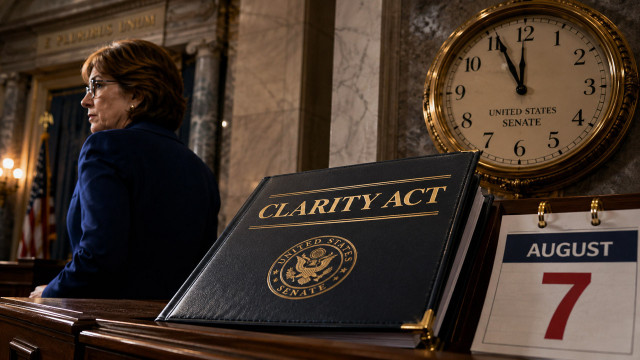
The CLARITY Act missed its July 4 target. The question now is whether Senate leaders can find floor time before the August work period closes.
Stand With Crypto urged supporters to press senators for a vote before August 7, calling that date the hard deadline for passage before the next recess. The Senate returns from its July state work period on July 13. The official schedule lists June 29 through July 10 as a state work period and August 10 through September 11 as another. Friday, August 7 is the final scheduled weekday before that break. For bill managers, the missed July 4 marker turns the question from momentum to compression: can leadership reserve floor time, keep the package intact, and clear the chamber before the fall calendar takes over?
Senator Cynthia Lummis framed CLARITY as more than a crypto bill. She said it was a decision about whether the United States leads the next financial system or watches from the sidelines. The political case is clear; the procedural problem is simpler. Floor time is the condition for a vote in the Senate, and it is never guaranteed.
The bill has already cleared the House. Congress.gov identifies H.R. 3633 as the Digital Asset Market Clarity Act and shows the House passed it 294-134 in July 2025. A House Financial Services Committee summary describes the measure as a digital asset market-structure framework covering exchanges, customer assets, disclosures, and the division of responsibilities between the CFTC and the SEC. The Senate Banking Committee advanced the bill in a bipartisan 15-9 vote, shifting pressure to Senate leadership and the bill's managers, including Banking Chair Tim Scott and crypto-policy senators such as Lummis.
A slip into the fall would matter beyond Capitol Hill timing. Exchanges and token issuers would remain without the federal regulatory map CLARITY is designed to provide. Market-structure planners would still work around unresolved questions over registration pathways, issuer disclosures, customer-asset safeguards, and agency boundaries. Crypto market analysis firms have already begun pricing in the risk of delay.
What would reduce the risk? Senate leadership schedules floor action before August 7, and the bill passes with bipartisan support. That scenario would lock in the market-structure framework and remove one layer of uncertainty for exchanges and token issuers. What would make it worse? No floor action, or a filibuster that pushes the bill into September or later. The fall calendar is crowded with appropriations, budget fights, and election-year politics. A delay past August would likely push the vote to 2027.
Between July 13 and August 7, the test is whether Senate leaders turn political pressure into floor action. The missed July 4 target shifts the story from momentum to compression. For traders tracking regulatory catalysts, that window is the only near-term opportunity for CLARITY to become law. The next key date is August 7. The work begins July 13.