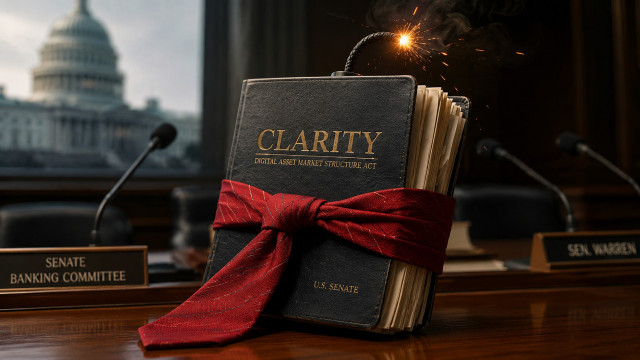
The Senate Banking Committee’s long-awaited CLARITY Act markup, penciled in for next week, is now facing an unexpected fracture point: a fight over whether to impose new ethics restrictions on federal officials and elected leaders who hold or trade crypto assets. The bill’s advocates had hoped the session would finally deliver a comprehensive regulatory framework for digital assets in the United States. Instead, the markup has become entangled in a push to target crypto-linked officeholders – including members of the Trump family – with rules that would ban them from participating in legislative decisions affecting their own holdings.
The simple market read is that any delay to the CLARITY Act is a short-term headwind for crypto prices. The bill is one of the few vehicles with bipartisan support that could define how staking rewards are taxed, how exchanges custody assets, and whether certain tokens should register as securities. If the markup stalls over an ethics amendment, uncertainty lingers longer, and traders who had priced in regulatory progress by the end of the current congressional session may need to unwind those expectations.
The sharper read, however, is that the ethics fight changes the political viability of crypto legislation altogether. The CLARITY Act, along with the GENIUS Act, was seen as carefully calibrated to pass a divided Senate. Injecting a provision that directly affects named political families transforms a technical regulatory bill into a partisan spectacle. Even if the markup proceeds, the addition of an ethics rider could cost votes on the floor, pushing a final vote into the midterm election window – the same timeline explored in our recent analysis of how the 2026 elections could threaten both acts. The sector readthrough here is not simply about a delayed calendar. It is about the risk that a bill designed to deliver clarity instead becomes a permanent bargaining chip.
Ethics fight threatens markup timeline
The precise mechanism of the delay is procedural. The markup is meant to finalise the committee’s version of the bill before it goes to the full Senate. If a contentious ethics amendment is introduced, debate could consume the allotted time, forcing a postponement. The amendment may require lawmakers and senior executive branch officials to divest or recuse themselves from crypto-related policy if they or their immediate family hold digital assets. While proponents frame it as a good-governance measure, critics inside the committee view it as a poison pill aimed at making the bill toxic for the very administration that would need to implement it.
From a market structure perspective, the Senate Banking Committee is the single most important chokepoint for U.S. crypto regulation. A stalled markup there freezes everything downstream: SEC rulemaking tied to the act, CFTC jurisdictional clarifications, and the safe harbour provisions that exchanges and DeFi protocols have been awaiting. The immediate casualty is the “regulatory certainty” premium that had started to build in assets like Ethereum (ETH), whose staking yield has been the subject of specific tax language in early CLARITY Act drafts.
Token-level readthrough: staking and exchange tokens in limbo
The readthrough is most direct for protocols that derive value from yield generated on-chain and for exchange tokens that depend on a clear U.S. licensing path. If the markup fails to deliver a committee-passed bill, the default assumption returns to one where proof-of-stake rewards remain in a grey zone and U.S.-domiciled exchanges continue to operate under a patchwork of state money transmitter licences. That uncertainty benefits short-volatility strategies, but it squeezes the long-duration positions that had been building around a legislative breakthrough.
Ether and similar proof-of-stake tokens could see a retracement of the relative outperformance they’ve logged in recent weeks, as traders who bought the legislative catalyst look to de-risk. Exchange-native tokens face a similar dynamic: a functioning U.S. regulatory perimeter would allow platforms to list more assets and expand derivative offerings, directly affecting token economics. Without that perimeter, the growth narrative dims, and the sector’s beta to Bitcoin rises, reducing the diversification case that had attracted macro allocators.
What makes this episode different from previous legislative disappointments is the political signal. When a bill stalls over lobbying or jurisdictional disputes, the market can treat it as a temporary setback. When it stalls because of a fight over the personal financial interests of elected officials and their families, the entire process appears contaminated. That perception matters for institutional flows that are already cautious about stepping into an unregulated market. The broader crypto equity and token universe tends to reprice regulatory risk aggressively when the legislative path narrows, and a failed markup would narrow it considerably.
What happens next depends on whether the committee chair can keep the bill clean. The moment an ethics amendment gains a second, the markup becomes a vote on the Trump family’s crypto dealings, not on stablecoin reserves or exchange custody rules. Watch for statements from the ranking member’s office in the next 72 hours. If the tone is combative, the smart trade is to fade the legislative-premium bid that’s been quietly building across staking-sensitive tokens and exchange names.