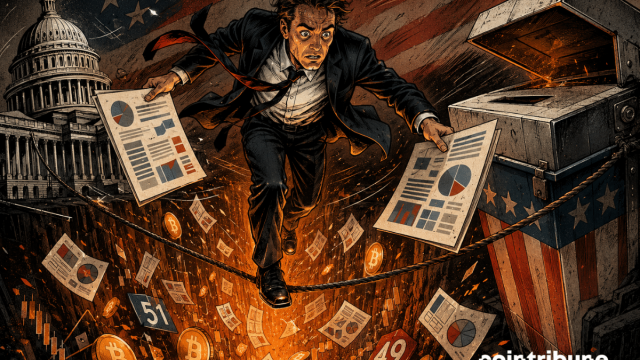
The 2026 midterm elections are shaping up as the event that can validate or vaporize the first real legislative wins for the U.S. crypto industry. After years of regulatory ambiguity, the GENIUS Act and the advancing CLARITY Act have given the sector a temporary anchor. But that anchor will only hold if the political map that enabled it survives November’s vote. That is the warning delivered this week by Jesse Spiro, head of government affairs at Tether, at Consensus Miami 2026: the midterms will be the key test for whether recent political support endures under a new Congress.
The simple read says crypto finally has its federal framework, and the market can now price in a mature regulatory environment. The better read recognizes that every piece of that framework is contingent on an election that can flip committee chairs, stall bills, and reverse priorities. The asset class is no longer just a market matter. It has become an electoral issue, and the window to convert campaign rhetoric into permanent code is dangerously narrow.
The Midterms as a Policy Gatekeeper
The immediate danger is not that voters reject crypto but that the structural churn of the U.S. legislative calendar swallows it. The GENIUS Act, signed into law in July 2025, created the first federal framework for dollar-backed stablecoins and gave the industry an institutional passport. That bill is now law, but it exists in isolation. The CLARITY Act, which aims to delineate the roles of the SEC and CFTC and define how crypto platforms must register, is still in motion. Its timeline is compressed: a Senate banking committee vote is expected in May, a short legislative window opens in June, and the White House is targeting adoption around July 4, 2026.
If the midterms break the current majority or produce a fragmented Congress, bills in mid-flight get stranded. Committee assignments rotate, priority lists get rewritten, and the political appetite for technology-friendly legislation can disappear overnight. Even a bill that has cleared a committee can die on the calendar if leadership changes. That is the core structural risk: crypto’s progress is real but not yet locked into law.
The Two Acts and the Fight Over Stablecoin Returns
The GENIUS Act gave stablecoins a legal on-ramp, but the CLARITY Act will determine how most digital assets are classified and traded. The most contentious detail is returns on stablecoins. A compromise is emerging that would ban yield structures resembling bank interest–the kind that looks like a deposit account–while preserving certain usage-reward programs that platforms argue are essential for user adoption. Banks insist this is too permissive. Crypto firms say it is the minimum viable framework to keep stablecoins functional.
For traders, the stakes are tangible. The CLARITY Act’s outcome will directly affect the liquidity and design of stablecoin products, stablecoin-backed lending, and the tokenization pipeline that depends on a clear legal wrapper. If the bill stalls after November’s election, the current wave of tokenization projects will spend another cycle in a legal gray zone, raising execution risk and delaying institutional entry. Stablecoins that depend on reward mechanisms to attract liquidity would face an uncertain path, and trading desks that have built strategies around composable stablecoin yields would need to re-evaluate those positions.
Prediction Markets and the ETF Freeze: A Political Flashpoint
Prediction markets add a layer that complicates the entire regulatory push. These platforms fascinate investors because they convert real-world events into priced probabilities, turning political races, economic data, and even corporate layoffs into tradeable assets. But they also blur the line between information, speculation, and betting, awakening a regulatory and political imagination that is far less forgiving than the one attached to payments or capital markets plumbing.
The SEC’s recent decision to delay the launch of more than two dozen exchange-traded funds linked to real events–elections, recessions, tech layoffs–shows that Washington is not opening all floodgates simultaneously. That caution is understandable from a market-integrity standpoint, but it also creates a political vulnerability. Stablecoins can be defended as payment infrastructure. Tokenization can be sold as a modernization of market plumbing. Prediction markets are harder to sell, and opponents will use them to paint the entire crypto agenda as a push for unfettered gambling.
The ETF delay is therefore not just a procedural speed bump. It is a signal that one of the industry’s most innovative verticals is also its most politically fragile. If the midterms produce a Congress less willing to distinguish between different crypto use cases, that fragility could spread to other parts of the agenda, making the entire legislative package harder to defend.
How the Political Calendar Reshapes Crypto Risk
The sequencing matters. The CLARITY Act must pass before the midterm campaign consumes all available legislative bandwidth. A July 4 adoption would create a fait accompli that a new Congress would be less likely to unwind immediately. It would also give regulators clear statutory authority, insulating rulemaking from the charge that unelected agencies are legislating by enforcement.
For active market participants, the midterms represent a binary catalyst that the market is not yet fully pricing. Crypto equities and tokens with heavy U.S. regulatory exposure carry an embedded premium for the expectation of legal certainty. If that certainty fails to materialize, the unwind could be sharp. If it does materialize, the repricing of those assets could accelerate. The direction of that binary will be known by the composition of the Senate banking committee in January 2027. If the committee flips, even an enacted CLARITY Act can be slow-walked on implementation through hearings, budget pressure, and interpretive guidance. A clean majority outcome that preserves the current direction would reduce the risk premium on U.S.-facing crypto assets.
As discussed in our crypto market analysis, regulatory momentum has been a primary driver of altcoin rotation this cycle. The midterms, therefore, are not a secondary political sideshow. They are the event that will either validate the legal infrastructure that has been priced into this rally or force a sharp re-evaluation of that thesis.
What Would Reduce the Risk
For the crypto legislative push to survive the midterms, two conditions must be met. First, the CLARITY Act must become law before the election cycle consumes remaining legislative days. The time between a likely May committee vote and the summer recess is measured in weeks, not months, and any delay beyond July risks the bill becoming a midterm campaign talking point rather than enacted law. Second, the industry’s narrative must shift from a handout to a framework. Supervised stablecoins, transparent markets, and innovation repatriated to the United States are messages that can survive a politically mixed environment. A narrative built on campaign contributions and access money will become a liability the moment the electorate shifts.
A concrete monitor: watch the margin and leadership outcomes of the Senate banking committee races. If a chairmanship change appears probable before November, the risk premium on U.S.-facing crypto names should widen, regardless of any apparent progress in committee votes.
What Would Magnify the Danger
A fragmented Congress would do more than pause bills. It would invite a season of regulatory infighting. The SEC and CFTC, already navigating an uneasy truce under the anticipated CLARITY Act framework, would face new political pressure to slow-walk rulemaking, leaving the industry in prolonged limbo. The ETF delay already hints at that dynamic: an agency that senses political sensitivity in real-world event products is more likely to pull back, not lean forward, under divided government.
Beyond Washington, the signal that U.S. crypto regulation has stalled again would push more innovation offshore, reversing one of the key selling points of the recent policy shift. That would weigh on the valuation of U.S.-listed crypto exchanges, token issuers, and stablecoin operators. The offshore drift would be gradual but unmistakable, beginning with liquidity migrations and ending with new protocol launches deliberately excluding U.S. touchpoints.
For traditional financial services firms with digital-asset exposure, the calculus is similar. AlphaScala’s Alpha Score for ING (ING) stands at 75, indicating a Strong profile. A favorable, durable crypto framework would add a growth layer to the bank’s digital-asset initiatives. A stalled or fragmented outcome would remove that optionality, capping the upside from what was starting to look like a multi-year tailwind. ING stock page
The 2026 midterms are not a background event for crypto markets. They are the event that will determine whether the GENIUS Act becomes a durable pillar or an anomaly, and whether the CLARITY Act becomes law or a missed window that defines the next cycle of U.S. crypto regulation.