Stocks● Neutral
CJP's Jantar Mantar Protest Tests India's Political Risk Premium
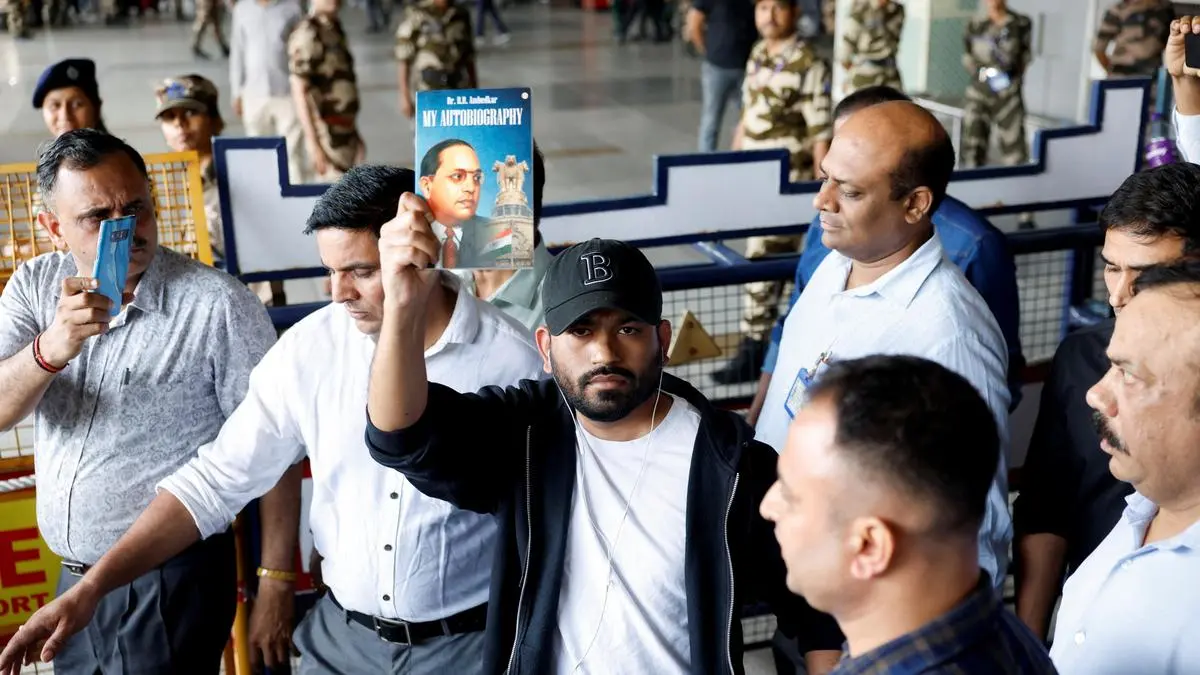
CJP's founder arrives in Delhi for Jantar Mantar protest over exam irregularities. With 1,000+ police deployed and Wangchuk's fast threat, we break down the sector exposure, the three confirmation triggers, and the options hedge that works either way.
Continue with
The Jantar Mantar Catalyst Arrives
Abhijeet Dipke, founder of the Cockroach Janta Party (CJP) , landed in New Delhi on Saturday for the group’s first major on-ground demonstration at Jantar Mantar. The protest targets alleged irregularities in examinations including NEET, CBSE, CUET, and SSC recruitment tests, and demands the resignation of Union Education Minister Dharmendra Pradhan. Dipke called on supporters to carry a book and the national flag, and to offer flowers to police personnel as a “gesture of compassion and gratitude.” Activist Sonam Wangchuk warned he would begin a six-week fast if Dipke is arrested.
For a trader screening Indian equities, the immediate question is whether this event becomes a volatility catalyst or a non-event that fades into the background noise. The answer depends on two variables: the scale of turnout and the tone of police response.
The Simple Read: Headline Risk Fades or Spikes
A naive interpretation scans the wire and concludes: peaceful protest equals no market impact; arrests and confrontation equal a risk-off move into defensives. That framing is too coarse. It treats every protest as identical and ignores the transmission mechanism from a social media movement to portfolio positioning.
The Better Read: The Exposure Runs Through Education and Consumption
The CJP movement targets the credibility of centralised examination boards. If the protest escalates and triggers a sustained political debate on exam integrity, the first-order consequences hit edtech stocks, test-prep firms, and government-linked education contractors. The second-order effect runs to consumer discretionary names if the unrest broadens into a general strike or campus closures in major cities. A trader needs to map exposure by three layers: direct sector, supply-chain labor disruption, and currency risk if foreign portfolio investors begin pricing in political instability.
Security forces have deployed more than 1,000 personnel across New Delhi, including at the airport, border entry points, and sensitive locations. Police said they received no formal permission request for the demonstration but acted on social media intelligence. That imbalance–a movement broadcasting its plan openly yet bypassing official channels–is a risk for anyone short volatility or long small-cap Indian names.
What the Security Setup Means for Positioning
The heavy police presence creates a double-edged scenario. A visible but peaceful crowd interacting with flowers and flags would validate Dipke’s “love and peace” framing and reduce political risk premia. A sudden enforcement action, by contrast, would be interpreted as a hardline signal, especially if Wangchuk’s six-week fast begins. Wangchuk is a known activist with cross-movement credibility; his involvement raises the protest’s profile and makes a non-escalation outcome harder.
Practical rule: when a single activist threatens a indefinite fast, the event’s tail risk duration extends across weeks, not days. Position sizing for Indian equities should account for a potential multi-week headline cycle.
The Mechanism of Social Media–Driven Market Moves
The CJP is a youth-led online movement that gained momentum through examination-result grievances. Unlike traditional union-led protests, its coordination relies on platforms like X, where Dipke posted his Jantar Mantar call. This changes the risk calculus for investors.
Why First-Touch Models Mislead
Standard event-risk models use police-permit timelines and strike-domain precedents. A movement with a diffuse online base and no formal organisational tree can scale faster than permit-based predictions. Trapped long positions in names tied to government education contracts would have a truncated reaction window if the protest turns violent.
The Activation Sequence to Track
A trader looking at this setup needs a three-step confirmation filter:
Step 1 – Crowd Sizing: Yesterday’s or today’s turnout at Jantar Mantar. Reports of more than a few thousand with no incidents tilts toward risk-off fade. A crowd in the tens of thousands with flowers and flag already signals sustained momentum.
Step 2 – Supply Chain Pinch: If the protest blocks traffic in central Delhi for more than six hours, it hits delivery-based businesses, quick-commerce platforms, and Zomato/Swiggy-type logistics. That is the second-order trigger.
Step 3 – Arrest or Fast: Dipke’s detention or Wangchuk’s announced start of a fast converts the protest from a one-day event to a sustained political story. That changes the time horizon for risk premia and may force portfolio rebalancing.