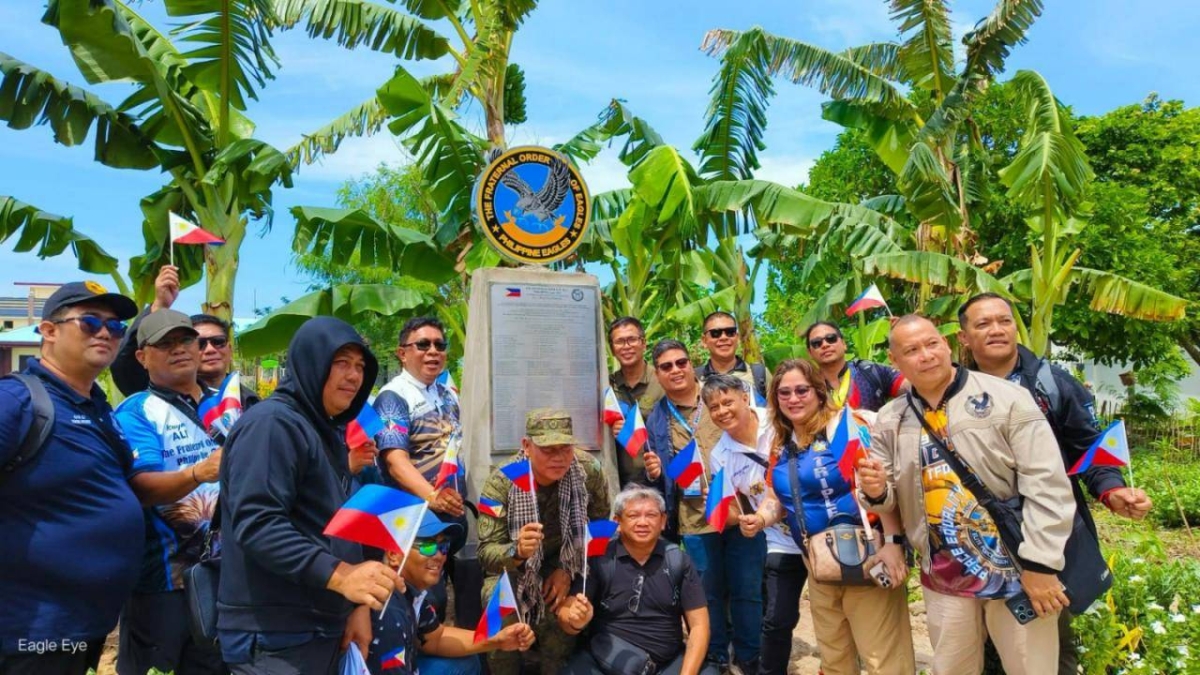
A Manila-based civic organization installed what it calls the first permanent marker by a non-military group on Pag-asa Island in the West Philippine Sea on Friday. The Fraternal Order of Eagles–Philippine Eagles Inc. (TFOE-PE) delivered nearly P1.2 million in donations alongside the marker. The package included 40 Android tablets valued at roughly P1 million, plus P200,000 in school supplies, recreational materials, and medical equipment. Mission leader Joseph Jocson said the installation was a first for any civilian organization on the island.
Practical rule: When a non-state actor places a permanent sovereign marker in a disputed territory, the event shifts the dispute from a state-to-state framework to a civil-society frame that is harder for an adversary to ignore without overreacting.
Why a Civilian Marker Changes the Sovereignty Game
The simple read is that a civic group visited a remote Philippine outpost, gave away tablets, and planted a sign. The better market read examines the mechanism of sovereignty signaling. Until now, markers on Pag-asa Island have been exclusively military or government-placed. A civilian marker introduces a different category of claim: one that can be presented as a popular, non-state assertion of jurisdiction. That distinction matters because it complicates any adversary's response calculus. A military response to a military marker fits within established rules of escalation. A military response to a civic group's marker carries a much higher diplomatic and reputational cost.
Kalayaan Island Vice Mayor Maurice Philip Alexis Albayda confirmed the feat, noting that previous groups had expressed interest but failed due to the island's formidable logistical barriers. "There were those who signified they also wanted to put up a marker. We all know it's not that easy," he said. The Philippine Air Force allotted the group about three hours on the island, within which they completed the marker unveiling and the donation turnover.
How the Delivery Mechanism Matters
The marker was constructed by local Pag-asa residents, providing them with livelihood income in the process. That detail turns the marker from a symbolic object into an economic entanglement. Residents who earned income from building it now have a material stake in its continued presence. The Armed Forces of the Philippines (AFP) facilitated the transport via C-130 to Puerto Princesa City for refueling, then a C295 aircraft to the island. Without military aircraft, Jocson noted, the trip required a two- to three-day boat voyage. "It's extremely far," he said.
Pag-asa Island: The Asset on the Ground
Pag-asa Island, also known as Thitu, is the largest Philippine-occupied island in the disputed Spratly archipelago. Its airstrip, school, and small civilian population make it the most developed of the Philippine outposts. The island hosts a school, a clinic, and a government center – the institutional infrastructure of a functioning municipality. That infrastructure is what makes civilian marker placement possible. Other Philippine-occupied features in the Spratlys are smaller reef-based structures without resident populations. Those locations cannot easily host a marker-unveiling ceremony with civilian participation.
The Surveillance Variable
The island falls inside Manila's Exclusive Economic Zone (EEZ) and within the nine-dash line claimed by Beijing. Chinese vessels, including coast guard and fishery patrol ships, regularly operate within visible range. The three-hour window the AFP allotted reflects the operational reality that a longer civilian stay increases the probability of interaction with Chinese assets. Any future civilian group attempting a similar mission will confront the same constraint.
Who Is Exposed: Philippine Firms With West Philippine Sea Exposure
This event does not directly move a stock. It provides a sovereignty-risk vector for companies operating in or near the disputed area. The companies with the clearest exposure fall into three categories:
A sustained civilian marker campaign would raise the salience of territorial disputes in Manila's policy discussions. Higher salience typically leads to higher defense spending, tighter vessel-tracking requirements, and more conservative navigation protocols for commercial vessels transiting near the Spratlys.
The Execution Risk for Logistics Providers
Any logistics firm that supplies the island outposts – whether via military contract or civilian charter – faces an indirect execution risk. An escalation that leads to a temporary naval standoff or increased patrol density would delay resupply schedules. The three-hour window constraint already exists. A tighter constraint would compress delivery windows further.
What Would Confirm or Weaken the Thesis
What confirms the thesis that sovereignty risk is rising:
- Philippine government announcement of a regular civilian marker program across occupied features
- Chinese diplomatic protest specifically naming the civic organization (as distinct from a generic protest against Philippine occupation)
- Philippine defense budget line item increase for island civilian infrastructure
- A second civic group announcing a marker mission within six months
What weakens the thesis:
- The marker disappears or is removed by local authorities without replacement
- TFOE-PE states publicly that this is a one-time project with no follow-up
- Philippine military tightens restrictions on civil-society access to zero
Risk to watch: The marker's durability. If it remains in place for 12 months without incident, it becomes a precedent that lowers the barrier for the next civilian group. If it is removed or damaged quickly, the precedent collapses.
What a Reader Should Track Next
The next catalyst is any official reaction from Beijing or Manila. A Chinese Foreign Ministry statement that singles out the civic organization by name rather than making a general sovereignty claim would indicate that Beijing perceives the civilian-marker mechanism as a meaningful escalation. A Philippine Department of Foreign Affairs statement supporting the initiative would provide cover for additional groups. The absence of either reaction within 30 days suggests the event stays at the symbolic level.
For readers tracking the Spratlys risk index, the key metric is not the number of markers. It is the frequency of civilian access. If one group lands every six months, the risk profile does not change. If that frequency rises to quarterly or monthly, the probability of a kinetic interaction increases. The AFP's logistical capacity – specifically, how many civilian groups it can transport to the island per quarter – is the binding constraint.
A final note on the donation component: Android tablets and school supplies create a constituency on the island that benefits from civilian engagement. That constituency makes it politically harder for Manila to restrict future access. The TFOE-PE mission was not just a sovereignty play. It was also an economic-entanglement play. Readers should watch whether future civic groups replicate the donation model, because that is the mechanism that builds local support for repeated access.