Stocks● Neutral
Citadel interns on the return-offer playbook: ask questions, skip perfection
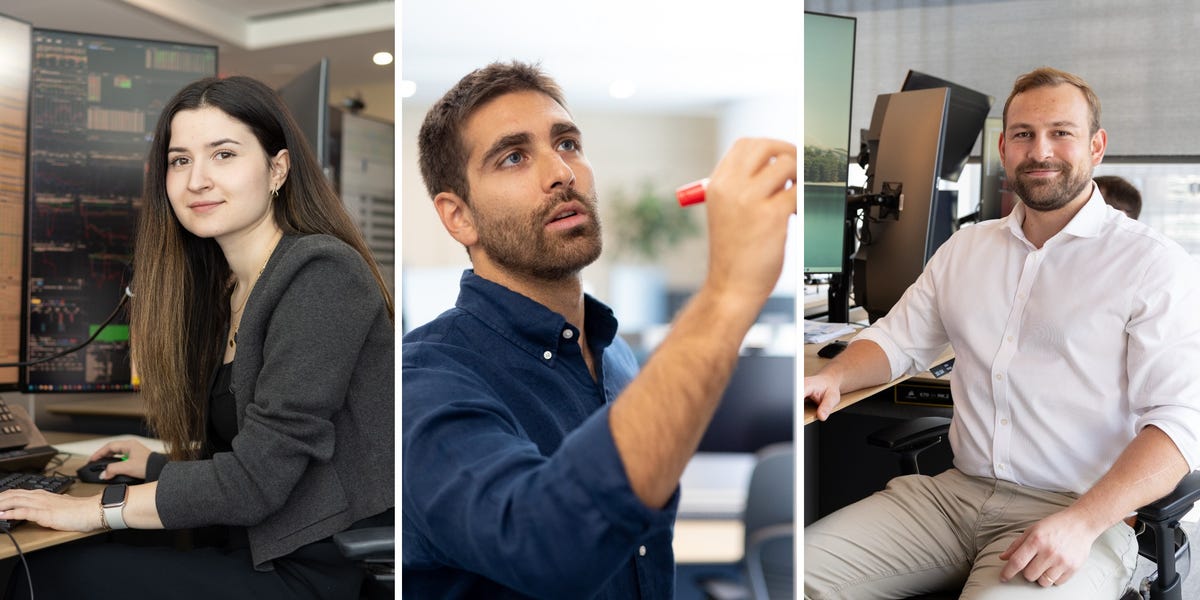
Five former interns at Citadel and Citadel Securities share how they landed jobs, earned return offers, and what separates top performers from the rest of the 0.36%.
Continue with
For the 0.36% of applicants who landed a summer internship at Citadel and Citadel Securities, the return-offer push is on. For those who come back, the next test is standing out inside a firm that cherry-picks from the world's top math, engineering, and finance programs.
Ken Griffin's companies treat campus hires as a strategic investment, not a pipeline to fill seats. Internal reviews show these recruits are roughly twice as likely to eventually rank as top performers. Some of the firms' most senior leaders started as interns or fresh graduates – Citadel Securities CEO Peng Zhao joined straight out of graduate school, and Citadel COO Gerald Beeson was an intern in 1993.
Business Insider spoke to five former interns and campus hires – three quantitative researchers, one engineer, and one trader – about how they got in, moved up, and what they tell the youngest class.
When Haris Nair was a software engineering intern on Citadel Securities' commodities trading desk in 2017, a trader showed him the volume the firm had traded based on his strategy. Nair does not remember the number. He remembers being "completely blown away."
Eight years later, Nair, 30, manages a global team of 10 engineers on the research platform team, working alongside quantitative researchers to speed up their market analysis. He moved from Chicago to Miami along the way. His advice to interns: focus on projects that matter to the business, not small fixes, and use the firm's non-hierarchical structure to tackle big problems.
"Everybody we hire is technically brilliant. Everybody's a very hard worker. Those are never the real differentiators," he said. "Do they find opportunities to improve the platform and capitalize on them? Do they have the initiative to identify their own problems and then go solve them?"
Tanya Otsetarova first heard about Citadel Securities as a senior in high school in Bulgaria, competing in international math competitions. By the time she reached Stanford, other students called it the "most educational" internship. She applied for the 2022 summer cohort.
Otsetarova, now 26 and a trader on the semi-systematic options team in Miami, said she was scared at first. Everyone seemed smarter. The firm felt intimidating.
"Not asking enough questions during the first few weeks of my internship was honestly my biggest mistake," she said. "If you're not an expert in the field yet, you just don't know enough. If you don't ask questions, you get stuck. You waste time and you don't learn."
As an intern, she was assigned a long-term project and made more progress than expected. The firm eventually changed its pricing strategy for options based on her work. Technical output alone did not earn her the return offer.
"Technology changes and the business can change, what you really need is a strong problem-solving ability," she said. "Being genuinely curious about every aspect of the business, why we're solving the problems we're solving."
Otsetarova now manages a team of traders and serves as a desk manager for interns – fewer than five years after she was in their position. When they stop by her desk, which is covered in board games and a giant stuffed flamingo, they usually want to talk about the fundamentals of options trading.
Jonas Metzger, 31, joined as a quantitative researcher in spring 2025 after a PhD and postdoc in economics and computer science at Stanford. He had not thought much about markets before. On his first week, he asked what a hedge fund actually does.