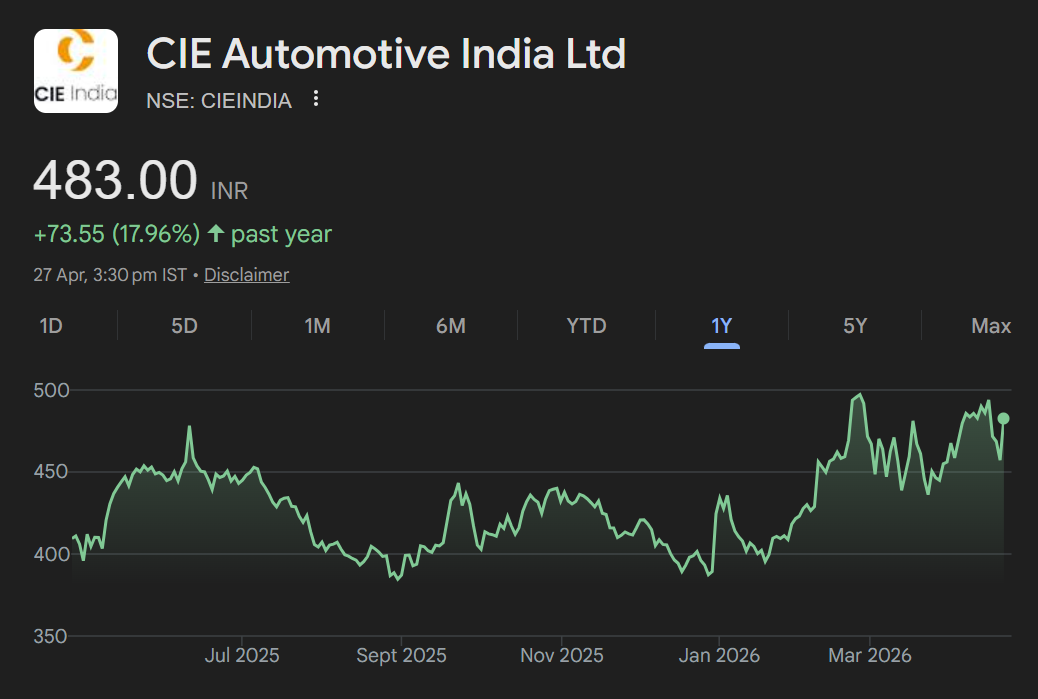
CIE Automotive India has shifted its operational narrative toward a concentrated focus on domestic capacity expansion, positioning itself to capture shifting demand across the passenger vehicle and light commercial vehicle segments. The company currently derives 53% of its sales from these sectors, with additional exposure to two-wheelers at 23%, commercial vehicles at 11%, and the off-highway tractor segment. This structural footprint makes the firm a direct proxy for the health of the Indian automotive manufacturing cycle.
Capacity Scaling and Segment Diversification
The core of the current growth thesis rests on the company's ability to scale production facilities to meet localized demand. By optimizing its manufacturing presence in India, CIE Automotive India is attempting to mitigate the volatility often seen in European automotive markets. The firm maintains a balanced portfolio that hedges against single-segment downturns by spreading its production capabilities across diverse vehicle classes. This diversification is intended to provide a buffer against cyclical shifts in the two-wheeler and heavy commercial vehicle markets.
Management is prioritizing capital expenditure to ensure that its Indian operations can support higher volume throughput. The strategy relies on the assumption that domestic original equipment manufacturers will continue to prioritize local sourcing to reduce supply chain dependencies. If these capacity additions align with the projected production schedules of major domestic automotive players, the firm stands to gain significant market share in the component supply chain.
Sectoral Read-Through and Valuation Context
The automotive component sector in India is currently navigating a transition toward higher value-added parts. Companies that can demonstrate consistent margin expansion through operational efficiency are increasingly favored over those reliant solely on volume growth. CIE Automotive India is attempting to position itself within this group by focusing on high-margin segments within the passenger vehicle category.
Market participants are evaluating whether the company can maintain its current growth trajectory without incurring excessive debt to fund its expansion. The reliance on the Indian domestic market serves as a hedge against global economic headwinds, though it leaves the firm susceptible to local interest rate fluctuations and consumer spending patterns. Investors often compare such domestic-focused manufacturers against broader consumer-facing entities. For instance, while firms like TGT operate within the consumer staples sector with a moderate Alpha Score of 70/100, CIE Automotive India remains in the consumer cyclical category, where demand is more sensitive to the broader economic cycle.
The Path to Operational Realization
The next concrete marker for the company will be the upcoming quarterly production report, which will serve as the first test of whether the new capacity is translating into higher revenue. Investors should monitor the utilization rates of the newly commissioned plants. Any delay in reaching optimal production levels would likely force a reassessment of the company's growth timeline. Furthermore, the firm's ability to maintain its current pricing power in the face of rising raw material costs will be a critical indicator of its competitive strength. The market will look for confirmation that the expansion is not merely increasing top-line figures but is also contributing to sustainable margin improvement.