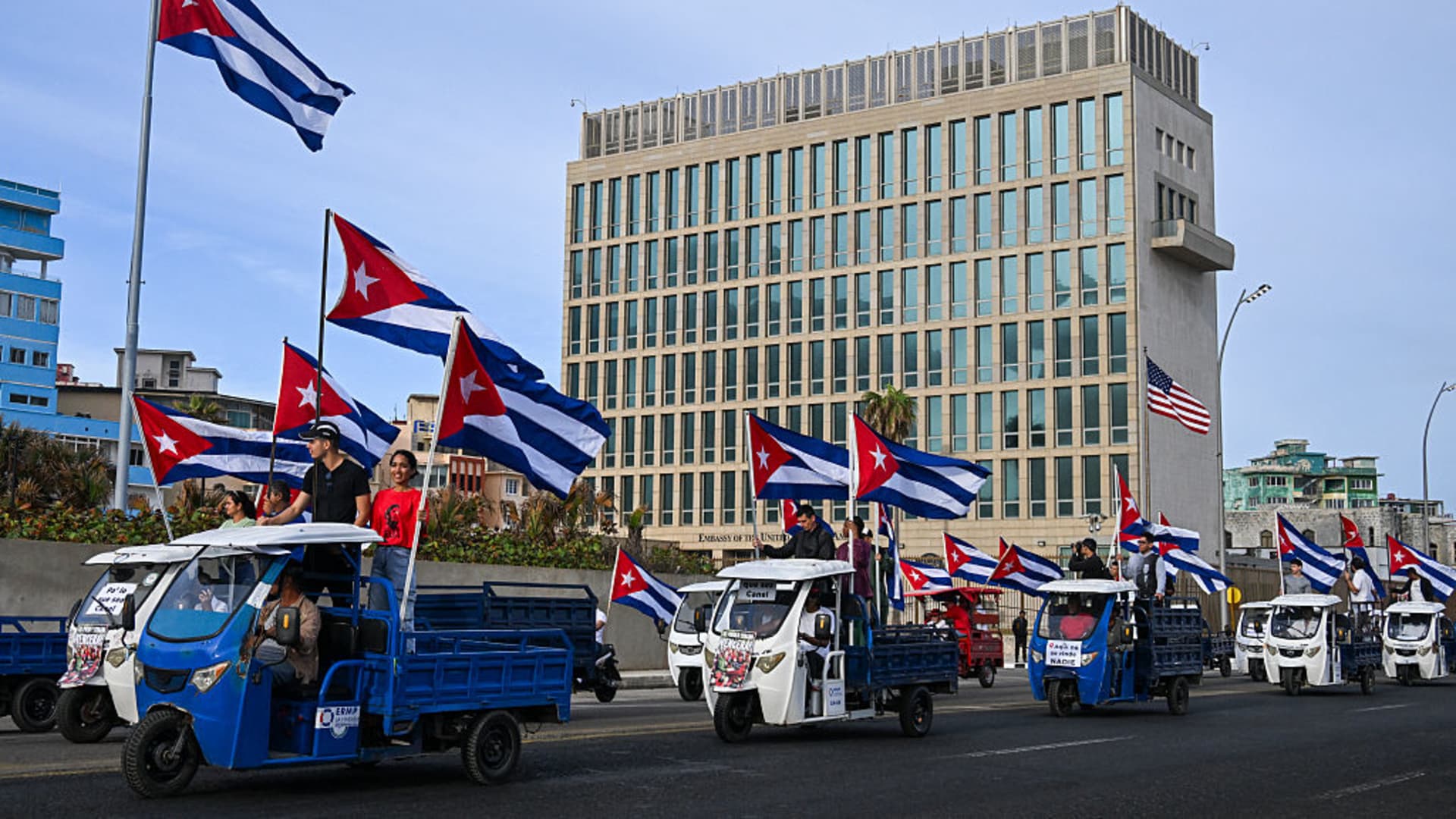
U.S. offers $100M aid for reforms as military flights and an oil blockade push Cuba's energy crisis to a breaking point. Next catalyst: Havana's response.
CIA director John Ratcliffe made a rare visit to Havana on Thursday, carrying a message that Washington would "seriously engage" with Cuba only if the communist government makes "fundamental changes." The trip, only the second by a CIA chief since the 1959 revolution, lands as the island's energy crisis reaches a breaking point: 22-hour blackouts are now routine, and the energy minister confirmed Wednesday that the country has zero reserves of fuel oil and diesel.
The sequence of events sharpens a geopolitical risk event for energy markets that has been building since early January, when a U.S. military operation to remove Venezuelan President Nicolás Maduro effectively severed Cuba's main oil supply line. The Trump administration has since tightened sanctions on Cuban officials and organizations, while the U.S. military has flown dozens of intelligence-gathering missions near Cuba's largest cities since February.
For traders, the immediate question is not whether Cuba's energy collapse will move global crude prices on its own. The island's consumption is too small. The risk is that a prolonged blockade, combined with escalating U.S. pressure and domestic unrest, creates a second-order supply disruption or a geopolitical premium that spills into the broader Caribbean basin and Venezuelan oil flows.
Ratcliffe delivered his message directly to top Cuban lawmakers, according to Reuters. The offer of engagement is conditional on political reform, a stance the administration has reinforced with both sanctions and a public aid proposal.
The CIA posted photos of Ratcliffe in Havana on social media without context, and CNBC's request for comment went unanswered. The visit itself signals that the administration is elevating Cuba as a priority theater, potentially alongside Iran.
The Cuban government's readout of the meeting struck a different tone, emphasizing law-enforcement cooperation rather than political conditions.
This framing suggests Havana is trying to decouple security dialogue from the demand for systemic change, a position that may limit how quickly any aid-for-reform deal materializes.
Cuba had been heavily dependent on oil imports from Venezuela. That flow stopped after the U.S. operation aimed at removing Maduro. The blockade has since been reinforced by fresh sanctions on Cuban officials and organizations, leaving the island without its primary source of crude and refined products.
The cutoff is not a formal naval blockade; it is a combination of sanctions, financial pressure, and the disruption of Venezuela's ability to ship oil. The practical effect is the same: Cuba's refineries and power plants have run dry.
On Wednesday, Energy Minister Vicente de la O Levy told state media that the country had exhausted its fuel oil and diesel supplies and held no reserves. The admission removes any ambiguity about the severity of the crisis. Blackouts lasting up to 22 hours a day have triggered protests in Havana, adding a domestic stability risk to the geopolitical equation.
The energy collapse also raises the cost of any future recovery. Restarting idle power plants after a prolonged shutdown is not a simple matter of refilling tanks; it requires maintenance, spare parts, and technical personnel, all of which are scarce under sanctions.
CNN reported that the U.S. military has conducted dozens of intelligence-gathering flights near Cuba's biggest cities since February. The flights, combined with the CIA director's visit, suggest a pattern of increased surveillance and operational preparation. The Trump administration has labeled Cuba's government "an unusual and extraordinary threat," a designation that could justify further action once the Iran conflict concludes.
For energy markets, the concern is not a direct military confrontation. The worry is the potential for miscalculation or escalation that disrupts shipping lanes or Venezuelan oil exports. The Caribbean is a transit route for crude and refined products, and any instability raises insurance costs and freight rates.
The U.S. State Department said Wednesday it was willing to provide $100 million in aid to Cuba, framing the offer as a test of the regime's accountability.
The aid offer creates a binary catalyst: if Cuba accepts, it could ease the humanitarian crisis and reduce the risk of uncontrolled instability. If Havana rejects the conditions, the blockade tightens, and the risk of a disorderly collapse rises.
The most direct path to de-escalation is Cuban acceptance of the U.S. aid offer, which would require at least a symbolic move toward political reform. Even a partial easing of sanctions on energy imports would allow Cuba to replenish fuel stocks and restore power generation, reducing the immediate risk of social unrest and the associated geopolitical premium.
A secondary path is a broader U.S.-Venezuela deal that restores some oil flows to Cuba. That scenario appears distant, given the administration's posture toward Maduro. It cannot be ruled out if the humanitarian cost becomes a political liability.
If the blockade persists and Cuba refuses the reform conditions, the energy crisis will deepen. Zero reserves mean any additional supply disruption, even a minor one, would extend blackouts further. Protests could escalate, and a heavy-handed government response would invite more sanctions, creating a feedback loop that raises the risk of a sudden, chaotic event.
For commodity traders, the key variable is not Cuba's domestic consumption. It is the contagion risk to Venezuelan oil exports and Caribbean shipping. A destabilized Cuba could become a platform for irregular migration or maritime incidents that disrupt tanker routes. The U.S. military flights and the CIA visit suggest Washington is preparing for a range of outcomes, and that preparation itself adds a risk premium that is not yet priced into crude oil.
Risk to watch: A formal U.S. designation of Cuba as a state sponsor of terrorism or additional sanctions on shipping companies that deliver oil to the island would be a material escalation, directly affecting the physical oil market and the cost of moving barrels through the region.
Prepared with AlphaScala research tooling and grounded in primary market data: live prices, fundamentals, SEC filings, hedge-fund holdings, and insider activity. Each story is checked against AlphaScala publishing rules before release. Educational coverage, not personalized advice.