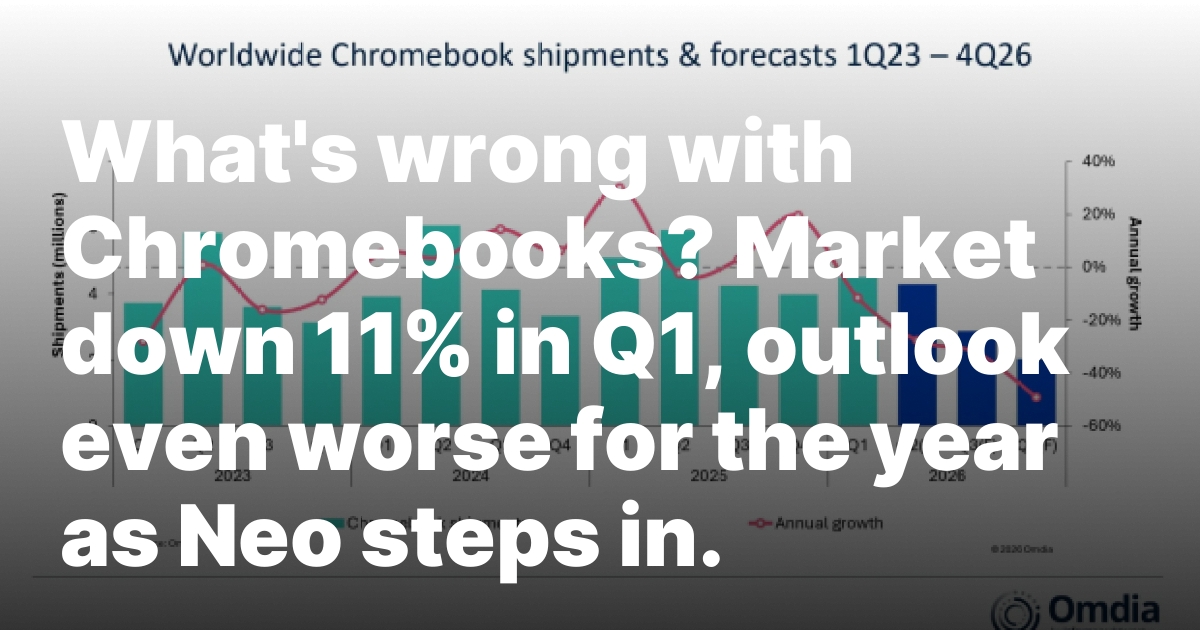
Chromebook Q1 shipments fell 11% YoY as education demand stalled. Japan's GIGA School Program 2.0 delay removes the key catalyst. Vendor splits and timeline to watch.
The Chromebook segment suffered an 11% year-on-year shipment decline in the first quarter of 2025, according to Omdia data. The drop is the steepest within the broader PC market, and the near-term outlook is worse. Japan's GIGA School Program 2.0, the category's most important upcoming procurement catalyst, faces supply-driven delays that could push orders into 2026. For investors tracking PC supply chains, the question is whether any substitute demand can fill the gap.
The first phase of the GIGA School Program 2.0, which ran from late 2024 through the end of 2025, completed without major disruption. That phase is now over. The second phase is deferred, with Kieren Jessop, Principal Analyst at Omdia, stating that supply constraints are likely to cause delays. Education-related deployments across other markets are also being postponed until conditions stabilize. For a category that depends almost entirely on government-funded school purchases, the pause creates a revenue vacuum. The single largest demand catalyst for Chromebooks – the GIGA program in Japan – is now uncertain on timing. If the second-phase tender slips past the second half of 2025, annual shipments could decline further.
Every major Chromebook vendor except one posted a decline in Q1. Lenovo, the market leader, shipped 1.5 million units, down 11.2% from a year earlier. That decline reflects the conclusion of the first GIGA phase, in which Lenovo was a key participant alongside its subsidiary NEC. HP placed second with 1.0 million units, a drop of 15.3%. Acer shipped 937,000 units, managing a smaller decline thanks to stable North American demand and increased shipments into APAC. The steepest decline came from Dell, whose shipments fell 28.3% year-on-year to 413,000 units.
The lone exception was ASUS, which posted a 3.5% year-on-year increase to 406,000 units, capturing 9% market share. ASUS is also a participant in the GIGA School Program 2.0. The growth may reflect share gains within the first phase or early orders linked to the delayed second phase. Still, ASUS's 3.5% growth is a minor offset against double-digit declines across the rest of the field.
Chromebooks rely on education-sector procurement – school districts and national programs. When the only buyer type is a government agency, volume swings can be extreme. The GIGA delay illustrates that risk. Vendors like Lenovo and Dell, which have the largest education exposure, now face a gap in orders with no obvious alternate buyer. Corporate adoption of Chromebooks remains limited, and consumer demand is weak. The next decision point is the timing of Japan's procurement tender. If the tender is released in Q3 of 2025, it could provide a brief reprieve. If it extends into 2026, the annual shipment decline will accelerate, and vendor margins will come under pressure from inventory build.
For readers tracking the PC cycle, see the latest stock market analysis and a review of best stock brokers for trading sector exposures.
Prepared with AlphaScala research tooling and grounded in primary market data: live prices, fundamentals, SEC filings, hedge-fund holdings, and insider activity. Each story is checked against AlphaScala publishing rules before release. Educational coverage, not personalized advice.