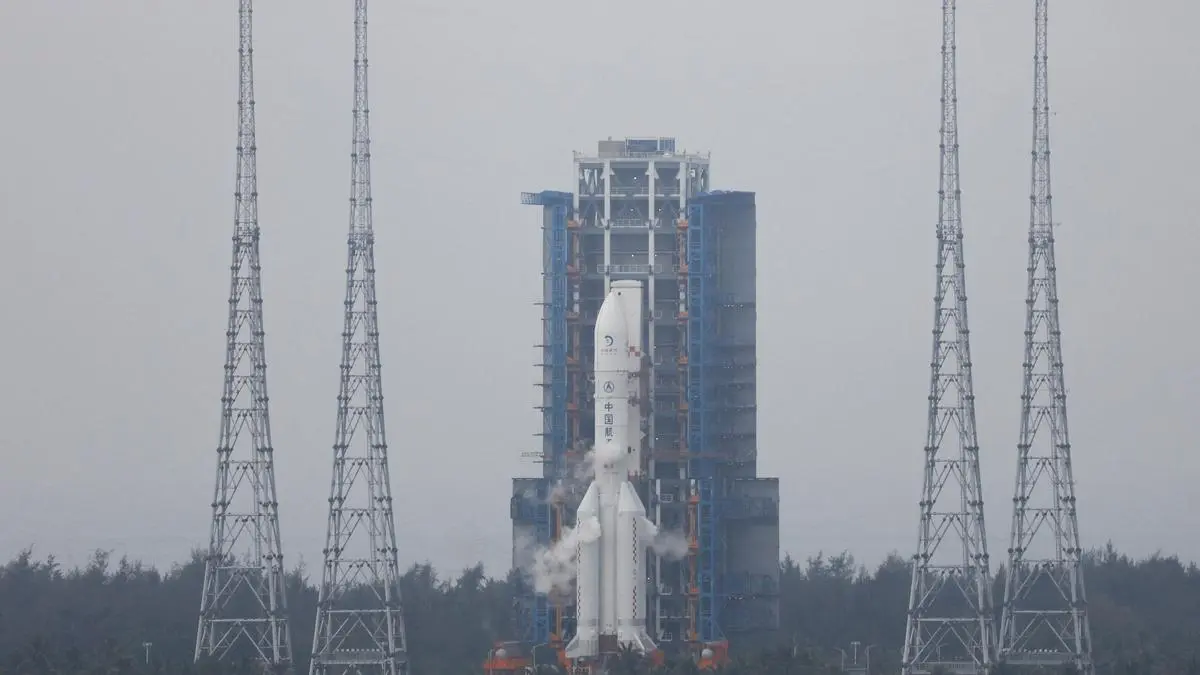
China will launch its Chang'e-7 lunar mission next week from the Wenchang Space Launch Site on Hainan island, a Long March 5 rocket carrying a lander, a rover and a novel hopping probe. The uncrewed spacecraft is heading for the moon's south pole, targeting permanently shadowed craters where scientists believe frozen water could be preserved.
Accessible water would be a game changer for future lunar bases. It can provide drinking water, oxygen for astronauts and raw rocket propellant. That would slash the cost of resupply missions from Earth. China's state news agency Xinhua reported that the hopper is expected to conduct at least three hops during the mission, using small thrusters to descend into crater floors and then return to sunlit rims to recharge.
Temperatures in those shadowed terrains can drop to minus 203 degrees Celsius, according to NASA. Scientists think such craters have not seen sunlight in billions of years and could preserve ancient water and organic compounds. The Chang'e-7 mission will deploy a water molecule analyzer on the hopper to search for the ice.
One candidate landing site is near the rim of the Shackleton crater, a permanently shadowed depression. The jagged rim receives near-constant sunlight, making it an ideal location for a future outpost with stable thermal conditions and continuous solar power. China has not publicly disclosed a precise timeline for the mission. Space watchers estimate a landing attempt around November.
The mission represents a major step toward Beijing's goal of a crewed lunar landing before 2030 and the establishment of a joint research station with Russia by 2035. Data collected by Chang'e-7 and its successor Chang'e-8, planned for around 2029, will lay the groundwork for a permanently inhabited research station.
Only India has successfully landed near the moon's south pole, with its Chandrayaan-3 in 2023. Over the coming years, NASA's VIPER rover, the European Space Agency's PROSPECT drilling package and the Japan-India LUPEX rover are also expected to arrive. The race to find water sources is intensifying as multiple space agencies target the same region.
One challenge for traditional wheeled rovers is the steepness of crater rims. The Chang'e-7 hopper solves that problem. It will fly into shadowed craters, land on six articulated legs and then hop back to sunlit rims to recharge. Technical details about the hopper's weight, engine performance or flight range remain unknown.
China's lunar ambitions coincide with NASA's Artemis programme. In April, the Artemis II mission completed a 10-day crewed lunar flyby, sending four astronauts farther into space than any humans in history. NASA aims to return humans to the moon by 2028 and eventually establish a sustained human presence there. Chang'e-7's findings will inform China's own crewed mission planning.
A single kilogram of water delivered from Earth to the lunar surface costs tens of thousands of dollars, according to industry estimates. Finding it on the moon would remove that constraint. That is why the search at the south pole has drawn so many missions. Chang'e-7 will be the first to deploy a hopping probe designed specifically to reach the coldest, darkest corners of the lunar surface.