Chilwa Minerals (ASX: CHW) more than doubled the JORC (2012) mineral resource at its Mpyupyu heavy mineral sands deposit in Malawi to 109.6 million tonnes at a 1.0% THM cut-off. The deposit holds ilmenite, zircon and rutile. QEMSCAN work also confirmed monazite throughout the deposit, the company said.
The new resource is up 114% on the prior estimate. Contained THM rose 62% to 3.61 million tonnes.
Classification shifted sharply. Measured now accounts for 24.47 million tonnes, Indicated 73.57 million tonnes, and Inferred 11.61 million tonnes. About 89% of the resource sits in the higher-confidence Measured and Indicated categories.
Chilwa also flagged a higher-grade core of 50.62 million tonnes at 4.65% THM using a 3.0% THM cut-off.
There is a trade-off in the numbers. Average grade at the 1.0% THM cut-off fell to 3.28% from the prior estimate, a decline of 1.08 percentage points. The deposit is larger and geologically better defined. The filing does not yet show how the lower average grade could affect processing assumptions, recoveries, or costs.
The improved confidence is expected to support mine planning inputs for the scoping study targeted for Q3 2026. No decision to mine has been made.
Mpyupyu sits within Chilwa's larger Lake Chilwa minerals portfolio in southern Malawi, on a single contiguous licence about one kilometre from the Nakombe niobium-REE target. That links the HMS project to Chilwa's separate critical minerals exploration push.
Chilwa has been advancing both tracks at the same time. The company earlier outlined a maiden conceptual Exploration Target at Nakombe South for a niobium-REE-tantalum-gallium system. Management is framing Mpyupyu as part of a wider district-scale development sequence rather than a standalone sand deposit.
Within the HMS side of the portfolio, Mposa remains the company's more advanced anchor asset. Chilwa previously reported a JORC 2012 Mineral Resource at Mposa of 25.65 million tonnes at 4.14% THM, with 83% of that resource in the Measured category. The Mpyupyu upgrade gives the company a second larger inventory base for upcoming study work.
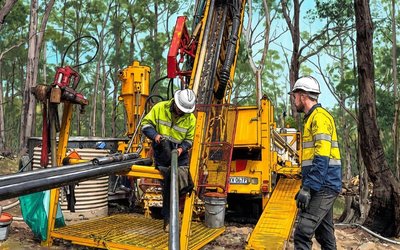
Chilwa has also been trying to grow the Mpyupyu footprint beyond the current estimate. Earlier this month it identified the Mpyupyu West HMS target over about five square kilometres. Sonic drilling is continuing there. Mpyupyu West remains a conceptual Exploration Target and there is currently insufficient exploration to estimate a Mineral Resource.
The clearest next milestone is the Mpyupyu scoping study, targeted for Q3 2026. That study is likely to be the first point at which outsiders can test whether the bigger and higher-confidence resource converts into a workable development concept through mining sequence, product mix, processing route, logistics and recovery assumptions.
In its 31 December 2025 quarterly, Chilwa reported A$3.591 million in cash after completing an A$8 million private placement. Prior disclosures pointed to a tight funding runway and ongoing capital needs as the company pursues parallel HMS study work and niobium-REE drilling.
The Mpyupyu update combines a sharp increase in tonnage with a large shift into Measured and Indicated categories. The next phase is less about more tonnes and more about whether the Q3 2026 scoping study can show workable economics, funding pathways and a realistic development sequence across the Lake Chilwa portfolio.
The company's preferred sequencing, including the idea of HMS being a first potential development front within the broader Chilwa Critical Minerals Project, is forward-looking and subject to approvals. The next stages still depend on technical study outcomes, financing capacity, permitting steps and metallurgical work.