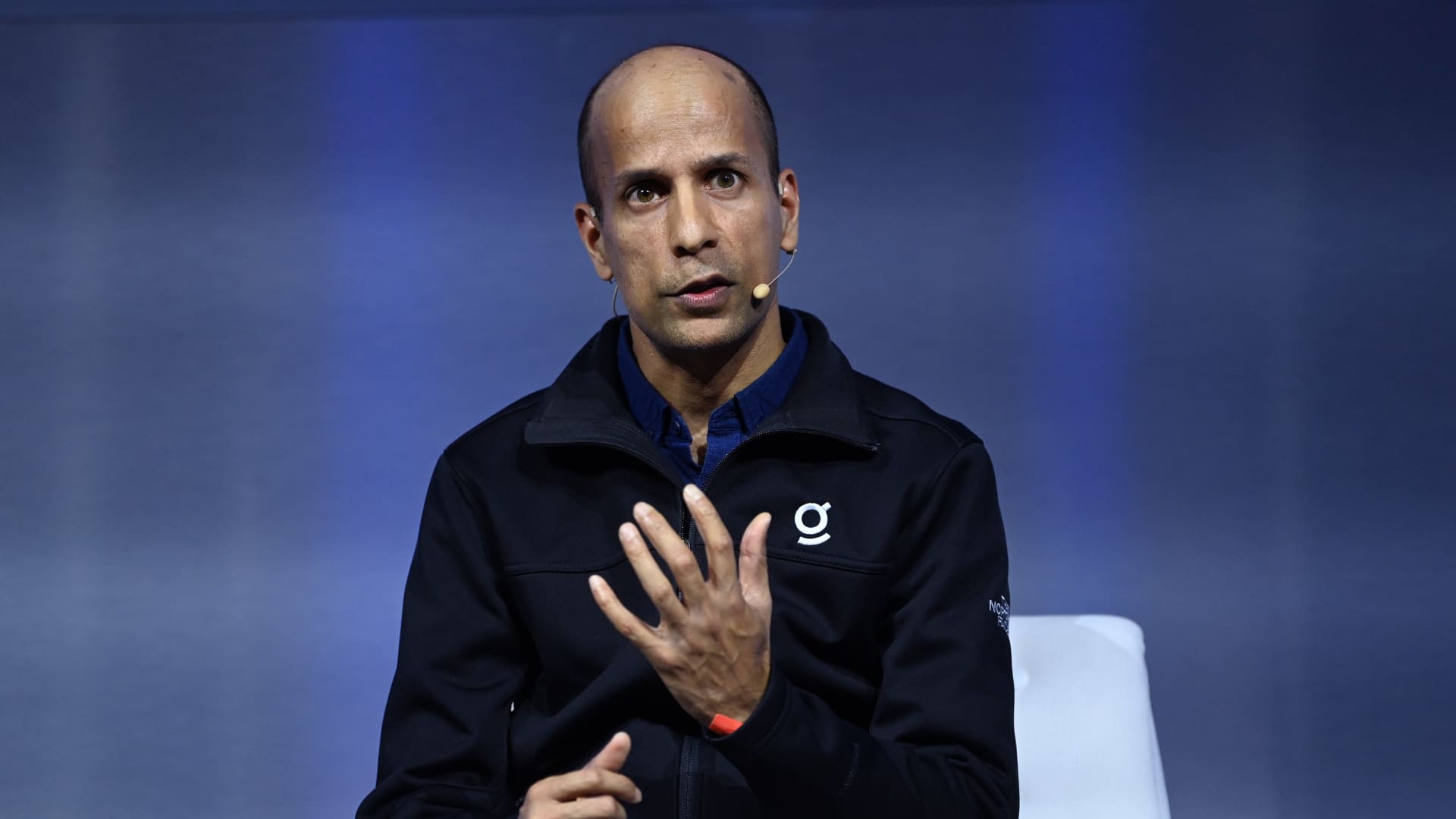
Enterprise AI budgets are being exhausted in one to two months, not one to two quarters. That is the picture two enterprise AI CEOs described in a CNBC interview this week, and it reveals a risk the equity market has not yet priced: the AI trade's assumption of inelastic demand may be wrong.
Arvind Jain, CEO of Glean, and Matan Grinberg, CEO of Factory AI, detailed a resource-allocation problem that has moved from boardroom mandates to CFO spreadsheets. The core tension is straightforward: each new frontier model release is roughly twice as expensive per token as the one it replaced. Technology now costs as much as people, a comparison that has never existed in corporate budgeting.
The AI Budget Crunch: Tokens vs. Headcount
The shift inside Fortune 500 finance teams is not about whether to deploy AI. It is about what to cut. Jain framed the decision as unprecedented: "This is the first time ever that I can remember that technology costs the same as people, and you're making that comparison: choose tech or people."
That growing AI budget is increasingly coming in lieu of future headcount growth. The trade-off is explicit. A CFO allocating a fixed operating budget must decide between hiring another engineer or buying more tokens from a frontier model. The market narrative that demand for AI is inelastic does not match what Jain sees inside his clients.
Three Phases of Enterprise AI Adoption
Grinberg described the evolution in three distinct phases over roughly one year. The first involved boards demanding that CEOs do something about AI. The second was tokenmaxxing – using AI by any means necessary regardless of cost. The third phase, happening now, is a reassessment of model necessity.
"Do we need to be using Opus-level intelligence for every single task?" Grinberg said. "You just don't need to."
Bottom line for traders: The enterprise AI budget squeeze introduces price sensitivity that the current market consensus ignores. Companies that burned cash on premium models without ROI are now being forced to optimize.
Why the Cost Problem Is Worse Than Expected
The root cause is that AI works but does not yet pay for itself at current pricing. "The way AI works today, it's very powerful, it's very inefficient," Jain said. "The value that AI drives at this point is trailing the cost that businesses are incurring."
The inefficiency is structural. Roughly 95% of enterprise AI usage still runs on the most expensive frontier models, even for tasks that could be handled by cheaper alternatives, Jain said. That means most companies are burning premium compute on routine work – summarising emails, classifying tickets, generating boilerplate code – tasks a smaller model could handle.
The 95% Overspend Problem
A simple fix exists: route the easy work to the cheaper tier. Jain called that the lowest-hanging fruit. "You have a 10x savings that you can actually achieve with the right model routing at the front."
That savings is not theoretical. It represents a direct margin improvement for companies that implement routing logic. The CFOs who are currently watching their AI budgets burn through in one month are the natural buyers of these efficiency tools.
Model Routing: The 10x Savings That Exists Today
That is the pitch behind Factory AI, which automatically sends each task to the model best suited to it. Grinberg said the trick is recognising how rarely a job actually needs the top of the line. He likened the gap between successive frontier models to the difference between two veteran academics.
If most enterprises can get acceptable quality from a cheaper model, the demand for premium tokens is far more elastic than the model providers assume. That introduces execution risk for OpenAI and Anthropic, whose business models are built on premium pricing and whose valuations assume sustained demand growth at current price levels.
What Confirm or Weaken the Thesis
A confirmatory signal would be a wave of enterprise customers announcing cost-optimisation programs or explicit caps on AI spend per employee. A weakening signal would be model providers cutting prices sharply to hold volume – that would compress their margins but keep the demand story intact.
A second risk is that the cost problem delays enterprise adoption timelines. If CFOs treat AI as a headcount-replacement line item rather than a productivity multiplier, the total addressable market for frontier models shrinks. Jain's comment that technology now costs "the same as people" implies that any incremental AI budget is a direct subtraction from payroll, a zero-sum game inside most corporate P&Ls.
The AI Trade's Demand Elasticity Bet Is Tested
The current market consensus assumes that enterprise AI spend is a durable multi-year growth line, relatively insensitive to price. The reports from Glean and Factory AI suggest otherwise. If 95% of usage is on the wrong model tier, a large portion of current revenue is ripe for optimisation. The very efficiency tools that vendors like Glean and Factory AI sell will cannibalise the premium volume that supports frontier-model revenue streams.
For traders, the implication is concrete. A reversal in the hyperscaler capex narrative – if CFOs start cutting AI budgets instead of people – would pressure the names that benefit most from the buildout. Those include the cloud platforms that sell inference compute and the model providers that sell tokens. The catalyst is not an earnings miss next quarter. It is the cumulative effect of cost discipline inside the Fortune 500 over the next two to three quarters.
Next Catalyst: A Public Spend Cap Announcement
The next decision point is when the first large enterprise publicly announces an AI spend cap or a shift to routing logic. That would validate Jain and Grinberg's accounts and force the market to reprice demand elasticity. Until then, the current view is a bet that companies will keep burning premium tokens without optimising. The evidence from inside the enterprise suggests that bet is getting harder to hold.
Read more about what the AI price reckoning means for the valuations of OpenAI and Anthropic, which have built their business models on premium pricing. For broader context on how this affects the broader market, see our stock market analysis and the NVIDIA profile given its central role in the AI compute buildout.