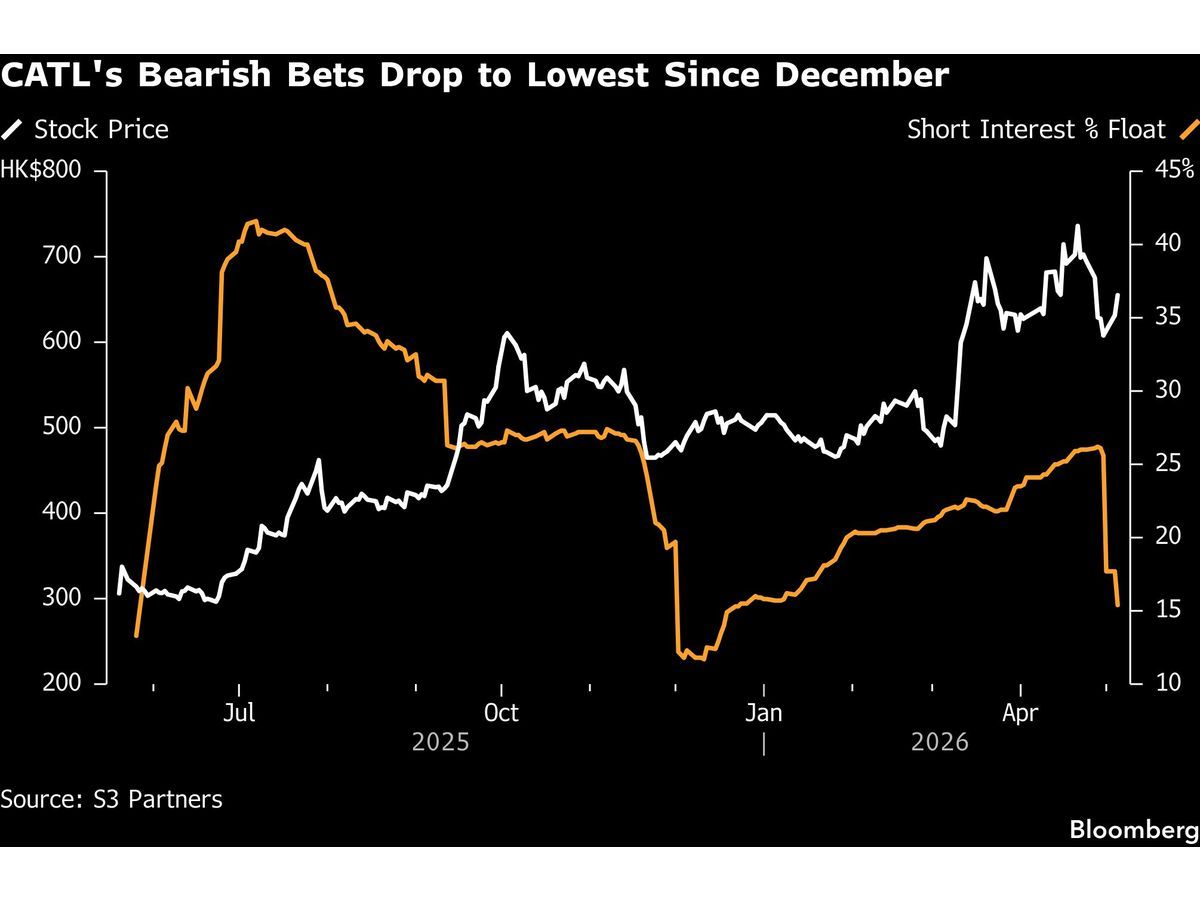
Traders are rapidly dismantling bearish bets against Contemporary Amperex Technology Co. Limited (CATL) as a $5 billion share sale fundamentally alters the liquidity profile of the battery giant’s Hong Kong-listed shares. The short interest in the stock has plummeted to 15.4% of the free float as of Monday, marking the lowest level since December. This represents a significant retreat from the 26% short interest recorded just one week prior, according to data from S3 Partners.
The Mechanics of the Short Unwind
The primary driver of this shift is the increased availability of shares following the jumbo offering. Historically, the Hong Kong-listed shares traded at an unusually high premium compared to the company’s Shenzhen-listed counterparts. This valuation gap encouraged traders to initiate a pair trade: going long on the cheaper Shenzhen shares while shorting the more expensive Hong Kong shares. Because there was no direct arbitrage mechanism to close the gap, the trade became a crowded, one-sided bet that persisted as the stock price doubled since its Hong Kong debut last year.
The $5 billion offering, combined with a concurrent sale by a large shareholder, acted as a catalyst for these participants to exit. By increasing the float, the sale reduced borrowing costs for those looking to cover their positions. Eugene Hsiao, a strategist at Macquarie Capital Ltd., noted that these share placements provided institutional funds a rare window to cover their short positions at a discount. With the liquidity crunch eased, the incentive to maintain a short position has diminished, leaving the market to focus on the company’s core growth narrative.
Fundamental Re-rating and Sector Read-through
Beyond the technical unwind, the market is pivoting toward the company’s fundamental outlook. Investor sentiment remains anchored by expectations of expansion in the battery energy storage business and a strategic shift toward downstream system integration. This transition is viewed by analysts as a defensive moat that supports the current valuation despite the recent volatility in the share price.
Market confidence was further bolstered this week when Morgan Stanley upgraded the stock to overweight. The firm cited the rapid scaling potential of next-generation battery technologies, specifically sodium-ion and condensed batteries, as a primary driver for future earnings growth. This bullish consensus is reflected in the broader analyst community; of the 25 analysts tracking the Hong Kong shares, 23 maintain a buy or equivalent rating, with only two holds and zero sell ratings. The Alpha Score for CYATY currently sits at 51/100, reflecting a mixed sentiment as the market digests the recent supply-side changes.
Price Action and Market Context
Following the holiday break, CATL shares demonstrated immediate strength. The Hong Kong-listed shares rose as much as 4% on Wednesday, while the Shenzhen-listed stock climbed more than 6% to reach an intraday high. This synchronized rally suggests that the market is no longer punishing the Hong Kong shares for their premium status, but is instead pricing in the company’s long-term technological dominance.
For traders, the current setup suggests that the primary risk—the high cost of borrowing and the difficulty of covering in a thin market—has been mitigated. The next concrete marker for the stock will be whether the increased float leads to sustained institutional accumulation or if the recent price action invites a new wave of volatility. Given the solid fundamental backdrop and the lack of sell ratings, the path of least resistance appears to be tied to the successful execution of its downstream integration strategy. Investors should watch for any further narrowing of the spread between the Hong Kong and Shenzhen listings, which would confirm that the structural arbitrage trade has been fully liquidated.