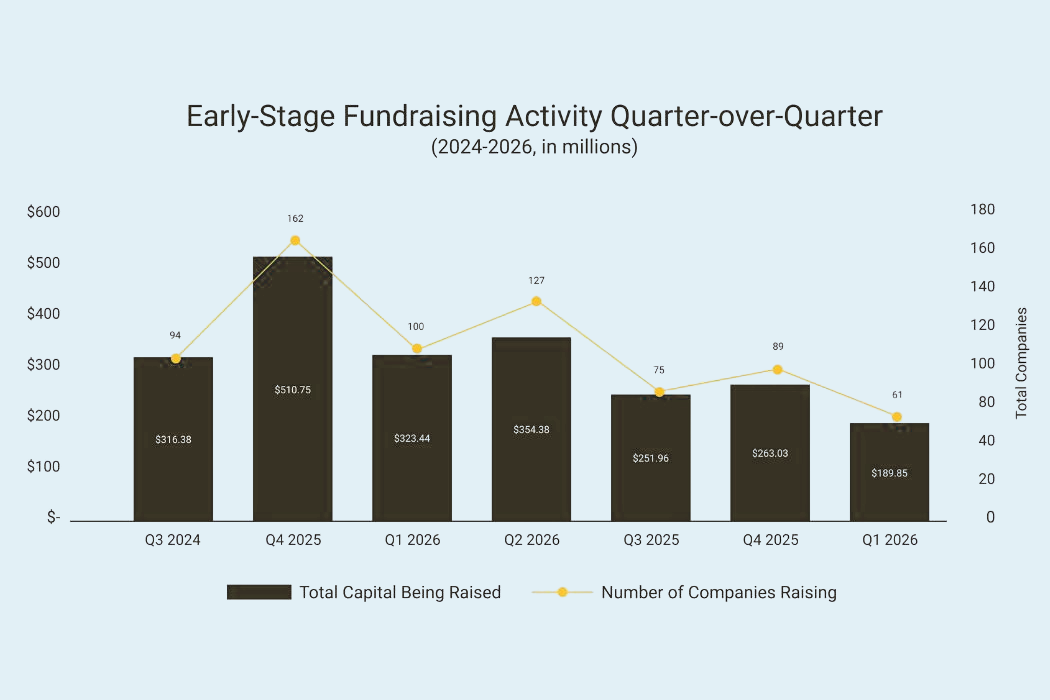
New data from RBCx shows a sustained decline in early-stage technology startup funding in Canada since the start of 2025, with the first quarter of 2026 marking another steep drop.
RBCx tracked fundraising across more than 700 Canadian-headquartered pre-seed and seed companies over two years. During Q1 2026, 61 startups closed nearly $190 million CAD. That is a 40 percent decline year-over-year by both deal count and total dollars. The average seed round held at $3 million, meaning companies still need the same capital even as fewer rounds get done.
Matt Roberts, managing director of RBCx's VC coverage, told BetaKit the trend is worth flagging. "If this trendline continues, that's not great [for] the Canadian market," he said.
The data follows a January RBCx report that found 2025 was the worst year for Canadian VC fundraising since 2016. Total dollars raised were the smallest since 2016, and the number of funds closed was the fewest since 2018. Those fundraising challenges have hit emerging managers hardest. They typically invest at the earliest stages, and the pressure now appears to be filtering down to early-stage investment activity.
Roberts said it is tough to pin the decline on any single factor. Fewer entrepreneurs are starting businesses. More founders are deciding not to raise as early because they can build more with AI. Some are turning to the U.S. for capital or as a place to establish a company. He is not sure whether the market has hit bottom yet.
Canada's five largest VCs swallowed roughly 80 percent of all capital raised in 2025. Even that group is feeling the squeeze: fundraising among the top five has fallen 50 percent since 2021. The rest of the market is hurting worse. RBCx found that fundraising outside the top five has dropped 90 percent over the past five years, with emerging managers bearing the brunt.
Growth-stage activity is also struggling. The Canadian Venture Capital & Private Equity Association recently charted a lack of growth-stage deals during the first quarter. As the CVCA, the National Angel Capital Organization, and the Canadian Startup Capital Association present competing visions for where the federal government should deploy the $750 million CAD it pledged toward "early growth-stage funding gaps," Roberts said there are issues "at every stage of the capital stack" in Canada's innovation market.
The concentration of capital among a shrinking number of funds creates a structural problem. If the top five VCs are raising less, and the rest of the market is raising almost nothing, the pipeline for early-stage companies narrows. Founders who would have raised a seed round in 2021 or 2022 may find no domestic fund willing to write the check. Some will bootstrap longer. Some will look south. Some will simply not start.
Roberts' uncertainty about the bottom matters because the data does not show a natural floor. The 40 percent drop in Q1 2026 came after a weak 2025. If the trend continues through the rest of 2026, the number of early-stage rounds could fall below 200 for the full year, a level not seen since before the pandemic-era boom. The average round size holding steady at $3 million suggests that when deals do happen, they are not getting smaller. The issue is deal volume, not deal size.
For a founder watching this, the implication is straightforward: raising a seed round in Canada is harder than it was two years ago, and there is no sign that the environment is about to improve. The $750 million federal pledge is still being debated, and the competing proposals from industry groups mean no quick resolution. In the meantime, the data from RBCx offers a clear read on the direction of travel.