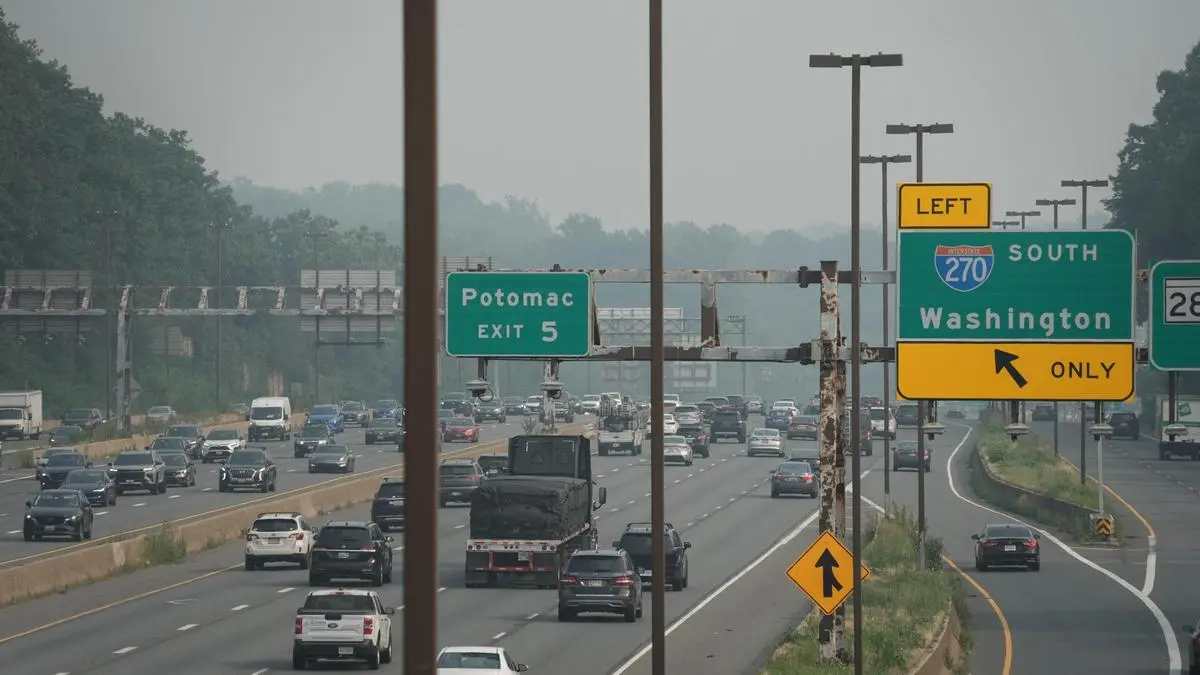
Millions of people across the Great Lakes, Northeast and Mid-Atlantic states endured another day of unhealthy air from uncontrolled Canadian wildfires on Friday. Thick smoke enveloped Washington, D.C., in an eerie orange haze and forced Major League Baseball's Cleveland Guardians to postpone their game against the Pittsburgh Pirates. Air quality warnings are expected to remain in effect through Saturday, with possible temporary relief from storms forecast in some affected areas over the weekend.
DC resident Stewart Verdery woke Friday expecting his usual sunrise view of the city's landmarks from a rooftop. Instead, he found a darkened horizon with no monuments in sight. "It's pretty crazy to wake up at sunrise and not see the sun when it's not even raining," he said after posting a video of the scene on X. "And it smells like somebody's having the world's largest cookout."
Bob Oravec, a lead forecaster at the National Weather Service in Maryland, said the smoky conditions will persist. "The source of the smoke is going to continue on for certainly a week, probably," Oravec said. "It's just going to depend upon which way the wind's blowing as to where the smoke is going to affect the most." Wildfires are burning in Ontario, Canada, and in Minnesota's Boundary Waters Canoe Area Wilderness, which U.S. officials have closed as they fight the blazes.
On Friday, communities in Minnesota, Illinois and Michigan, including Detroit, registered some of the worst air quality in the world, according to IQAir, an air quality monitoring website. Washington, D.C., was not far behind. The Washington Monument, the Lincoln Memorial and other national landmarks were shrouded in an orange-tinted haze through much of the day.
People with heart or lung disease, older adults and children were urged to limit or avoid going outside until air quality improves. Long-term exposure to smoky conditions can complicate existing health problems and lead to respiratory illness, cardiovascular and neurological diseases and premature death, officials warned.
Maria Travela, who has asthma, wore a mask as she crossed a bridge over the Chicago River on Friday. It was her first day outside since smoke blanketed the Chicago area early Thursday. "Now it's better. This morning, it was bad," she said. "They were saying that, for people like me, with asthma, any kind of issues like that, it would be bad for your lungs."
Hundreds of wildfires are burning in Canada, including about 190 in northern Ontario, Premier Doug Ford said at a news conference. Flames destroyed the Namaygoosisagagun First Nation community. Ten northern Ontario communities have been evacuated or are being evacuated, with more possible. The increase in fire activity across vast Canadian forests has largely been blamed on climate change.
U.S. President Donald Trump posted on social media Friday blaming Canada for its forest management and threatening additional tariffs. The Canadian government did not immediately respond to questions about Trump's comments. Asked about criticism from a Michigan lawmaker, Ford noted Canada has helped the U.S. fight fires in the past. "If there's some politicians out there chirping away, maybe what you should do rather than complain is send support, send help, because we have done the exact same thing for our American friends and that's what you're supposed to do," Ford said.
In the New York City area, concern focused on how the smoky air might affect Sunday's World Cup final between Spain and Argentina at MetLife Stadium in New Jersey. Oravec said winds will continue pushing the wildfire smoke east, though conditions should be better on game day than on Saturday.
On Thursday, a thick haze tinged with orange and yellow darkened skies across several states and partly obscured Manhattan's skyline. Officials from New York, New Jersey, Pennsylvania and other Northeast states distributed free KN95 face masks, canceled outdoor programming and opened libraries and other public buildings as cooling centers where people could get respite from the sooty air. By Friday afternoon, air quality measures improved from "unhealthy" to "moderate" in some places in and around New York City, with a strong sun breaking through a thin veil of smoke and clear blue sky visible across much of the region.