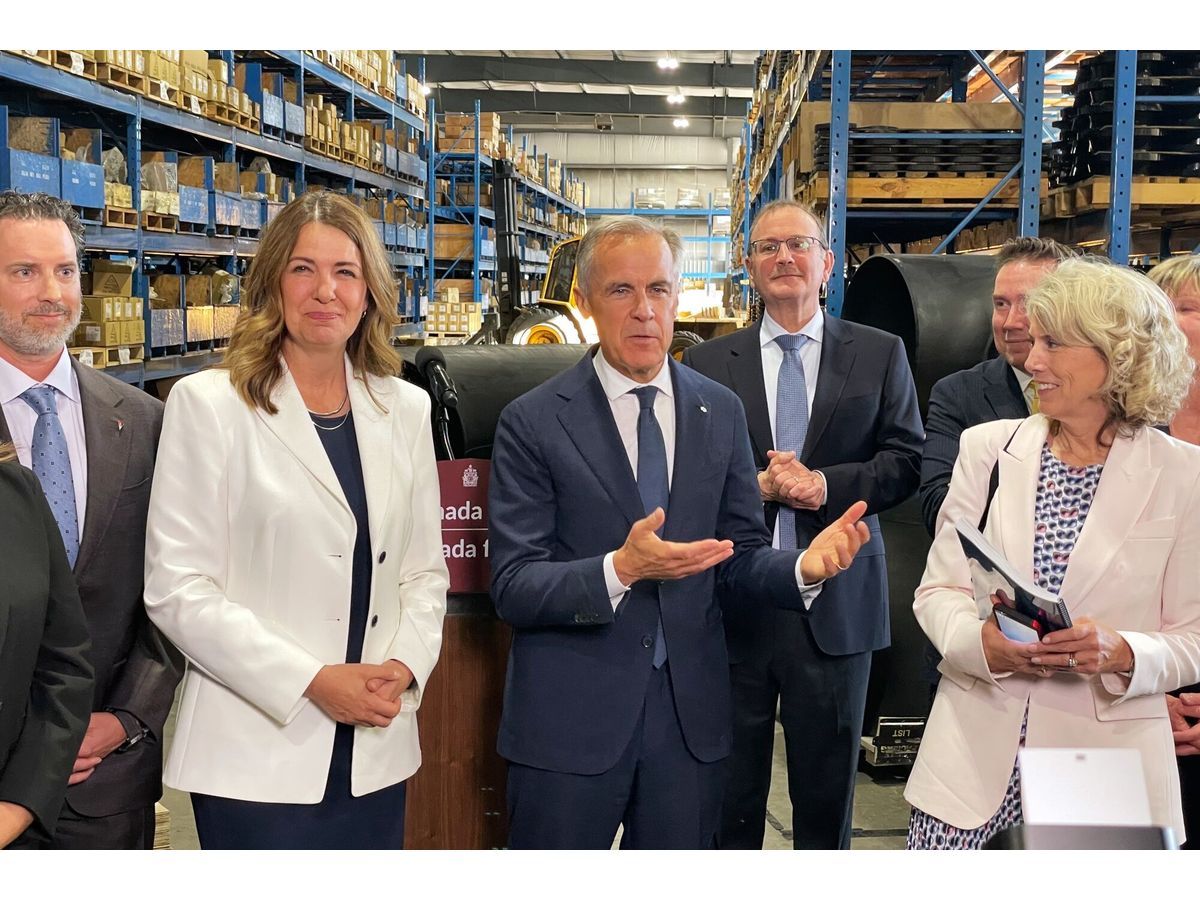
Canada’s plan to build a new 1 million barrel-a-day oil pipeline to the Pacific coast comes with a condition. The oil sands producers that ship on it must also fund what Energy Minister Tim Hodgson called the world’s largest carbon capture facility.
The arrangement, announced Thursday by Prime Minister Mark Carney and Alberta Premier Danielle Smith, is the biggest step yet toward a second major pipeline out of Alberta. State-owned Trans Mountain Corp. will build the conduit. Pembina Pipeline Corp. may take a stake. Key details on carbon capture funding and pipeline tolls remain unresolved.
Hodgson, a former Goldman Sachs banker, described the negotiations as “hard choices.” The pipeline route and backers were only half the puzzle. The other half was getting oil companies to agree on carbon taxes and a shared carbon capture project called Pathways. The idea is to capture emissions from oil sands production and inject them deep underground in northeastern Alberta.
Some in the oil industry are skeptical. Hodgson said the project would take the equivalent of 5 million cars’ worth of emissions off the road. “To show the world that Canada is a leader in clean technology, and that we as a result can grow our production of oil here in Alberta – I think that was a really important coming together,” he said in an interview.
The Oil Sands Alliance, a group of five large producers including Canadian Natural Resources Ltd. and Imperial Oil Ltd., has not signed a formal deal yet. Carney said the governments “agreed on the terms,” but the final contract is still being written. Pathways would start around 2032, with construction beginning by the end of the decade, according to Alliance President Kendall Dilling. “Everybody was committed to what needed to happen and we found a middle ground,” Dilling said.
For oil producers, the simple read is straightforward. More takeaway capacity means less reliance on U.S. refineries and potentially narrower discounts on Western Canadian Select. The better market read is more complicated. The carbon capture requirement adds a layer of cost and regulatory uncertainty. The fiscal frameworks around carbon markets, clean fuel credits and royalties are still being negotiated. Until those numbers are locked in, the net benefit for producers is unclear.
Canadian Natural Resources, with an Alpha Score of 66 out of 100, has the scale to absorb carbon capture costs. The timing matters. If Pathways construction starts before the pipeline is built, CNQ’s capital spending could rise sooner than expected. Pembina Pipeline, scoring 55, stands to gain from a pipeline stake and from transporting captured CO2. Its exposure is tied to the final toll structure, which has not been disclosed.
The next concrete marker is the formal Pathways agreement. Until it is signed, the “grand bargain” remains a framework, not a done deal. The carbon tax details and the pipeline tolls will determine whether the middle ground is profitable or just political.