Canada’s long-delayed federal AI strategy will go live next week, Prime Minister Mark Carney confirmed in Ottawa on Wednesday. The release itself is a concrete policy catalyst for Canadian AI companies and their investors. The real question is what the strategy actually changes in terms of procurement, capital allocation, and IP retention.
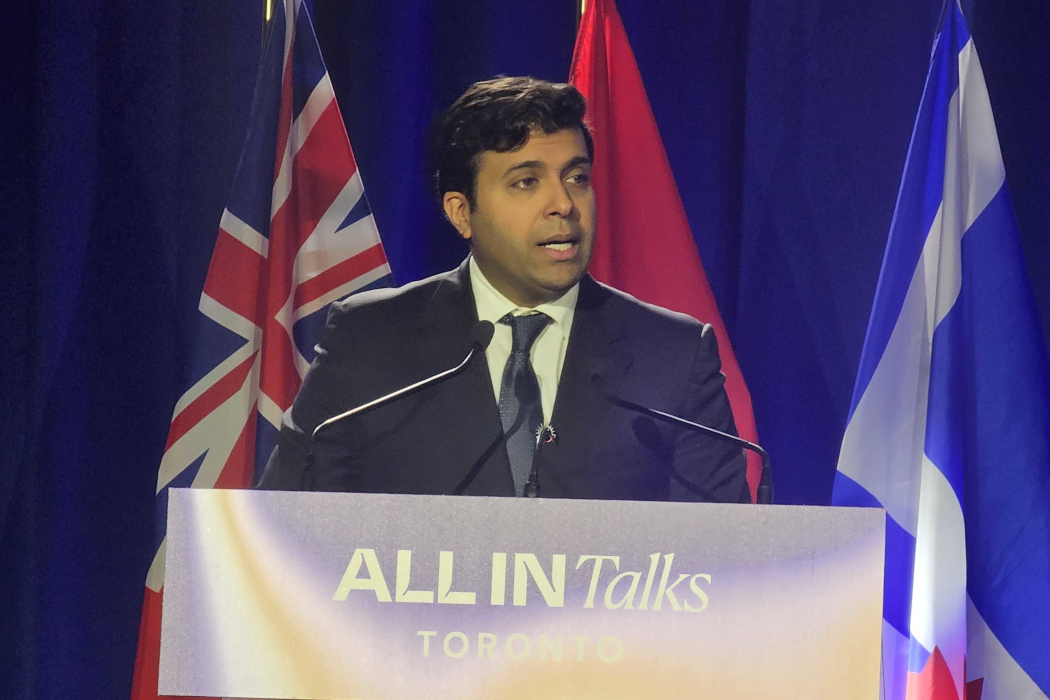
Parliamentary secretary Taleeb Noormohamed, speaking at All In Talks Toronto during Toronto Tech Week, gave the clearest signal yet. The renewed AI strategy will alter how the government makes choices around procurement, support, and capital deployment. The goal, he said, is to stop the migration of intellectual property and long-term value out of the country.
The IP Retention Mechanism: Procurement and Capital
Noormohamed stated directly that Canadians have watched “industrial-scale intellectual property and long-term value migrate elsewhere.” “Our job is to make sure that stops,” he said.
The practical mechanism: federal procurement is one of the largest pools of spending in the Canadian economy. If the strategy mandates that government departments buy AI services and infrastructure from domestic vendors first, it creates a revenue base that most early-stage AI companies lack today. That revenue visibility can support higher valuations and reduce the pressure to sell to a U.S. acquirer.
Capital Deployment as a Second Lever
The government also intends to provide capital. Noormohamed did not specify the vehicle. Past consultations have discussed direct investments through a sovereign fund or expanded R&D grants. That lowers the dilution risk for startups and can keep ownership inside Canada when the next funding round arrives.
Key insight: The naive read is that all Canadian tech wins. The better read is to identify which companies are most exposed to government contracts or have the most at-risk IP that could be retained. Companies with existing federal relationships or large patent portfolios are the first to screen.
Panel Signal: AMD, Snowflake, Hypertec, Bell Focus on Commercialization
The parliamentary secretary’s comments prefaced a panel at Toronto Tech Week featuring leaders from AMD, Snowflake, Bell, and Hypertec. The panel’s theme was infrastructure access. The speakers “somewhat sidestepped” that topic and instead focused on how they can help Canadian AI companies commercialize and grow.
That shift is worth examining. Infrastructure access – specifically GPUs and data centre capacity – is a known bottleneck. The fact that panelists chose to talk about commercialization suggests the strategy may emphasize demand-side support (helping companies sell) rather than supply-side subsidies (buying compute).
Snowflake’s Angle
Snowflake (ticker: SNOW) operates a data cloud that Canadian AI companies already use to store and process training data. Snowflake’s FY27 guide, covered separately by AlphaScala, signals an AI monetization tipping point. If Canadian policy drives more domestic AI workloads, Snowflake could see incremental cloud revenue from government-funded projects.
AMD’s Position
AMD (ticker: AMD) is a supplier of CPUs and GPUs. Hypertec’s Mike Marracino noted that Canada will need to “keep an open mind” and acquire some components, including GPUs, from elsewhere. AMD is an alternative to NVIDIA. It could benefit if government procurement policies encourage diversification. AMD’s Alpha Score is 59/100 (Moderate) on the AlphaScala scale, reflecting its mixed valuation and competitive positioning. The policy shift could add a domestic catalyst to the stock’s larger AI narrative.
Bell and Hypertec
Bell (ticker: BCE) provides connectivity and cloud services. Hypertec supplies IT infrastructure. Both could see increased demand from a federally stimulated AI ecosystem.
Confirmation and Invalidation: What the Strategy Text Must Contain
Confirmation of the strategy’s impact will depend on the specific language released next week.
- Confirmation signals: Explicit procurement preferences for Canadian vendors. A committed capital figure, for example a dollar amount for a sovereign AI fund. IP retention clauses in federal contracts. A follow-on announcement of a direct investment into a Canadian AI startup would also confirm the mechanism is working.
- Invalidation risks: The strategy could be broad language without binding procurement rules. Governance requirements, if too strict, could make government funding unattractive. Another delay would also weaken the catalyst.
Risk to watch: Noormohamed did not address ethical governance during his remarks. Public consultations showed Canadians want both growth and regulation. If the final strategy leans heavily on governance, it could slow the commercialization that panelists highlighted.
Next Catalyst: Strategy Release and Re-Rating Potential
The strategy’s release next week is the immediate catalyst. After that, investors should watch for subsequent policy actions: requests for proposals, direct investments, or partnership announcements with companies like Snowflake and AMD.
Noormohamed’s direct plea to the room – “if you’re an investor … don’t [hesitate]” – is a deliberate attempt to change the perception that Canadian AI is a second-tier opportunity. If the strategy delivers on procurement and capital, the re-rating of Canadian tech stocks – both publicly traded and private – could follow.
For a broader view of how AI monetization is evolving, see AlphaScala’s analysis of Snowflake’s $5.84B FY27 guide. The AMD stock page includes a full breakdown of the company’s valuation and competitive risks.
The strategy is a concrete catalyst. Execution details matter. The best approach is to wait for the text. Focus on the companies with the most direct exposure to government procurement and capital. Anything less specific is noise until the policy is in writing.