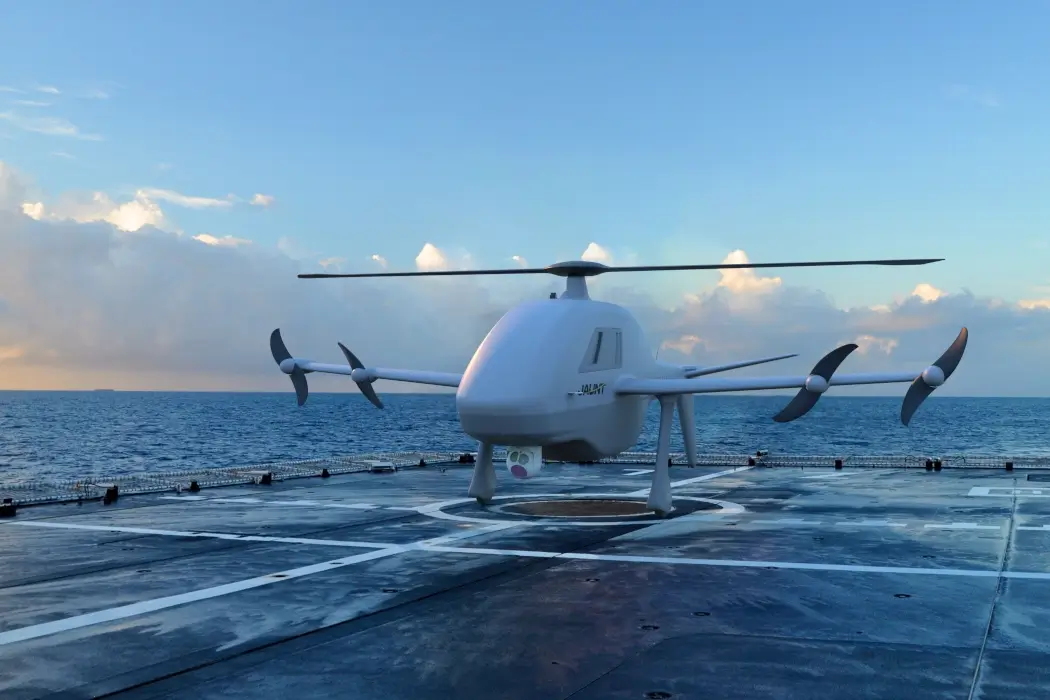
Sherbrooke, Que.-based Calogy Solutions will design the battery system for Jaunt Air Mobility Canada's next-generation autonomous drone under a $1.2-million CAD contract.
The deal shows "clear product-market fit" for Calogy's batteries and its patented Uni T thermal management technology, co-founder and CEO Mahmood Shirazy told BetaKit. Calogy claims its air cooling solution is simple, compact, and cheaper than liquid cooling alternatives.
"Their expertise in battery engineering and their innovative thermal management technology align well with our focus on building a safe, reliable, and high-performance aircraft capable of operating in demanding environments," Jaunt Air Mobility Canada president Eric Côté said in a statement.
Jaunt Air Mobility Canada is a subsidiary of Nasdaq-listed American aerospace and defence firm Airo. It is developing a new line of large, autonomous, hybrid-electric, dual-use drones. The aircraft do not require runways to launch and can hover like helicopters while also operating at the range and speed of fixed-wing aircraft, for defence and commercial applications.
Shirazy said battery temperature is largely moderated with liquid cooling in aerospace. Those systems are heavy, add complexity, and create reliability concerns. Calogy claims it can provide liquid-cooling-level performance without the weight and complexity, building systems for extreme conditions from Arctic cold to intense heat.
Uni T allows Calogy to make lightweight, safe, high-performance batteries. Shirazy said this makes it a natural fit for the drone industry. He sees the Jaunt Air Mobility Canada contract as a sign that customers are prepared to pay "big dollars" for it. The company's goal is to deliver the battery system that Jaunt wants for testing before the end of the year, then move into manufacturing together and enter the market next year.
Calogy, founded in 2020, got its start as an electric vehicle-focused lithium battery firm with a thermal management solution. Selling into the automotive market proved "very difficult" because it means long development cycles and low margins, Shirazy said.
After contacting hundreds of prospective investors and hearing back from none of them, the startup joined Creative Destruction Lab (CDL) Montréal and was nearly eliminated in its first session, Shirazy told CDL Super Session attendees back in May.
One early believer correctly pointed out that the company's cooling tech, rather than its battery, was its true innovation, Shirazy said. This led Calogy to refocus its plans around the thermal management side of its business.
Shirazy joked that Calogy went from likely shutting down to a hot startup that sees a much larger opportunity in keeping data centre servers cool during the age of AI, offering a solution it claims is easier, faster, and cheaper to implement than existing approaches. He said it is now in talks with large computer chip manufacturers to demonstrate and pilot its tech.
The 18-person startup has raised approximately $3 million CAD to date from Investissement Québec, ACET, and angel investors. It is currently raising a pre-Series A financing to take Calogy to the next level.
Once it completes that round, Shirazy said Calogy might carve its two products – the battery module and thermal management tech – into separate businesses. He views the former as a potential "cash cow" for the latter, which he thinks could become a "billion-dollar business" but will likely take much longer to build into a sustainable company.