California's proposed one-time 5% tax on residents with assets above $1 billion was certified for the November 2026 ballot on June 25. The measure, pushed by the SEIU-United Healthcare Workers West labor union, aims to fill a projected multibillion-dollar state budget deficit. It would apply retroactively to all California residents as of January 1, 2026.
Business leaders are reacting. Some are leaving. The threat of relocation has already reshaped where companies incorporate and where founders live.
Larry Page, the Google cofounder, converted several entities from California to Delaware, including his family office and Flu Lab LLC, Business Insider reported. One Aero, which funds his flying car ventures, lists its principal office in Florida. A source close to Page told Business Insider that he had already left the state. Sergey Brin, the other Google cofounder, has donated $102 million to the Building a Better California coalition opposing the tax. He told The New York Times in April, "I fled socialism with my family in 1979 and know the devastating, oppressive society it created in the Soviet Union. I don't want California to end up in the same place."
Attorney Alex Spiro wrote to Gov. Gavin Newsom that his clients would "permanently relocate" if the tax becomes law, according to Business Insider. Spiro has represented billionaires and celebrities.
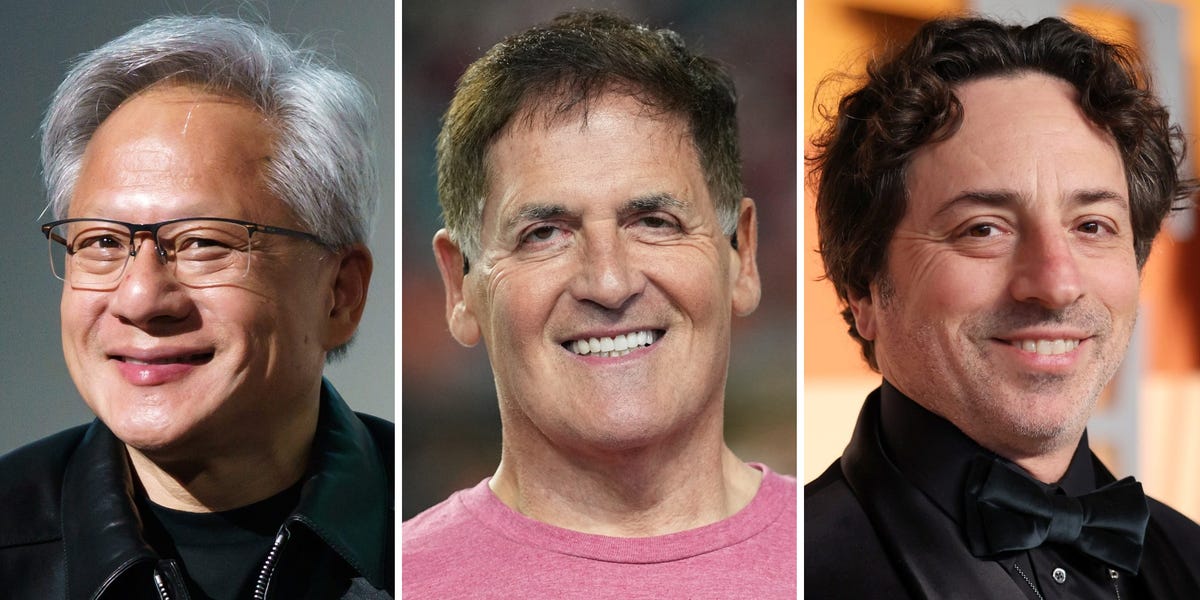
Nvidia CEO Jensen Huang is staying put. Huang, ranked the ninth-richest person in the world with a net worth of $155 billion as of January 6, told Bloomberg TV that the tax hadn't crossed his mind while "trying to build the future of AI." Nvidia is based in Silicon Valley because "that's where the talent pool is," he said. The company's stock is up 0.48% today at $226.23, with an Alpha Score of 78 out of 100, labeled Strong.
Palmer Luckey, the Oculus founder and Anduril cofounder, wrote on X in December that the tax would force founders to "sell huge chunks of our companies." He said he made money from Oculus, sold to Facebook in 2014, and paid hundreds of millions in taxes on it. Then he used the remainder to start Anduril. "Now me and my cofounders have to somehow come up with billions of dollars in cash," he wrote. The policy makes no provision for companies that funnel revenue back to research and development, he added. "You are effectively forcing companies to immediately pivot into profit obsession over mission or long-term sustainability."
Peter Thiel, the billionaire investor and cofounder of PayPal and Palantir, recently opened a Miami office for Thiel Capital. The announcement came days after The New York Times reported that Thiel was considering spending more time out of state in response to the tax proposal. David Sacks, the White House AI and crypto czar, predicted on X that Austin would overtake San Francisco as the American tech hub, and Miami would overtake New York as the finance hub.
Mark Cuban, who lives in Dallas, wrote on X that if he were investing in a startup, he would ask them to move from California. "Do you really think each of multiple founders, who started an amazing company in Cali and is now a billionaire, can each just pull out $250m per billion of net worth from their raise?" he asked. "You know they can't."
Garry Tan, CEO of Y Combinator, wrote that the tax would "kill little tech in California." Unicorn startup founders become a "paper billionaire" around the $5 billion valuation point, he noted. The proposed tax on unrealized gains means founders would be on the line before their wealth is liquid. If the tax passed, Tan wrote that Y Combinator would consider opening Austin or Cambridge programs. But he later explained why they haven't yet: "It is much more likely that people create successful PMF unicorns staying in SF Bay Area at a rate of 2.5x more."
Bill Ackman, CEO of Pershing Square Holdings, wrote on X that he opposed wealth taxes because they represent "expropriation of private property" with "unintended and negative consequences." But he supports a "fairer tax system" – for example, preventing billionaires from living off loans secured by stock to avoid personal income tax. As for California's budget problems, he said the issue wasn't a lack of tax revenue but "how the money is being spent."
Gov. Gavin Newsom said he opposed the one-time wealth tax for the state but advocated a nationwide billionaire tax instead. He told The New York Times' Dealbook conference in December, "People of that status, they already have two or three homes outside the state. You've got to be pragmatic about it." If the tax passes as a ballot measure, Newsom cannot veto it.
Rep. Ro Khanna, whose district covers much of Silicon Valley, supports the proposal. He wrote on X that Nvidia would be built all over again, even with the wealth tax. "Jensen wasn't thinking I won't start this company because I may have to one day pay a 1% tax on my billions," Khanna wrote. "He built here because the talent is here." Khanna also proposed a workaround: illiquid founders could pledge shares to the government as collateral for a loan to pay the tax, with a 10-year repayment period. Commenters on X didn't like it. Luckey responded that founders would have to "speedrun" their way to a pile of cash or "surrender their company to the government if they can't do it fast enough."
Alexis Ohanian, the Reddit cofounder, wrote on X that addressing the "rapidly increasing wealth gap" will be required to "preserve our republic," but that the billionaire tax "wouldn't help." The answer is definitely not taxing unrealized gains, he said. Three days later, he replied to his own post, writing that he had received death threats. He said he doesn't oppose taxation but is against a tax proposal that is "objectively broken" and makes Democrats look "financially illiterate."
Elon Musk reposted a comment on X saying that his stocks weren't wealth. He wrote in December that his "wealth" was mostly tied up in Tesla and SpaceX shares. "This means my 'wealth' can only increase due to producing more products and services for the public," he wrote. Musk said in 2020 that he had moved from California to Texas.
Tom Steyer, the billionaire investor and former Democratic presidential candidate, wrote on Substack that he had "some real concerns" about the proposal but would vote for it if it funds health care and education. "This is better than nothing, but this is not the solution," he told Politico after his defeat in the California governor primary.
Ben Horowitz, the Andreesen Horowitz cofounder who relocated from California to Las Vegas in 2021, said the tax was the "best strategy" to break the state's streak of birthing successful entrepreneurs. "It's been so hard to break the Silicon Valley network effect, but this is the best strategy I've seen," he said. He pointed to Norway, where founders left because of an unrealized capital gains tax.
The ballot measure is set for November 2026. Between now and then, the debate will shape where the next generation of startups incorporate and where the wealth already in California stays or goes.