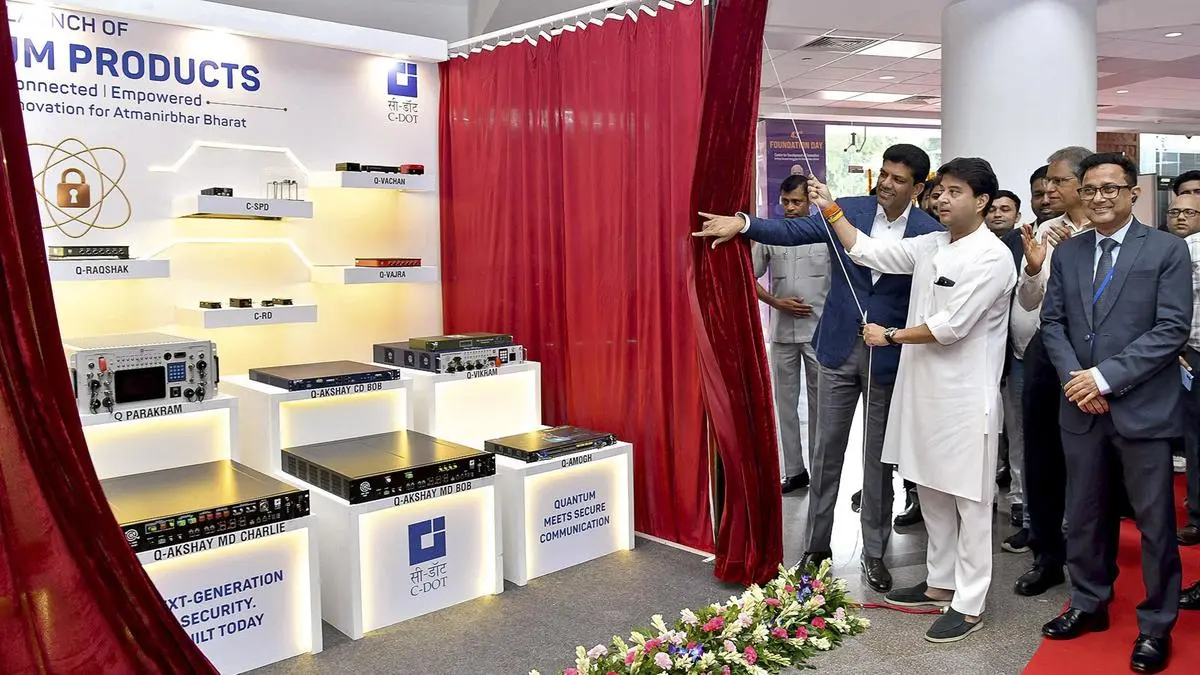
India's state-owned telecom technology centre, C-DOT, unveiled around 14 quantum products at its 43rd foundation day on Tuesday. Some have already been deployed in live networks and are considered important for national security, the government said.
CEO RK Upadhyay said revenue has climbed from ₹80 crore to ₹600 crore over the last five years. The organisation has set a target of ₹5,000 crore in the next few years.
Communications Minister Jyotiraditya Scindia said C-DOT will carry India from self-reliance to global telecom leadership. India has become the fifth country to develop its own 4G stack, joining a club of four nations that supply advanced telecom gear for 4G and 5G worldwide.
"I am very confident that my (C-DoT) family present here today will lead India from an India that was vishwa par nirbhar (dependent on the world) to an India today that is Atmanirbhar to a C-DOT that will contribute to India tomorrow on a vishwa Bharat par nirbhar (world dependent on India)," Scindia said.
India lagged the world on 4G and walked with it on 5G. The country will lead the world in 6G, Scindia said. The next era of telecom will not be defined merely by connecting people, he added. Connectivity and the networks must be trusted, resilient, intelligent and secure.
Minister of State for Communications Chandra Sekhar Pemmasani pointed to C-DOT's Sanchar Saathi platform. The app has traced about 36 lakh stolen devices and blocked nearly 57 lakh lost or stolen phones, he said. The portal logs more than 25 crore daily visits and around 2.5 crore app downloads each day. The platform is estimated to have prevented financial fraud worth ₹4,000 crore, he said.
"It might seem simple for many people, but for many families, that phone is not just a simple device; it is probably one of the most expensive items that they own. It contains everything about their life," Pemmasani said.
The quantum product portfolio includes quantum key distribution systems and quantum random number generators. The technology is designed to secure telecom networks against quantum computing threats. C-DOT developed these in partnership with Indian startups and academic institutions.
The revenue surge from ₹80 crore to ₹600 crore reflects C-DOT's expanding role beyond research. The centre now licenses technology to Indian telecom equipment makers and works with global operators on 5G and 6G standards. The ₹5,000 crore target implies a compound annual growth rate exceeding 50% over the next few years.
India's push for indigenous telecom gear has created openings for domestic firms. The government has mandated that state-run BSNL and MTNL use locally developed 4G and 5G stacks. Private operators like Reliance Jio and Bharti Airtel have also shown interest in sourcing from Indian vendors, though they continue to rely on Ericsson, Nokia and Samsung for parts of their networks.
The global telecom equipment market is dominated by Huawei, Ericsson and Nokia. India's entry as a supplier of 4G and 5G gear could shift pricing dynamics, particularly in emerging markets where cost sensitivity is high. C-DOT's quantum products add a security dimension that could appeal to governments seeking alternatives to Chinese equipment.
Scindia said India has to march from lab to market, from research to development, globally marketing those developmental products. The comment signals a shift in C-DOT's mandate from pure R&D to commercialisation. The centre's partnerships with private industry will determine how quickly it can scale production and win export orders.
Upadhyay said the target of ₹5,000 crore is ambitious but achievable given the pipeline of products and the government's policy support. "Under the guidance of our ministers, we have set a target to ourselves to achieve ₹5,000 crore in the next few years," he said.
The quantum products unveiled include a quantum key distribution system that has been deployed on a live fibre network in Gujarat. Another product, a quantum random number generator, is being used by a government agency for secure communications. C-DOT said it is working with the Defence Research and Development Organisation to integrate quantum cryptography into military networks.
Pemmasani said the Sanchar Saathi app has become a critical tool for law enforcement. The platform uses device identification and network data to track stolen phones. The ₹4,000 crore fraud prevention figure is based on cases where the app helped block fraudulent transactions linked to compromised devices.
C-DOT's revenue growth and product pipeline position it as a key player in India's telecom technology ecosystem. The centre's success in quantum security could open export opportunities in countries looking for alternatives to Chinese and Western suppliers. The government's target of Viksit Bharat 2047 includes a self-reliant telecom sector that competes globally. C-DOT's quantum products and rising revenue suggest that transition is underway.