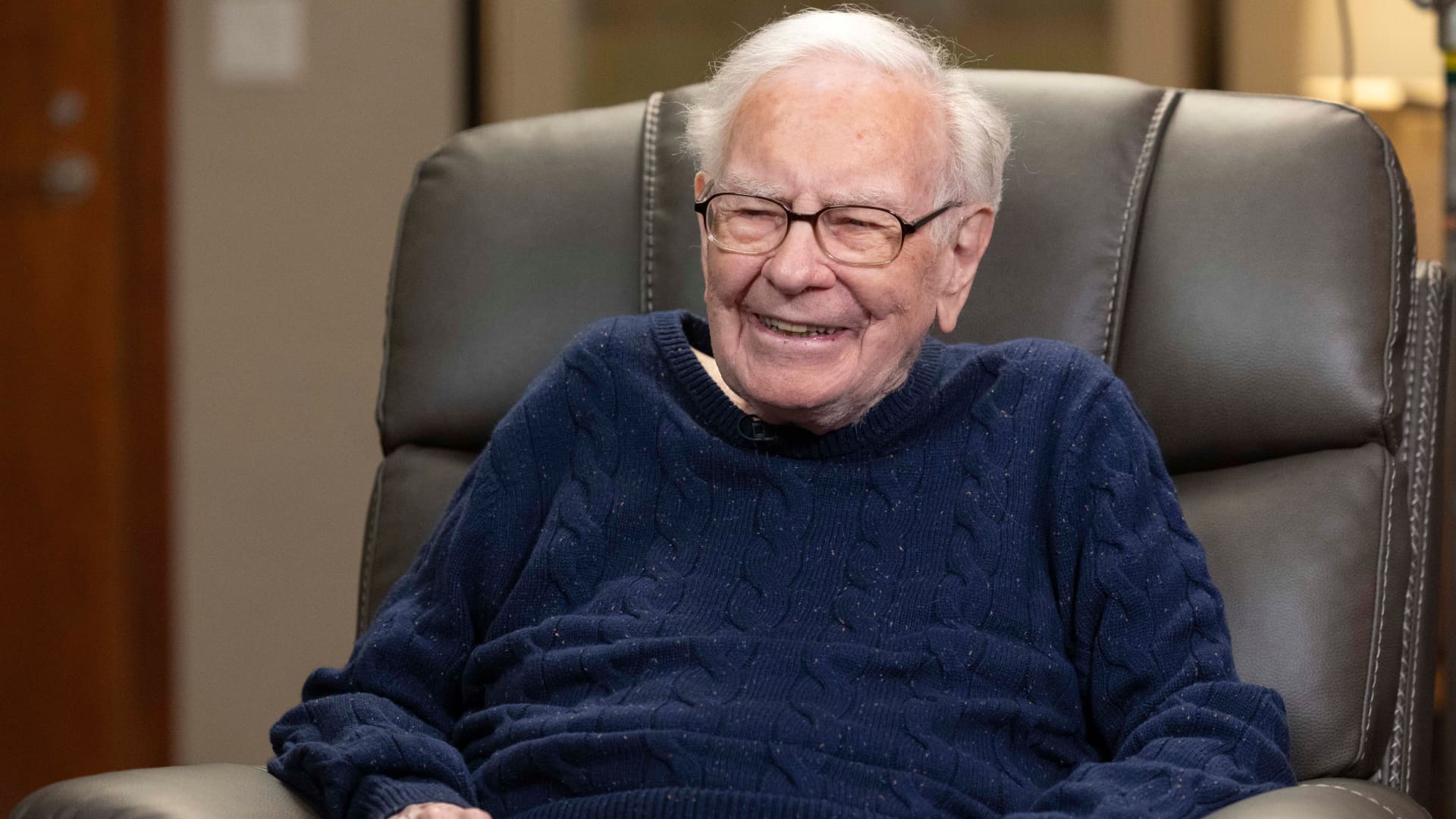
Warren Buffett said he will give away all of his Berkshire Hathaway shares within about eight years, accelerating the pace of donations from his prior plan of a decade after his death. The shift, disclosed in a CNBC interview this week, puts roughly $140 billion of stock into a compressed dispersal window and raises questions about how the market will absorb the flow.
Buffett's existing plan called for the shares to be distributed over 10 years after his death. The new timeline targets the end of 2034, with annual gifts increasing to hit that goal. He gave about $6 billion in shares this year and said the annual amount would need to rise to roughly $17.5 billion to clear the eight-year runway.
Berkshire shares fell on the day of the interview, then recovered to end the week slightly lower. The stock carries a 49 Alpha Score at AlphaScala, a Mixed label, reflecting neutral sentiment on the company's near-term prospects.
What changed. Buffett said his confidence in his three children's ability to give away large sums efficiently drove the decision. He also cited his trust in CEO Greg Abel, who he said makes the investment decisions now. "He is the decider," Buffett said. The accelerated sales mean Buffett will shed voting control of Berkshire more quickly than planned, a shift that could alter the company's governance profile.
Who is exposed. Berkshire's stock is the direct asset at risk. If the market views the accelerated sales as a signal that Buffett sees less upside in his own company, the stock could face persistent selling pressure. The company itself is not issuing shares; Buffett is donating his personal holdings. The overhang of a known, large seller could compress the stock's valuation multiple, especially if the pace draws attention to the succession risk.
Buffett also revealed he was responsible for the now-$30 billion-plus investment in Alphabet, the Google parent. That stake is among Berkshire's five largest equity holdings, alongside Apple, American Express, Coca-Cola, and Bank of America. The Alphabet position adds tech exposure that Buffett historically avoided, and he acknowledged the company is "putting out huge amounts of money" on AI infrastructure. He said he does not like the stock as much as four or five other Berkshire businesses but believes Alphabet is more likely to be a winner than 90% of what Wall Street sells.
Timeline. The next concrete marker is Berkshire's second-quarter earnings, due early next month. Barron's estimated the company repurchased $5 billion to $11 billion of its own shares in the quarter, based on a calculation from Buffett's ownership disclosure. A larger-than-expected buyback would signal management's confidence in the stock's value, potentially offsetting the overhang from Buffett's sales.
What would reduce the risk. Strong quarterly results that demonstrate Berkshire's earnings power–especially from its insurance, railroad, and utility operations–could reassure investors that the company's intrinsic value is growing faster than the pace of Buffett's gifts. Continued stock repurchases at attractive prices would also signal alignment between management and shareholders. Buffett's explicit endorsement of Abel's investment decisions, repeated in the interview, helps reduce the succession uncertainty that has hung over the stock.
What would make it worse. An acceleration of the share sales beyond the eight-year plan, for instance if Buffett's health deteriorates sharply, would amplify the overhang. A sharp decline in the value of Berkshire's top holdings, particularly Apple or Alphabet, would reduce the cushion that the company's cash pile provides. The cash balance stood at $397 billion on March 31, up 6.5% from year-end. If that cash starts to be drawn down for subpar acquisitions or if the insurance underwriting cycle turns, the risk premium on Berkshire shares could widen.
Buffett's decision to end donations to the Bill & Melinda Gates Foundation, which received nearly $48 billion over two decades, also shifts the philanthropic landscape. The money will now flow to the Susan Thompson Buffett Foundation, named for his first wife, and to the three foundations run by his children. The change is not a direct financial risk to Berkshire, it removes a high-profile charitable partner that had been a stable outlet for the shares.
Buffett addressed the Epstein matter that had clouded his relationship with Bill Gates. He said he read Gates' congressional testimony and found nothing "beyond what I could picture myself doing" in terms of making mistakes in choosing friends. He and Gates met in Omaha three weeks ago and spent three hours together. Gates said in a statement that Buffett is "one of the greatest philanthropists of all time."
Buffett, 95, broke a leg a few weeks ago said he feels good. The accelerated share sale plan is his way of ensuring the money goes out while he is still around to see it. "I was incredibly lucky," he said. "I can't change the design of the world, I can level at the edges."
Berkshire's next earnings release will provide the first real data point on whether the company's underlying performance can keep pace with the accelerated share distribution.