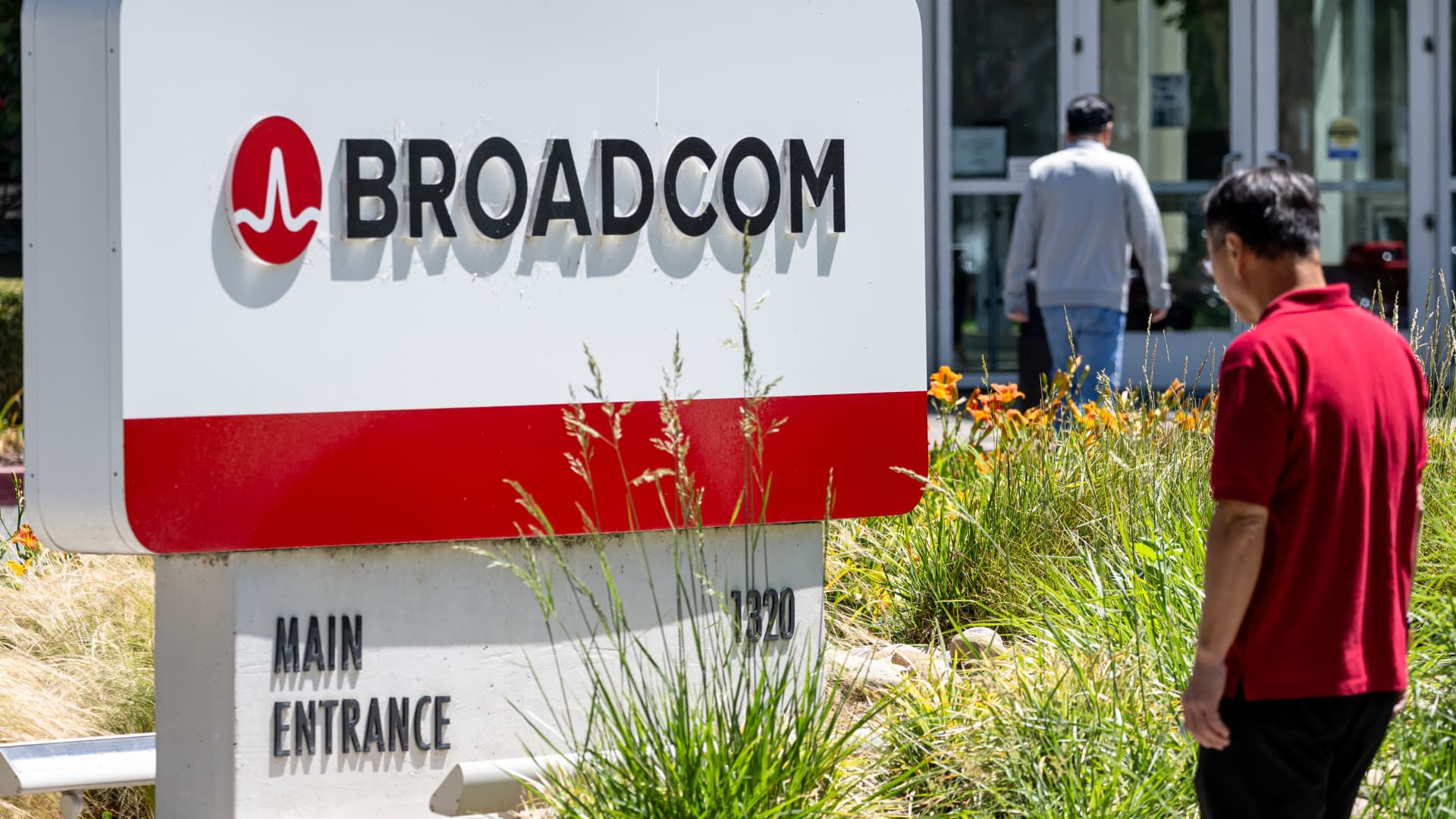
Broadcom Inc. delivered a fiscal second-quarter 2026 report that beat adjusted earnings and EBITDA estimates but missed total revenue by a razor-thin margin. The market reaction was swift: shares fell in after-hours trading. The disappointment centered on guidance that did not raise the multiyear AI revenue targets investors have come to expect from CEO Hock Tan. Yet beneath the surface of the headline numbers, the quarter revealed a deepening AI pipeline, a new financing structure for customer purchases, and order volumes that suggest the $100 billion AI revenue target for fiscal 2027 may prove conservative.
The Quarter: Beat and Miss in the Same Print
Revenue for the quarter ended May 3 came in at $22.19 billion, a slight miss against the $22.27 billion consensus compiled by LSEG. That represented 48% annual growth, a deceleration from the prior quarter’s pace but still well above the broader semiconductor industry. Adjusted EPS rose 54% to $2.44, beating expectations of $2.40. Adjusted EBITDA grew 52% to $15.24 billion, topping the FactSet consensus of $15.06 billion.
Segment-Level Breakdown
The Semiconductor Solutions segment, which houses the AI custom chip and networking businesses, posted revenue of $15 billion, beating the FactSet estimate of $14.7 billion. Growth accelerated to 78.5% year over year from 52.4% in the year-ago period. Infrastructure Software revenue came in at $7.18 billion, missing the $7.32 billion consensus and marking the second consecutive quarter that the segment fell short.
AI Semiconductor Revenue
AI semiconductor revenue totaled $10.8 billion, up 143% year over year and slightly above the $10.7 billion management had flagged. The networking component made up about 40% of that figure, underscoring the breadth of Broadcom's AI exposure beyond custom chips. For the current quarter, management guided AI revenue to grow more than 200% to $16 billion. Analysts had been modeling closer to $17 billion, which contributed to the after-hours selling.
Guidance: A Beat on Total Revenue but No Raise on Multi-Year Targets
For the third fiscal quarter, Broadcom forecast total revenue of about $29.4 billion, above the $28.54 billion consensus. Semiconductor revenue is expected at $20.5 billion, and Infrastructure Software at $8.9 billion. The company expects adjusted EBITDA of about 68% of projected revenue, or $19.992 billion, ahead of the Street’s $19.392 billion estimate. Adjusted operating income is seen at roughly 67% of revenue, or about $19.698 billion.
The sticking point for the market: Tan reiterated the existing targets of $56 billion in AI semiconductor revenue for fiscal 2026 and at least $100 billion for fiscal 2027. In a rally that has seen the stock gain over 80% in the past year, investors expect upward revisions. The lack of a raise was interpreted as a ceiling.
Key insight: A $30 billion quarterly order book and the pacing of existing deals make the $100 billion target look like a floor, not a ceiling. The conservative guidance pattern is consistent with Tan’s history of under-promising and over-delivering.
The AI Customer Pipeline and New Financing
Tan detailed several large customer commitments that extend well beyond fiscal 2027. In April, Broadcom signed a long-term agreement with Alphabet (GOOGL) to supply multiple generations of tensor processing units (TPUs) and AI networking. A separate deal with Anthropic calls for an additional 5 gigawatts (GW) of next-generation TPU-based compute beginning in 2027. With OpenAI, Broadcom has a contractual commitment to deploy 1.3 GW of compute in 2027, part of a larger 10 GW deal that extends to 2029. Meta Platforms plans to deploy 3 GW of compute capacity through the end of 2028.
Two unnamed core customers have placed purchase orders totaling $6 billion, with shipments expected to begin in late 2026 and accelerate in 2027.
The Apollo/Blackstone SPV
A major variable in the AI chip narrative has been how frontier labs like Anthropic and OpenAI – both still private or soon-to-be-public – will fund their massive compute purchases. Tan addressed this by announcing the creation of an AI special purpose vehicle (SPV) alongside Apollo and Blackstone. The two alternative asset managers will provide debt financing to facilitate Broadcom’s chip sales, effectively transferring credit risk from Broadcom’s balance sheet to the capital markets.
This structure could allow Broadcom to book revenue more quickly while reducing execution risk on customer payment terms. It also signals that institutional capital sees the AI compute cycle as durable enough to underwrite.
Why the Sell-Off Is a Technical Signal, Not a Fundamental One
The negative reaction to a quarter that beat on earnings, EBITDA, and AI revenue can be understood through three mechanisms:
- Guidance expectations: The market was pricing in an upward revision to the $100 billion target. Without it, there was no immediate catalyst for multiple expansion.
- Competition risk: On the earnings call, Tan acknowledged that competitors could win some design slots in Google’s custom chip program. While Broadcom’s relationship with Google remains strong, any hint of diversification pressures the stock’s AI premium.
- Positioning: A stock that has rallied more than 80% in a year leaves little room for good news that is not great news. The after-hours decline reflects profit-taking rather than thesis destruction.
Tan also noted that the company booked more than $30 billion in AI semiconductor orders during the quarter, nearly three times the $10.8 billion in revenue recorded. That book-to-bill ratio is a forward-looking signal that the pipeline is robust.
Valuation and Price Target
Following the report, the CNBC Investing Club raised its price target on Broadcom to $480 from $425, while maintaining a 2 rating (buy on weakness). At the current level, the stock trades at roughly 30x forward earnings, a premium justified by AI growth rates but vulnerable in a risk-off rotation.
AlphaScala’s proprietary model assigns AVGO an Alpha Score of 75 out of 100, with a Moderate label. The score reflects strong momentum and fundamentals but flags the stretched valuation and the market’s heightened expectations. The stock page is at /stocks/avgo.
Risk to Watch: Conservative Guidance vs. Competitive Shifts
The primary risk is not that Broadcom misses its targets but that the market stops rewarding guidance that is systematically conservative. If Google does diversify some custom-chip designs, the AI growth rate could decelerate sooner than modeled. The counterargument is that Broadcom’s networking business – 40% of AI revenue – is less contestable and benefits from any data center buildout.
For traders, the sell-off creates an entry point if the stock finds support near the 50-day moving average. The catalyst to watch is the fiscal third-quarter report in late August, where any upward revision to the $100 billion target would likely reverse the post-print weakness.
Broadcom’s quarterly results were solid. The market’s disappointment was about narrative momentum, not business momentum. The AI pipeline is wider and deeper than one guidance miss suggests.