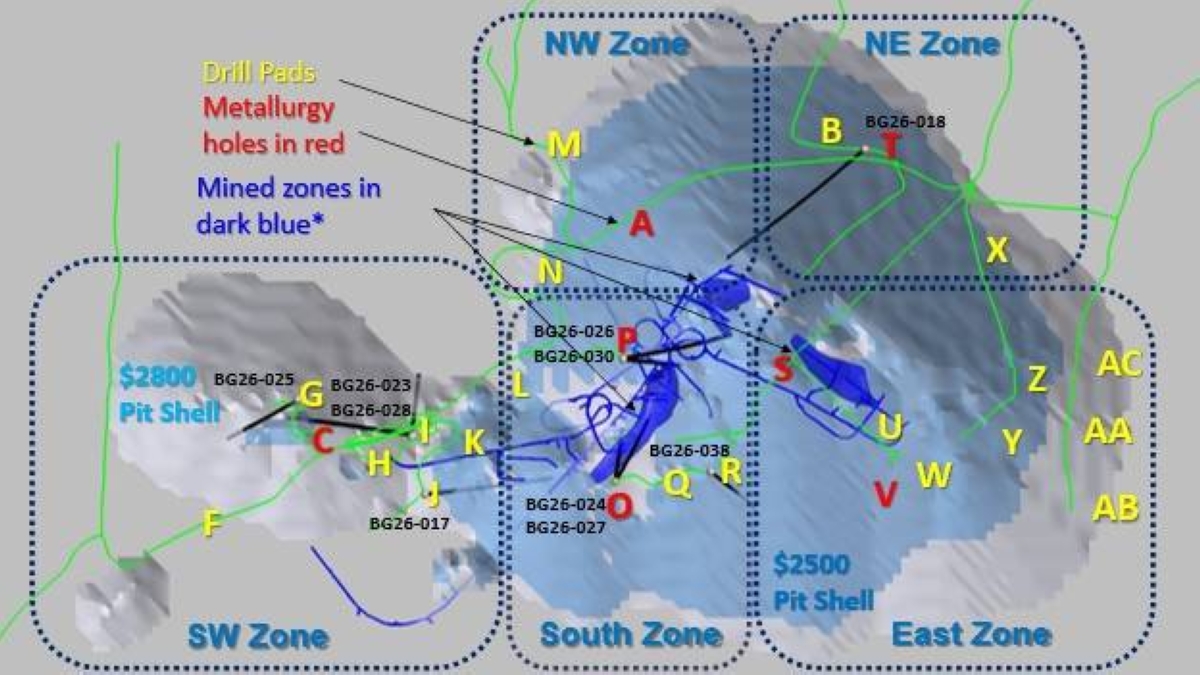
Blossom Gold reported drill results from its Rosebud open-pit heap-leach project in Nevada that extend mineralization across the South and Southwest zones, with new intercepts also from the Northeast zone. The company is running four rigs on a 24,000-meter program and has drilled 13,991 meters to date.
Notable intervals include 28 meters at 1.682 grams per tonne gold in hole BG26-027 and 115.4 meters at 0.553 g/t including 52.6 meters at 0.860 g/t in hole BG26-030. The results build on a June 30 release and confirm that significant thicknesses of gold mineralization surround the historic south mined zones, the company said.
CEO Rick Winters said the results demonstrate the scale of the mineralized system and what was not mined underground. “We are open and expanding in the NE and SW Zones and have yet to drill the NW Zone,” he said in the release.
The project hosts an inferred resource of 70.8 million tons at 0.62 g/t gold and 6.49 g/t silver for 1.28 million ounces of gold and 13.4 million ounces of silver, based on long-term gold and silver prices of $2,500 and $35 an ounce. The deposit remains open in all directions.
South Zone drilling confirmed mineralization extending up-dip along the South Ridge Fault Zone to nearly the surface. Hole BG26-038 and prior results support continuation south of the historic mined zones. Roughly 600 meters west of the south underground area, the Southwest Zone shows a mineralized zone in an area with limited historic drilling. The Northeast Zone's BG26-018 indicates near-surface mineralization near the proposed pit outline.
VP Exploration Dr. John DeDecker said the team is encouraged by the large halo of gold mineralization surrounding the south mined zone and extending up-dip to nearly the surface. “We also see continued evidence for extensive gold mineralization to the southwest of the underground workings, and early signs of near-surface mineralization in the northeast zone,” he said.
The historic Rosebud mine was operated by a Newmont-Hecla joint venture from 1997 to 2000 using underground methods with a cut-off grade around 0.2 opt gold (6.8 g/t) when gold prices ranged from $250 to $350 an ounce. The current vision for the project is an open-pit operation with on-site heap-leach processing, targeting both the remaining higher-grade mineralization and the surrounding lower-grade material.
Three core rigs are drilling: one for technical work, now 80% complete, and two for resource expansion and infill. A reverse circulation rig has been secured to increase drilling rates. Earthwork at Portal #2 for underground access has taken longer than expected. The company still expects to have it opened with rehabilitation underway by the end of August.
The underground infill drilling program is being finalized and will start once the first drill station is rehabilitated. Surface and underground drilling are scheduled for completion in the first quarter of 2027 to support an updated mineral resource estimate.
Winters said the company will twin one of the higher-grade intercepts, a 4.6-meter subinterval at 3.95 g/t gold in BG26-030, with a larger PQ hole for heap-leach testing at Kappes Cassiday in Reno as an option to milling underground high-grade material.