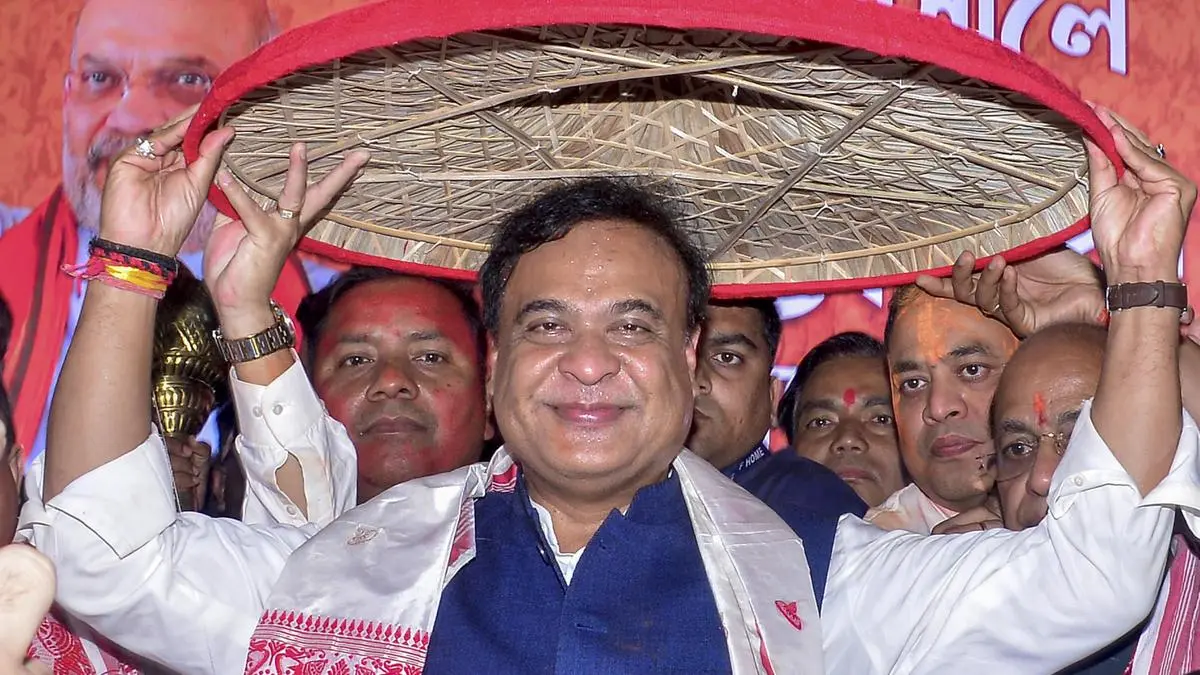
The Bharatiya Janata Party (BJP) has secured a third consecutive term in Assam, cementing its political hegemony in the northeastern state with a landslide victory in the 2026 assembly elections. According to the Election Commission of India (ECI), the BJP-led National Democratic Alliance (NDA) is projected to cross the 100-seat threshold in the 126-member assembly. This result marks the party's most significant electoral performance since it first unseated the Congress party in 2016.
Structural Advantages and Delimitation Impact
The BJP’s success is not merely a product of campaign momentum; it is the result of a deliberate structural realignment. The 2023 delimitation exercise played a pivotal role in the outcome, effectively redrawing constituency boundaries to favor the indigenous population over migrant-origin minority groups. This strategy was further bolstered by the 2022 administrative decision to merge four newly created districts—including Hojai and Biswanath—back into their parent districts. By consolidating these voter bases, the state government successfully mitigated the fragmentation of its core support, a move that proved decisive in newly created constituencies like Sissibargaon.
In Sissibargaon, BJP candidate Jiban Gogoi secured a victory margin of 40,593 votes, polling 75,758 votes against Raijor Dal’s Dulal Chandra Boruah. This performance illustrates the efficacy of the party's territorial strategy. When analyzing the broader electoral landscape, investors and observers should note that the BJP’s vote share has climbed to 38.17 percent, up from 33.21 percent in the 2021 assembly polls and 37.43 percent in the 2024 Lok Sabha elections. This upward trend suggests a deepening consolidation of the Hindu vote, which has become the bedrock of the party’s regional dominance.
Opposition Fragmentation and Strategic Missteps
The opposition’s failure to mount a credible challenge stems from a lack of strategic cohesion. By distancing itself from the All India United Democratic Front (AIUDF), the Congress party inadvertently fractured the anti-incumbency vote. The resulting split—where the Congress led a separate bloc including the Raijor Dal, Assam Jatiya Parishad, and CPI(M)—allowed the NDA to capitalize on divided opposition in multiple constituencies. The AIUDF’s decline is stark; its vote share plummeted to 5.41 percent from 9.29 percent in 2021, reflecting the impact of the delimitation process on its traditional strongholds.
For the Congress, the electoral defeat was compounded by the loss of high-profile candidate Gaurav Gogoi in the Jorhat constituency. Gogoi was defeated by BJP’s Hitendra Nath Goswami by a margin of 23,182 votes. While the Congress maintained a relatively stable vote share of 29.51 percent compared to 29.67 percent in 2021, its seat count collapsed, demonstrating that vote share stability is insufficient when the underlying electoral map has been fundamentally altered.
Leadership and Voter Participation Dynamics
Chief Minister Himanta Biswa Sarma continues to serve as the central figure of the BJP’s regional apparatus. His victory in the Jalukbari constituency, where he secured a lead of 89,434 votes, underscores his personal political capital. Sarma’s leadership style, characterized by a focus on identity politics and a hardline stance on migration, has resonated with the party’s base. This victory reinforces the stability of the current administration, which remains a key factor for those analyzing stock market analysis and regional economic policy in the northeast.
The election also saw a historic 85.91 percent voter turnout, driven by record participation from women at 86.5 percent. The BJP’s long-term cultivation of this demographic, coupled with its narrative of development and cultural protection, has created a formidable electoral machine. As the party enters its third term, the focus will likely remain on the implementation of its ideological agenda, including the continued emphasis on the identity and infiltrator narrative that has defined its decade-long governance. The stability of this political environment provides a predictable, albeit polarized, backdrop for regional economic development, contrasting with the volatility often seen in markets like Welltower Inc. or Delta Air Lines Inc., which carry an Alpha Score of 52/100. For those tracking the energy sector, the political climate remains a critical variable for entities like Sunoco LP.