Bitget launched US stock options this week and says no other major crypto exchange offers them. The product starts with the simplest version of options trading, where eligible users buy single call or
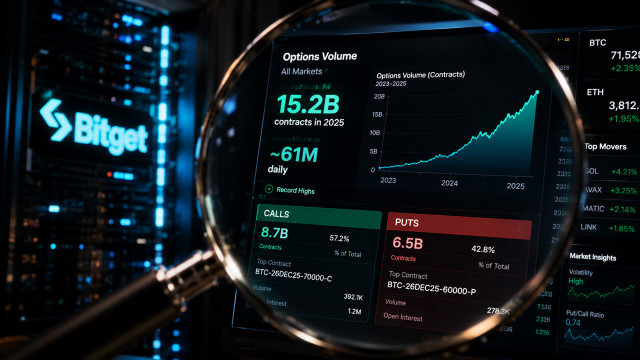
Bitget launched US stock options this week and says no other major crypto exchange offers them. The product starts with single call or put contracts for eligible users. More complex strategies are scheduled later.
It sits alongside Bitget's existing crypto markets and over 500 tokenized stocks. The exchange also runs contract-for-difference products in gold and forex.
The launch follows a record stretch for listed options. US volume reached 15.2 billion contracts in 2025, up 26% from the prior year, with roughly 61 million contracts changing hands daily, according to Cboe. Same-day options made up 24.1% of that total. An exchange built on crypto now wants a piece of one of the busiest markets in traditional finance.
The SEC defines an option as a contract that gives the purchaser the right, without the obligation, to buy or sell a security at a fixed price within a set period. A simple example: a stock trades at $100 and a trader expects it to jump after earnings. They buy a call option with a $110 strike for a small upfront premium. If the stock climbs far enough before expiry, the contract gains value. If it does not, the option expires worthless. The buyer loses the premium and nothing more.
A call is a bet the stock will rise. A put is a bet it will fall, or a way to protect shares the trader already owns. For buyers of simple calls and puts, the most they can lose is the premium paid. Sellers face a different risk profile because their losses can far exceed the premium collected. That gap explains why Bitget opened with buying only. More advanced trades stay off the menu for now.
Options let a trader control a large stock position for a fraction of the shares' cost. Institutions use them to protect portfolios. Retail traders use them for earnings bets. Short-dated contracts drove much of the 2025 record.
A tokenized stock is not automatically a share sitting in a brokerage account. Depending on how it is built, the token can stand for a real share a custodian holds on the buyer's behalf, a claim that tracks the stock's price while granting none of the ownership rights, a private deal that only copies the price movement, or an official record of share ownership kept on a blockchain.
SEC staff defined this in a January 28 statement. Tokenized securities are regular securities recorded, in whole or in part, on a blockchain. What a product actually does, not what it is called, decides how it is regulated, the staff wrote. A share stays a share whether it sits in a traditional brokerage system or on a blockchain. A token that only mimics a stock's price can even count as a security-based swap, a category of contract that US markets keep on a short leash.
Tokenized stocks come with open questions the buyer often cannot see. Who actually holds the underlying share. Whether the holder collects dividends or gets to vote. Whether the token can be traded back for the real share. What happens if the issuer or custodian goes under.
Reuters reported June 17 that the SEC is preparing an innovation exemption that would allow crypto companies to offer tokenized stock trading. Citadel Securities and the industry group SIFMA are pushing back on how well investors would be protected and how the market would hold up. That exemption could move regular stocks onto blockchain systems and force exchanges to answer what token holders actually own.
Bitget claims 125 million users. The announcement names no supported stocks, no list of countries where the product is available, no clearing arrangements, and no volume expectations. The real market is the smaller group of users who get approved, understand the risks, and want US stock exposure inside a crypto account.
Even a small slice of that base could produce real activity. How smoothly the options trade will depend more on the firms that provide prices and fill orders than on the raw user count. A standard listed option, settled through the Options Clearing Corporation, comes with known protections and a clearinghouse standing behind the trade. An option-style product built through other arrangements might behave the same on a good day and very differently on a bad one. Bitget's announcement does not say which kind it is selling. The tokenized stocks carry the same ambiguity. Their value to a holder rests on rights the token may or may not actually grant.
Convergence has made these products easy to buy in a single app. It has done nothing to make them easy to tell apart. That job still falls to securities law. For now, the exchanges that put everything on one screen are the ones saying the least about what lies beneath each asset.
For traders looking to access both crypto and traditional markets, the choice of platform matters. Best crypto brokers offer clear disclosure on asset types.
Prepared with AlphaScala research tooling and grounded in primary market data: live prices, fundamentals, SEC filings, hedge-fund holdings, and insider activity. Each story is checked against AlphaScala publishing rules before release. Educational coverage, not personalized advice.